
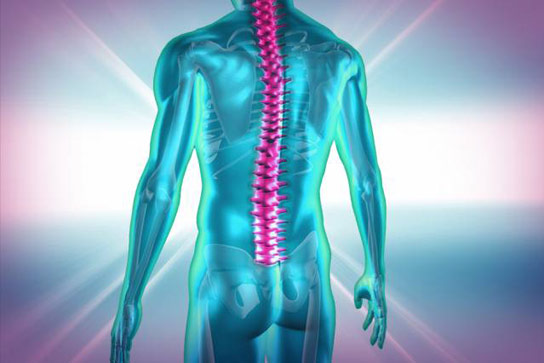
In a newly published study, MIT neuroscientists show that they can control muscle movement by shining light on spinal cord neurons in mice.
For the first time, MIT neuroscientists have shown they can control muscle movement by applying optogenetics — a technique that allows scientists to control neurons’ electrical impulses with light — to the spinal cords of animals that are awake and alert.
Led by MIT Institute Professor Emilio Bizzi, the researchers studied mice in which a light-sensitive protein that promotes neural activity was inserted into a subset of spinal neurons. When the researchers shone blue light on the animals’ spinal cords, their hind legs were completely but reversibly immobilized. The findings, described in the June 25 issue of PLoS One, offer a new approach to studying the complex spinal circuits that coordinate movement and sensory processing, the researchers say.
In this study, Bizzi and Vittorio Caggiano, a postdoc at MIT’s McGovern Institute for Brain Research, used optogenetics to explore the function of inhibitory interneurons, which form circuits with many other neurons in the spinal cord. These circuits execute commands from the brain, with additional input from sensory information from the limbs.
Previously, neuroscientists have used electrical stimulation or pharmacological intervention to control neurons’ activity and try to tease out their function. Those approaches have revealed a great deal of information about spinal control, but they do not offer precise enough control to study specific subsets of neurons.
Optogenetics, on the other hand, allows scientists to control specific types of neurons by genetically programming them to express light-sensitive proteins. These proteins, called opsins, act as ion channels or pumps that regulate neurons’ electrical activity. Some opsins suppress activity when light shines on them, while others stimulate it.
“With optogenetics, you are attacking a system of cells that have certain characteristics similar to each other. It’s a big shift in terms of our ability to understand how the system works,” says Bizzi, who is a member of MIT’s McGovern Institute.
Muscle control
Inhibitory neurons in the spinal cord suppress muscle contractions, which is critical for maintaining balance and for coordinating movement. For example, when you raise an apple to your mouth, the biceps contract while the triceps relax. Inhibitory neurons are also thought to be involved in the state of muscle inhibition that occurs during the rapid eye movement (REM) stage of sleep.
To study the function of inhibitory neurons in more detail, the researchers used mice developed by Guoping Feng, the Poitras Professor of Neuroscience at MIT, in which all inhibitory spinal neurons were engineered to express an opsin called channelrhodopsin 2. This opsin stimulates neural activity when exposed to blue light. They then shone light at different points along the spine to observe the effects of neuron activation.
When inhibitory neurons in a small section of the thoracic spine were activated in freely moving mice, all hind-leg movement ceased. This suggests that inhibitory neurons in the thoracic spine relay the inhibition all the way to the end of the spine, Caggiano says. The researchers also found that activating inhibitory neurons had no effect on the transmission of sensory information from the limbs to the brain, or on normal reflexes.
“The spinal location where we found this complete suppression was completely new,” Caggiano says. “It has not been shown by any other scientists that there is this front-to-back suppression that affects only motor behavior without affecting sensory behavior.”
“It’s a compelling use of optogenetics that raises a lot of very interesting questions,” says Simon Giszter, a professor of neurobiology and anatomy at Drexel University who was not part of the research team. Among those questions is whether this mechanism behaves as a global “kill switch,” or if the inhibitory neurons form modules that allow for more selective suppression of movement patterns.
Now that they have demonstrated the usefulness of optogenetics for this type of study, the MIT team hopes to explore the roles of other types of spinal cord neurons. They also plan to investigate how input from the brain influences these spinal circuits.
“There’s huge interest in trying to extend these studies and dissect these circuits because we tackled only the inhibitory system in a very global way,” Caggiano says. “Further studies will highlight the contribution of single populations of neurons in the spinal cord for the control of limbs and control of movement.”
The research was funded by the Human Frontier Science Program and the National Science Foundation. Mriganka Sur, the Paul E. and Lilah Newton Professor of Neuroscience at MIT, is also an author of the paper.
Reference: “Rostro-Caudal Inhibition of Hindlimb Movements in the Spinal Cord of Mice” by Vittorio Caggiano, Mirganka Sur and Emilio Bizzi, 25 June 2014, PLOS One.
DOI: 10.1371/journal.pone.0100865
Never miss a breakthrough: Join the SciTechDaily newsletter.
Follow us on Google and Google News.