
At the agency’s Jet Propulsion Laboratory, team members are building the Coronagraph Instrument for the spacecraft and contributing to the mission’s science goals.
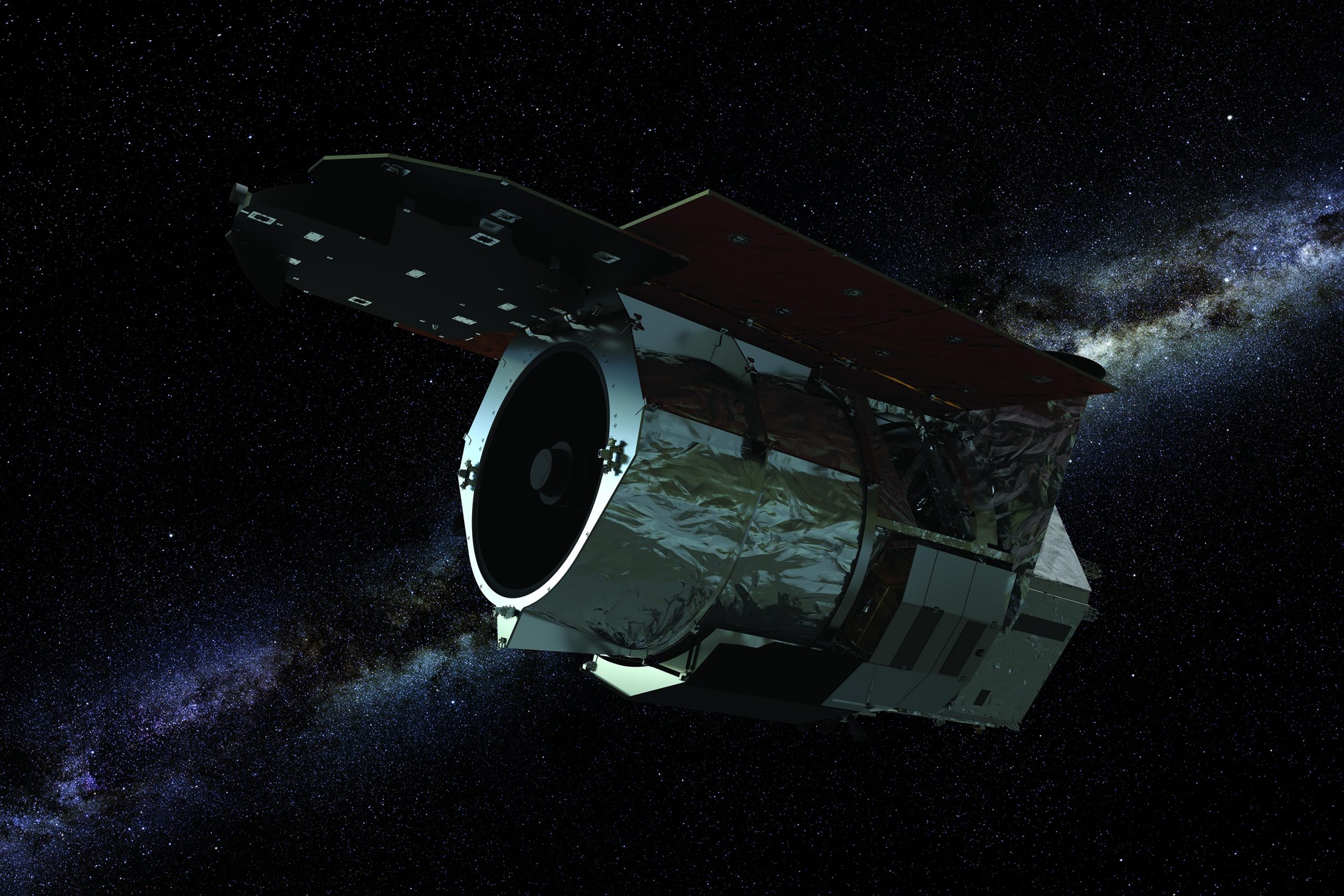
NASA is naming its next-generation space telescope currently under development, the Wide Field Infrared Survey Telescope (WFIRST), in honor of Nancy Grace Roman, NASA’s first chief astronomer, who paved the way for space telescopes focused on the broader universe.
The newly named Nancy Grace Roman Space Telescope – or Roman Space Telescope, for short – is set to launch in the mid-2020s. It will investigate long-standing astronomical mysteries, such as the force behind the universe’s expansion, and search for distant planets beyond our solar system.
Considered the “mother” of NASA’s Hubble Space Telescope, which launched 30 years ago, Roman tirelessly advocated for new tools that would allow scientists to study the broader universe from space. She left behind a tremendous legacy in the scientific community when she died in 2018.
“It is because of Nancy Grace Roman’s leadership and vision that NASA became a pioneer in astrophysics and launched Hubble, the world’s most powerful and productive space telescope,” said NASA Administrator Jim Bridenstine. “I can think of no better name for WFIRST, which will be the successor to NASA’s Hubble and Webb Telescopes.”
Former Senator Barbara Mikulski, who worked with NASA on the Hubble and WFIRST space telescopes, said, “It is fitting that as we celebrate the 100th anniversary of women’s suffrage, NASA has announced the name of their new WFIRST telescope in honor of Dr. Nancy Roman, the Mother of Hubble – well deserved. It recognizes the incredible achievements of women in science and moves us even closer to no more hidden figures and no more hidden galaxies.”
Scheduled to launch in the mid-2020s, the Nancy Grace Roman Space Telescope, formerly known as WFIRST, will function as Hubble’s wide-eyed cousin. While just as sensitive as Hubble’s cameras, the Roman Space Telescope’s 300-megapixel Wide Field Instrument will image a sky area 100 times larger. This means a single Roman Space Telescope image will hold the equivalent detail of 100 pictures from Hubble.
Who Was Nancy Grace Roman?
Born on May 16, 1925, in Nashville, Tennessee, Roman consistently persevered in the face of challenges that plagued many women of her generation interested in science. By seventh grade, she knew she wanted to be an astronomer. Despite being discouraged about going into science – the head of Swarthmore College’s physics department told her he usually dissuaded girls from majoring in physics, but that she “might make it” – Roman earned a bachelor’s degree in astronomy from Swarthmore in 1946 and a doctorate from the University of Chicago in 1949.
She remained at Chicago for six years and made discoveries about the compositions of stars that had implications for the evolution of our Milky Way galaxy. Knowing that her chances of achieving tenure at a university as a woman were slim at that time, she took a position at the U.S. Naval Research Laboratory and made strides in researching cosmic questions through radio waves.
Roman came to NASA in 1959, just six months after the agency had been established. At that time, she served as the chief of astronomy and relativity in the Office of Space Science, managing astronomy-related programs and grants.
“I knew that taking on this responsibility would mean that I could no longer do research, but the challenge of formulating a program from scratch that I believed would influence astronomy for decades to come was too great to resist,” she said in a NASA interview.
This was a difficult era for women who wanted to advance in scientific research. While Roman said that men generally treated her equally at NASA, she also revealed in one interview that she had to use the prefix “Dr.” with her name because “otherwise, I could not get past the secretaries.”
But she persisted in her vision to establish new ways to probe the secrets of the universe. When she arrived at NASA, astronomers could obtain data from balloons, sounding rockets and airplanes, but they could not measure all the wavelengths of light. Earth’s atmosphere blocks out much of the radiation that comes from the distant universe. What’s more, only a telescope in space has the luxury of perpetual nighttime and doesn’t have to shut down during the day. Roman knew that to see the universe through more powerful, unblinking eyes, NASA would have to send telescopes to space.
Through Roman’s leadership, NASA launched four Orbiting Astronomical Observatories between 1966 and 1972. While only two of the four were successful, they demonstrated the value of space-based astrophysics and represented the precursors to Hubble. She also championed the International Ultraviolet Explorer, which was built in the 1970s as a joint project between NASA, ESA (European Space Agency) and the United Kingdom, as well as the Cosmic Background Explorer, which measured the leftover radiation from the big bang and led to two of its leading scientists receiving the 2006 Nobel Prize in Physics.
Above all, Roman is credited with making the Hubble Space Telescope a reality. In the mid-1960s, she set up a committee of astronomers and engineers to envision a telescope that could accomplish important scientific goals. She convinced NASA and Congress that it was a priority to launch the most powerful space telescope the world had ever seen.
Hubble turned out to be the most scientifically revolutionary space telescope of all time. Ed Weiler, Hubble’s chief scientist until 1998, called Roman “the mother of the Hubble Space Telescope.”
“Nancy Grace Roman was a leader and advocate whose dedication contributed to NASA seriously pursuing the field of astrophysics and taking it to new heights,” said Thomas Zurbuchen, NASA’s associate administrator for science. “Her name deserves a place in the heavens she studied and opened for so many.”
The Nancy Grace Roman Space Telescope, formerly known as WFIRST, is an upcoming space telescope designed to perform wide-field imaging and spectroscopy of the infrared sky. One of the Roman Space Telescope’s objectives will be looking for clues about dark energy – the mysterious force that is accelerating the expansion of the universe. Another objective of the mission will be finding and studying exoplanets.
What Is the Roman Space Telescope?
The Roman Space Telescope will be a NASA observatory designed to settle essential questions in the areas of dark energy, exoplanets and infrared astrophysics. The telescope has a primary mirror that is 2.4 meters (7.9 feet) in diameter and is the same size as the Hubble Space Telescope’s primary mirror. The Roman Space Telescope is designed to have two instruments, the Wide Field Instrument and a technology demonstration Coronagraph Instrument. The Wide Field Instrument will have a field of view that is 100 times greater than the Hubble infrared instrument, allowing it to capture more of the sky with less observing time. The Coronagraph Instrument will perform high contrast imaging and spectroscopy of individual nearby exoplanets.
The WFIRST project passed a critical programmatic and technical milestone in February, giving the mission the official green light to begin hardware development and testing. With the passage of this latest key milestone, the team will begin finalizing the mission design by building engineering test units and models to ensure the design will hold up under the extreme conditions during launch and while in space.
NASA’s Fiscal Year 2020 Consolidated Appropriations Act funds the WFIRST program through September 2020. It is not included in the Fiscal Year 2021 budget request, as the administration wants to focus on completing the James Webb Space Telescope.
Never miss a breakthrough: Join the SciTechDaily newsletter.
Follow us on Google and Google News.
2 Comments
Hello dear NASA
I’m so glad for your job’s
Best regards
God bless you.
Awesome communications hope to do business some day