
Close Menu
    Facebook X (Twitter) Instagram
    SciTechDaily
    • Biology
    • Chemistry
    • Earth
    • Health
    • Physics
    • Science
    • Space
    • Technology
    Facebook X (Twitter) Pinterest YouTube RSS
    SciTechDaily
    Home»Technology»Pushing Boundaries: Smaller, Lighter Space-Based Imaging Spectrometers With High Spectral Resolution
    Technology

    Pushing Boundaries: Smaller, Lighter Space-Based Imaging Spectrometers With High Spectral Resolution

    By OpticaJune 1, 2023No Comments3 Mins Read
    Facebook Twitter Pinterest Telegram LinkedIn WhatsApp Email Reddit
    Share
    Facebook Twitter LinkedIn Pinterest Telegram Email Reddit
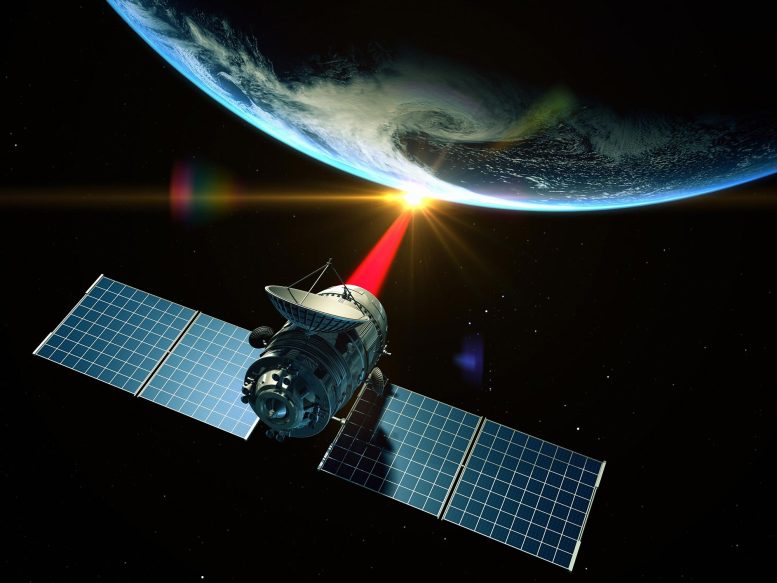
    Satellite Laser Illustration
    Scientists from NASA’s Jet Propulsion Laboratory have designed a new compact and lightweight high-resolution imaging spectrometer for space-based use. The research introduces spectrometers that are a tenth the size and weight of conventional designs and cost less, thus enabling a range of new applications.

    NASA researchers have created a new, lightweight, and cost-effective imaging spectrometer for space use. These designs deliver high-resolution spectroscopy in a compact form, potentially expanding their applications in atmospheric study.

    Researchers have developed a new smaller, lighter design for space-based imaging spectrometers with high spectral resolution. These high-dispersion imaging spectrometers could be used onboard spacecraft or satellites to study the Earth’s atmosphere or the atmospheres of other planets.

    James P. McGuire, Jr. from NASA’s Jet Propulsion Laboratory in Southern California will present the new research at the Optica Design and Fabrication Conference, which will take place June 4 – 8, 2023 in Quebec City, Canada.

     “This spectrometer provides the same measurement capabilities as conventional designs, but at one-tenth the size and mass and at a lower cost.  Smaller, lighter, and cheaper open the door to new applications and markets,” said McGuire.

    Imaging spectroscopy, also known as hyperspectral imaging, acquires information across the electromagnetic spectrum for each pixel in the image of a scene. When performed from space, it is typically used to observe solids or liquids, which requires high spatial resolution and low spectral resolution. However, there is a need for smaller and lighter-weight space-based imaging spectrometers that gather atmospheric information, which requires high spectral resolution and low spatial resolution.

    In the new work, the researchers describe near-infrared (NIR) and long-wave infrared (LWIR) imaging spectrometer designs that could help fill this need. The spectrometer designs combine desirable features from several existing designs, including an immersed grating that reduces the grating size by as much as the refractive index, a Littrow optical configuration that uses the same optics before and after the grating, and a grating on a spherical surface to simply the correction of an optical error known as Petzval field curvature. Gratings separate white light into its constituent spectrum of colors.

    The researchers developed an NIR imaging spectrometer design that covers a spectral range from 2302 nm to 2370 nm with 2,048 spectral pixels and 512 spatial pixels at an aperture of f/1.9. Using different materials, they also designed a LWIR version that covers 8 μm to 12 μm with 1536 spectral pixels and 256 spatial pixels at f/1.7.

    Never miss a breakthrough: Join the SciTechDaily newsletter.
    Follow us on Google and Google News.

    JPL NASA Optica
    Share. Facebook Twitter Pinterest LinkedIn Email Reddit

    Related Articles

    NASA Researchers Test Deep Space Atomic Clock (DSAC)

    ‘Chemical Laptop’ Could Be Used to Search for Life Beyond Earth

    Engineers Developing ‘Hedgehog’ Robots That Hop and Tumble in Microgravity

    How Scientists Manage the Flood of “Big Data” from Space

    Ape-Like RoboSimian Robot in Development

    Superconducting Amplifier Designed to Study the Universe

    Help NASA Test-Drive Curiosity Interactive Experience

    Robonaut 2: A Robotic Space Station Crew Member

    SCaN Testbed Headed for International Space Station Later This Year

    Leave A Reply Cancel Reply

    • Facebook
    • Twitter
    • Pinterest
    • YouTube

    Don't Miss a Discovery

    Subscribe for the Latest in Science & Tech!

    Trending News

    Common Laxative May Help Reverse Depression-Related Brain Fog

    Younger Generations Are Aging Faster – and It May Be Fueling a Surge in Cancer

    New Discovery Could Unlock Quantum Computers the Size of a Coin

    Shingles Vaccine Linked to 24% Lower Dementia Risk in Older Adults

    Scientists Found a Wordle Trick That Solves 99% of Puzzles

    A Hidden Galaxy Called Shadow Blaster May Explain One of Astronomy’s Biggest Mysteries

    These 3 Common Sleep Habits May Be Aging Your Brain Faster

    Rare Goblin Shark Spotted Alive in Its Natural Habitat for the First Time

    Follow SciTechDaily
    • Facebook
    • Twitter
    • YouTube
    • Pinterest
    • Newsletter
    • RSS
    SciTech News
    • Biology News
    • Chemistry News
    • Earth News
    • Health News
    • Physics News
    • Science News
    • Space News
    • Technology News
    Recent Posts
    • 520-Million-Year-Old Fossils Solve One of Evolution’s Biggest Mysteries
    • This Extraordinary Desert Mouse Defies Aging – and It Could Change Human Longevity
    • A Simple Blood Test Can Reveal the True Age of Your Brain, Heart, and Other Organs
    • This Popular Workout Supplement May Give Cancer Immunotherapy a Big Boost
    • Scientists Built a Mars Rover That “Swims” Through Sand
    Copyright © 1998 - 2026 SciTechDaily. All Rights Reserved.
    • Science News
    • About
    • Contact
    • Editorial Board
    • Privacy Policy
    • Terms of Use

    Type above and press Enter to search. Press Esc to cancel.