
Close Menu
    Facebook X (Twitter) Instagram
    SciTechDaily
    • Biology
    • Chemistry
    • Earth
    • Health
    • Physics
    • Science
    • Space
    • Technology
    Facebook X (Twitter) Pinterest YouTube RSS
    SciTechDaily
    Home»Technology»Superconducting Amplifier Designed to Study the Universe
    Technology

    Superconducting Amplifier Designed to Study the Universe

    By Priscilla Vega, Jet Propulsion LaboratoryJuly 18, 20121 Comment3 Mins Read
    Facebook Twitter Pinterest Telegram LinkedIn WhatsApp Email Reddit
    Share
    Facebook Twitter LinkedIn Pinterest Telegram Email Reddit
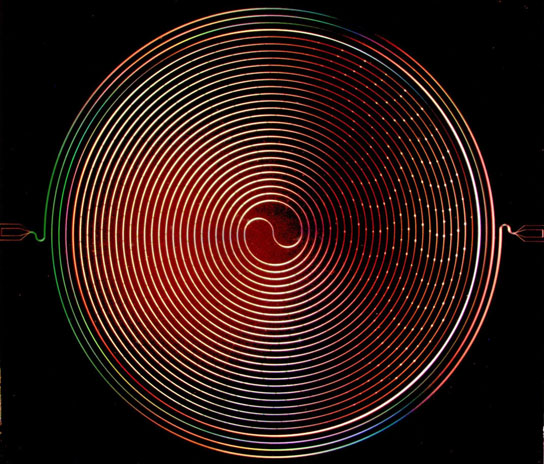
    New Amp to Study the Universe
    The new amplifier consists of a superconducting material (niobium titanium nitride) coiled into a double spiral 16 millimeters in diameter. Credit: NASA/JPL-Caltech

    Designed by scientists at the California Institute of Technology and at NASA’s Jet Propulsion Laboratory, a new amplifier using titanium nitride and niobium titanium nitride will help researchers study the universe.

    Researchers at NASA’s Jet Propulsion Laboratory and the California Institute of Technology, both in Pasadena, have developed a new type of amplifier for boosting electrical signals. The device can be used for everything from studying stars, galaxies, and black holes to exploring the quantum world and developing quantum computers.

    “This amplifier will redefine what it is possible to measure,” said Jonas Zmuidzinas, chief technologist at JPL, who is Caltech’s Merle Kingsley Professor of Physics and a member of the research team.

    An amplifier is a device that increases the strength of a weak signal. “Amplifiers play a basic role in a wide range of scientific measurements and in electronics in general,” said Peter Day, a principal scientist at JPL and a visiting associate in physics at Caltech. “For many tasks, current amplifiers are good enough. But for the most demanding applications, the shortcomings of the available technologies limit us.”

    One of the key features of the new amplifier is that it incorporates superconductors-materials that allow an electric current to flow with zero resistance when lowered to certain temperatures. For their amplifier, the researchers are using titanium nitride and niobium titanium nitride, which have just the right properties to allow the pump signal to amplify the weak signal.

    Although the amplifier has a host of potential applications, the reason the researchers built the device was to help them study the universe. The team built the instrument to boost microwave signals, but the new design can be used to build amplifiers that help astronomers observe in a wide range of wavelengths, from radio waves to X-rays.

    “It’s hard to predict what all of the applications are going to end up being, but a nearly perfect amplifier is a pretty handy thing to have in your bag of tricks,” Zmuidzinas said. And by creating their new device, the researchers have shown that it is indeed possible to build an essentially perfect amplifier. “Our instrument still has a few rough edges that need polishing before we would call it perfect, but we think our results so far show that we can get there.”

    The team recently described the new instrument in the journal Nature Physics.

    Reference: “A wideband, low-noise superconducting amplifier with high dynamic range” by Byeong Ho Eom, Peter K. Day, Henry G. LeDuc and Jonas Zmuidzinas, 8 July 2012, Nature Physics.
    DOI: 10.1038/nphys2356

    In addition to Zmuidzinas and Day, the other authors of the paper are Byeong Ho Eom of Caltech, and Henry LeDuc of JPL. This research was supported by NASA, the Keck Institute for Space Studies, and the JPL Research and Technology Development program. JPL is managed by Caltech for NASA.

    Never miss a breakthrough: Join the SciTechDaily newsletter.
    Follow us on Google and Google News.

    Astronomy California Institute of Technology Exploration JPL NASA
    Share. Facebook Twitter Pinterest LinkedIn Email Reddit

    Related Articles

    JPL Image of the Day – The Orion Nebula

    How Scientists Manage the Flood of “Big Data” from Space

    Astronomers Discover Earliest Starburst Galaxy Ever Observed

    “Habitable Zone” Might Help Extreme Life Forms Survive on Exoplanets

    NASA’s Curiosity Readies for First Drive on Mars

    New NASA InSight Mission Set to Explore the Depths of Mars

    NASA’s Space Launch System Passes Review, Moving to Preliminary Design Phase

    Robonaut 2: A Robotic Space Station Crew Member

    NASA’s NuSTAR is One Step Closer to Launching

    1 Comment

    1. Steve fedden on July 18, 2012 9:53 am

      Does that mean that they will be able to look at the CMB in greater detail?

      Reply
    Leave A Reply Cancel Reply

    • Facebook
    • Twitter
    • Pinterest
    • YouTube

    Don't Miss a Discovery

    Subscribe for the Latest in Science & Tech!

    Trending News

    Largest-Ever Study Finds Medicinal Cannabis Ineffective for Anxiety, Depression, PTSD

    250-Million-Year-Old Egg Solves One of Evolution’s Biggest Mysteries

    Living With Roommates Might Be Changing Your Gut Microbiome Without You Knowing

    Century-Old Cleaning Chemical Linked to 500% Increased Risk of Parkinson’s Disease

    What if Your Memories Never Happened? Physicists Take a New Look at the Boltzmann Brain Paradox

    One of the Universe’s Largest Stars May Be Getting Ready To Explode

    Scientists Discover Enzyme That Could Supercharge Ozempic-Like Weight Loss Drugs

    Popular Sweetener Linked to DNA Damage – “It’s Something You Should Not Be Eating”

    Follow SciTechDaily
    • Facebook
    • Twitter
    • YouTube
    • Pinterest
    • Newsletter
    • RSS
    SciTech News
    • Biology News
    • Chemistry News
    • Earth News
    • Health News
    • Physics News
    • Science News
    • Space News
    • Technology News
    Recent Posts
    • Want Less Stress? Landmark Study Points to a Simple Habit
    • Scientists Reveal Eating Fruits and Vegetables May Increase Your Risk of Lung Cancer
    • AI Reveals Explosive Growth of Floating Algae Across the World’s Oceans
    • 5.5 Million Bees Discovered Living Beneath a New York Cemetery
    • Scientists Reverse Brain Aging With Simple Nasal Spray
    Copyright © 1998 - 2026 SciTechDaily. All Rights Reserved.
    • Science News
    • About
    • Contact
    • Editorial Board
    • Privacy Policy
    • Terms of Use

    Type above and press Enter to search. Press Esc to cancel.