
Close Menu
    Facebook X (Twitter) Instagram
    SciTechDaily
    • Biology
    • Chemistry
    • Earth
    • Health
    • Physics
    • Science
    • Space
    • Technology
    Facebook X (Twitter) Pinterest YouTube RSS
    SciTechDaily
    Home»Space»Solar Dynamics Observatory Measures Magnetic Fields on Sun’s Surface
    Space

    Solar Dynamics Observatory Measures Magnetic Fields on Sun’s Surface

    By Karen C. Fox, NASAJanuary 18, 2012No Comments3 Mins Read
    Facebook Twitter Pinterest Telegram LinkedIn WhatsApp Email Reddit
    Share
    Facebook Twitter LinkedIn Pinterest Telegram Email Reddit
    Solar Dynamics Observatory Measures Magnetic Fields on Sun's Surface
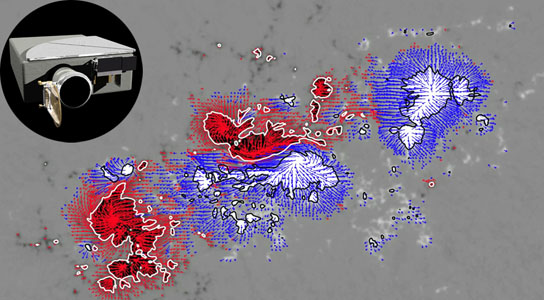
    The Helioseismic and Magnetic Imager on the Solar Dynamics Observatory has been mapping the sun’s magnetic fields since 2010. Credit: NASA/SDO and the HMI science team

    The Helioseismic and Magnetic Imager aboard the Solar Dynamics Observatory helps map the sun’s magnetic fields and has been gathering data since 2010. Recent vector magnetograms on the area of the sun named Active Region 11158 were released for researchers to examine to gain a better understanding of the strength and direction of magnetic fields on the solar surface and their effect on solar flares and coronal mass ejections.

    A subset of data that helps map out the sun’s magnetic fields was recently released from the Solar Dynamics Observatory (SDO). Observations that measure the strength and direction of magnetic fields on the solar surface — known as vector magnetograms — play a crucial role in understanding how those fields change over time and trigger giant eruptions off the surface of the sun such as solar flares and coronal mass ejections (CMEs).

    Collecting the information needed to make vector magnetograms is one of several tasks performed by SDO’s Helioseismic and Magnetic Imager (HMI), an instrument led by a team at Stanford University. HMI has been collecting data since May of 2010, providing scientific data on the strength of the sun’s magnetic field and the sound waves moving around inside the Sun.

    HMI relies on interpreting the way light is affected as it travels through the fields in order to measure them from afar. For example, a phenomenon known as the Zeeman effect splits light into different wavelengths based on the magnetic field strength and, in addition, light may be polarized based on the magnetic field direction. HMI uses these observations to produce vector magnetograms. Producing vector magnetograms at HMI’s high resolution, however, required developing new computer processing techniques to successfully interpret subtle details about the magnetic field.

    In early December, the HMI team released their vector magnetograms for one area of the sun, named Active Region 11158, collected during February 12-16, 2011. As a larger group of researchers examines the new data, the team can refine their computer processing algorithms if necessary and then release all the vector magnetic field data that HMI has collected.


    This movie shows how magnetic fields evolved on the surface of the sun at an active region in February of 2011. The blue arrows show where magnetic fields rise up off the surface and the red arrows show the magnetic field lines returning to the surface.

    Never miss a breakthrough: Join the SciTechDaily newsletter.
    Follow us on Google and Google News.

    Helioseismic and Magnetic Imager Magnetic Fields NASA Popular Solar Dynamics Observatory Sun
    Share. Facebook Twitter Pinterest LinkedIn Email Reddit

    Related Articles

    Fury Unleashed: Sun Emits Monumental X6.3 Flare, the Strongest in 6 Years

    Sun Unleashes X3.3 Fury – NASA’s SDO Captures Powerful Solar Flare

    NASA Captures Sun’s Fury: Strongest Solar Flare Since 2017

    Intensely Powerful X1.0 Solar Flare Witnessed by NASA’s Solar Dynamics Observatory

    Radiant Fury: Sun Unleashes Powerful X1.0 Class Solar Flare

    New Clues To Predict When and Where the Sun’s Next Flare Might Explode

    Powerful X-Class Solar Flare Erupts From Sun – Captured by NASA’s Solar Dynamics Observatory

    NASA’s Solar Dynamics Observatory Caught the Sun “Smiling”

    Sun Blasts Out 3 Powerful Bursts of Energy in Last 24 Hours

    Leave A Reply Cancel Reply

    • Facebook
    • Twitter
    • Pinterest
    • YouTube

    Don't Miss a Discovery

    Subscribe for the Latest in Science & Tech!

    Trending News

    Scientists Discover Major Errors in Al Gore-Founded Climate Pollution Database

    New Vitamin B12-Based Therapy Could Change How Brain Cancer Is Treated

    This Common Fat Could Be Fueling Type 2 Diabetes, Researchers Warn

    Simple Fiber Supplement Cuts Knee Arthritis Pain in Just 6 Weeks, Study Finds

    Common Asthma Drug May Reverse Dangerous Fatty Liver Disease

    Extra Weight Could Age Your Brain Faster, Study Warns

    Scientists Warn: America’s Most Popular Cooking Oil May Be Harming Your Intestines

    Scientists Say a 59,000-Year-Old Neanderthal Tooth Shows Evidence of Surgery

    Follow SciTechDaily
    • Facebook
    • Twitter
    • YouTube
    • Pinterest
    • Newsletter
    • RSS
    SciTech News
    • Biology News
    • Chemistry News
    • Earth News
    • Health News
    • Physics News
    • Science News
    • Space News
    • Technology News
    Recent Posts
    • Could Low Vitamin D Be Making Your Pain Worse?
    • Scientists Say ‘Yo-Yo Dieting’ May Not Be Ruining Your Metabolism After All
    • Scientists Discover Once-Weekly Workout That Melts Belly Fat Surprisingly Effectively
    • Are Your Choices Really Yours? New Brain Study Raises Big Questions
    • Super Jupiters Expose a Long Standing Space Mystery
    Copyright © 1998 - 2026 SciTechDaily. All Rights Reserved.
    • Science News
    • About
    • Contact
    • Editorial Board
    • Privacy Policy
    • Terms of Use

    Type above and press Enter to search. Press Esc to cancel.