
A new Duke Quantum Center study shows how quantum simulators can help researchers explore particle formation and the conditions that followed the Big Bang.
Quarks are the fundamental building blocks of matter, but they never exist alone. Bound tightly inside protons and neutrons, pairs of quarks behave as if connected by a taut string. Pulling them apart takes so much energy that when the connection finally snaps, that built-up energy transforms into entirely new particles. This process, known as string breaking, normally occurs only in extreme environments such as the Large Hadron Collider or the immediate aftermath of the Big Bang.
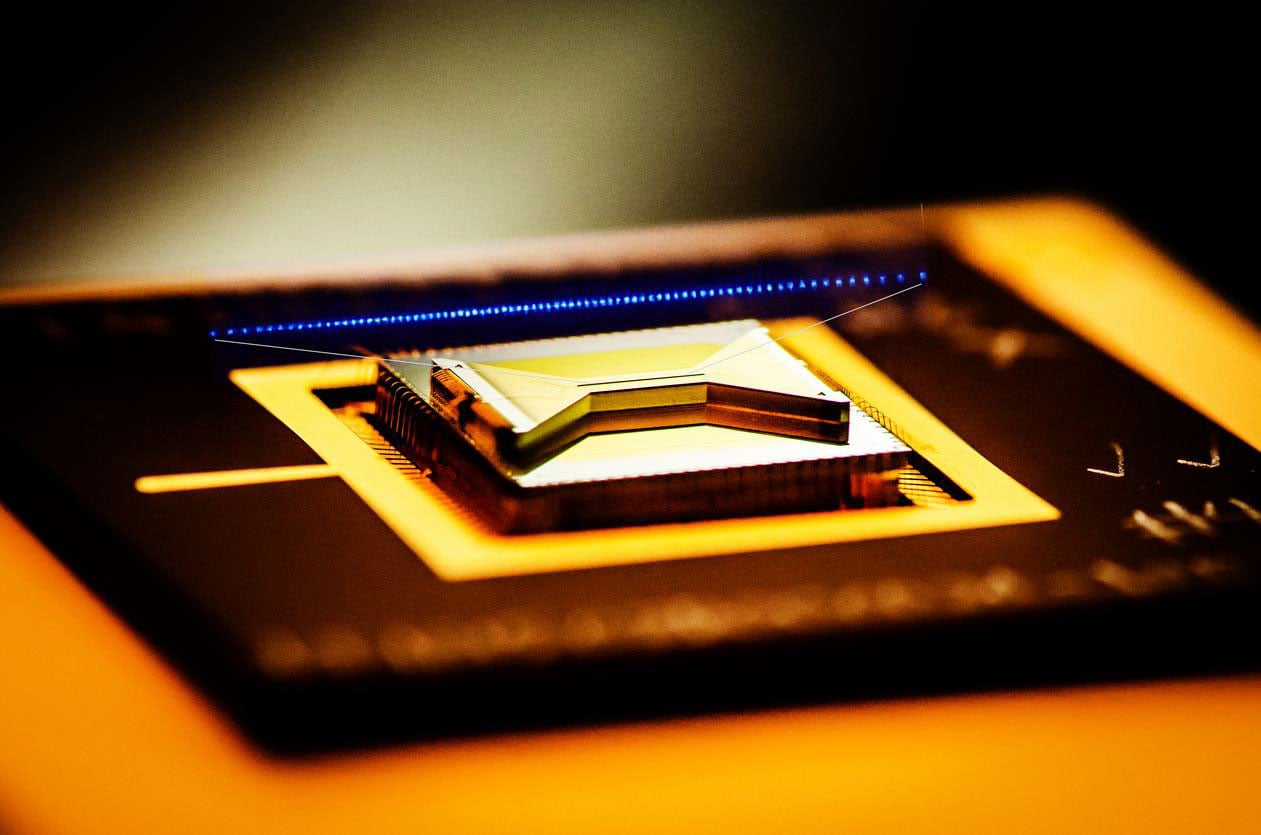
A team led by faculty at the Duke Quantum Center has now recreated analogous behavior using a quantum simulator built from 13 trapped ions, or electrically charged atoms. By programming the ions to follow a mathematical model, the researchers could track how a simulated string broke and effective charges emerged. The results, published September 23 in Nature Physics, are among the field’s first quantum simulations of string-breaking dynamics related to particle-antiparticle formation.
String breaking under laser control
Quarks themselves are about a billion times smaller than an atom and cannot currently be observed directly. A quantum simulator makes it possible to investigate a model of their behavior through a system researchers can control. In the Duke experiment, precisely directed laser beams adjusted the interactions among the ions, allowing those interactions to mimic the energy buildup associated with stretching a connection between quarks.
The creation of particles from that energy reflects the relationship between mass and energy described by Einstein’s equation, E = mc². When new particles “pop into existence” and the string breaks, two or more pairs remain where there was originally one. To follow the analogous transformation in their simulator, the researchers prepared the ion chain out of equilibrium, meaning it began in a state that would evolve rather than remain in balance. They then tracked the appearance of effective charges, features of the model representing charged particles, and reconstructed the resulting string dynamics.
“Working at the intersection of quantum simulation and high-energy physics is incredibly exciting,” said Arinjoy De, the paper’s first author and a former doctoral student in the lab of Christopher Monroe, who led the research and is a professor of electrical and computer engineering and physics at Duke. De is now production machine lead at QuEra Computing. “By simulating quark confinement and string-breaking phenomena in a controlled lab environment, we’re opening up new pathways for experimental investigations into the behavior of matter at its most fundamental level.”
Quantum results pass a classical check
The researchers checked their results by running the same model on a classical computer. Agreement between the calculations and the experiment confirmed that the quantum simulator accurately reproduced the model at the size tested. The challenge ahead is to expand these simulations until they can address problems too complex for classical computers, including the largest supercomputers.
That would give researchers a way to investigate more demanding questions about how matter evolves, including under conditions associated with the aftermath of the Big Bang.
“As a physicist, it is incredibly exciting to investigate the conditions of the early universe in an atomic-level computing machine,” said Zohreh Davoudi, an associate professor of physics at the University of Maryland and a member of the research team. “Even the slightest insights from an out-of-equilibrium physics model will guide us in the future.”
Three platforms, one quantum benchmark
The Duke-led collaboration included researchers from the University of Maryland, Oxford University, the California Institute of Technology, Cornell University, and KU Leuven. Its results join two similar published studies that reproduced string breaking in other models using different quantum computing technologies.
Teams led by Google and QuEra Computing used superconducting circuits and neutral atoms, respectively. Each approach has its own advantages and challenges, so reproducing the phenomenon across these systems provides a way to compare what different types of quantum hardware can do.
“These are the three platforms leading the charge in quantum computing, so it’s a nice benchmark and comparison for the quantum community,” said Monroe, who led the Duke research and is the Gilhuly Family Presidential Distinguished Professor of Electrical and Computer Engineering and Physics.
“Quantum computer simulations provide the best platform to investigate complex questions like matter formation, short of having witnessed the Big Bang itself,” Monroe said. “These findings signal a marked development in the quantum science field and open new avenues for us to understand string-breaking dynamics.”
Reference: “String-breaking dynamics in a quantum simulator” by Arinjoy De, Alessio Lerose, De Luo, Federica M. Surace, Alexander Schuckert, Elizabeth R. Bennewitz, Brayden Ware, William Morong, Kate S. Collins, Zohreh Davoudi, Alexey V. Gorshkov, Or Katz and Christopher Monroe, 23 September 2026, Nature Physics.
DOI: 10.1038/s41567-026-03422-0
This work was supported by the Department of Energy (DE-SC0020312, DE-SC0025341, DESC0019040, DE-SC0024220, DE-SC0020271), National Science Foundation (OMA-2120757), Air Force Office of Scientific Research, Defense Advanced Research Projects Agency and Amazon Web Services.
Never miss a breakthrough: Join the SciTechDaily newsletter.
Follow us on Google and Google News.
3 Comments
Observing this threshold point in real-time offers an unprecedented window into non-perturbative quantum chromodynamics. In standard QCD, color confinement and the snapping of confining flux tubes under extreme tension are typically locked behind complex lattice gauge calculations or indirect collider debris. Being able to physically dial up tension in a controllable quantum simulator and watch a color string break—triggering immediate vacuum pair production—bridges abstract field theory with direct observation.
This dynamic provides vital empirical footing for advanced field models.
Torsion Hill Architectural : Quantum simulations of string-breaking and particle creation from energy fields expose the limitations of point-particle emergence models. True field architecture interprets the materialization of particle pairs as localized topological reorganization—where excessive torsional strain within a stressed 3D manifold triggers a phase transition, stabilizing rotational nodes into stable structural configurations. The Link , https://docs.google.com/document/d/1TIuQESrA-mJao6h7rBiv_sXv_DjDAJbPEnGQJxh9IaQ/edit?usp=drive_link
This helps solidify the concept that virtual vacuum space is indeed an energetic entity comprised of quantum fields that make up the essence of spacetime. Virtual particles that pop into our spacetime from virtual vacuum space, and that then cross-link with existing fermionic quark matter in our 4D spacetime, in the form of quark pairs (meson) or a baryon consisting of 3 quarks, which bind together to form either a proton or a neutron helps substantiate quantum theories of QCD and QED. Amazing!
When they say a quark suddenly appears that’s because we can’t see 99.9999% of energy which is called dark matter or dark energy.. ✌️