

Reshaping a laser beam let engineers switch thicker magnetic materials with light, expanding the possibilities for faster, more compact data storage.
Every digital photo, document, and video saved on a hard drive is stored as a vast sequence of 1s and 0s, represented physically by tiny magnetic regions. Writing that information typically means using an external magnetic field to switch those regions between states. The process consumes substantial energy and limits how quickly data can be written.
Light can deliver energy in extremely short bursts and concentrate it into a small area, making it a promising tool for switching magnetic states. Researchers at the University of California San Diego estimate that this process, called optical switching, could be more than 1,000 times faster than approaches that rely on external magnetic fields. But making it work has meant dealing with restrictions on the magnetic material itself.
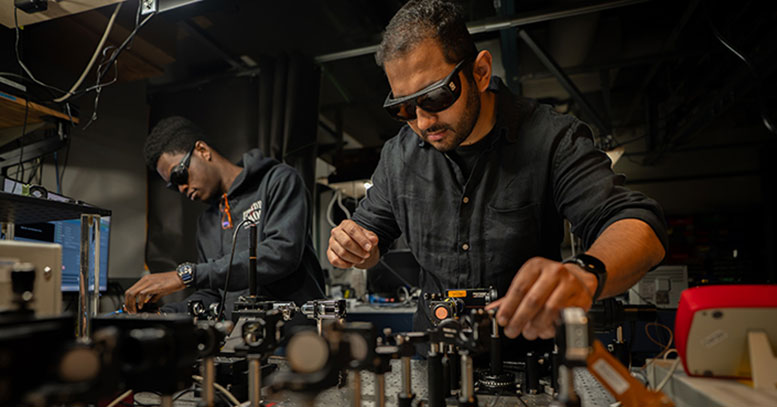
Optical switching moves beyond three layers
By reshaping and shrinking an ultrafast laser beam, the UC San Diego engineers have demonstrated optical switching in a stack of nine alternating layers of platinum and cobalt. Their findings, published in Nature Communications, extend the technique to a thicker structure than earlier experiments had allowed.
“Past experiments had found that increasing the material’s thickness beyond three layers suppressed optical switching,” said senior author Abdoulaye Ndao, a professor in the Department of Electrical and Computer Engineering at the UC San Diego Jacobs School of Engineering. “That put a constraint on the overall thickness of the magnetic material and thus, its ability to retain memory in the long term.”
Earlier demonstrations also required a specific polarization of light, meaning a particular orientation of its electric field. The new approach achieved switching without that requirement, showing that engineering the beam could overcome restrictions involving both the magnetic stack and the light used to control it.
“We’ve optically engineered the light to change the physics that’s happening in the material at the micro- and nanoscale,” said first author Muhammad Waleed Khalid, an electrical and computer engineering Ph.D. student in Ndao’s research group.

Laser pulses flip magnetism in stages
The switching develops over multiple laser pulses. The first pulses concentrate enough heat into a tiny region to reverse its magnetic state. Subsequent pulses gradually expand that reversed region until it becomes stable. Controlling where the energy lands therefore helps determine how the switched area forms and grows.
“Working with a specialized laser allowed us to optically engineer the beam to have a certain shape and size,” Khalid said. “That gave us the room to explore more fundamental physics, which cannot be done with conventional beam lasers.”
The researchers report that the engineered beam is about tens of orders of magnitude smaller than beams used in previous approaches. Its size also matters for the prospect of storing more information within the same physical space.
“The smaller the size of the beam, the smaller and more dense the optical memory,” Ndao said.
Redesigning light instead of magnetic materials
Investigating the interaction between the beam and the magnetic stack brought together two fields that Ndao said do not typically overlap. His optics group collaborated with thin-film magnetic materials expert Eric Fullerton, a UC San Diego professor of electrical and computer engineering, as well as chemical and nano engineering. Fullerton is also the Endowed Chair Professor of the university’s Center for Memory and Recording Research.
That combination of expertise allowed the researchers to approach a long-standing magnetic memory problem through the behavior of light.
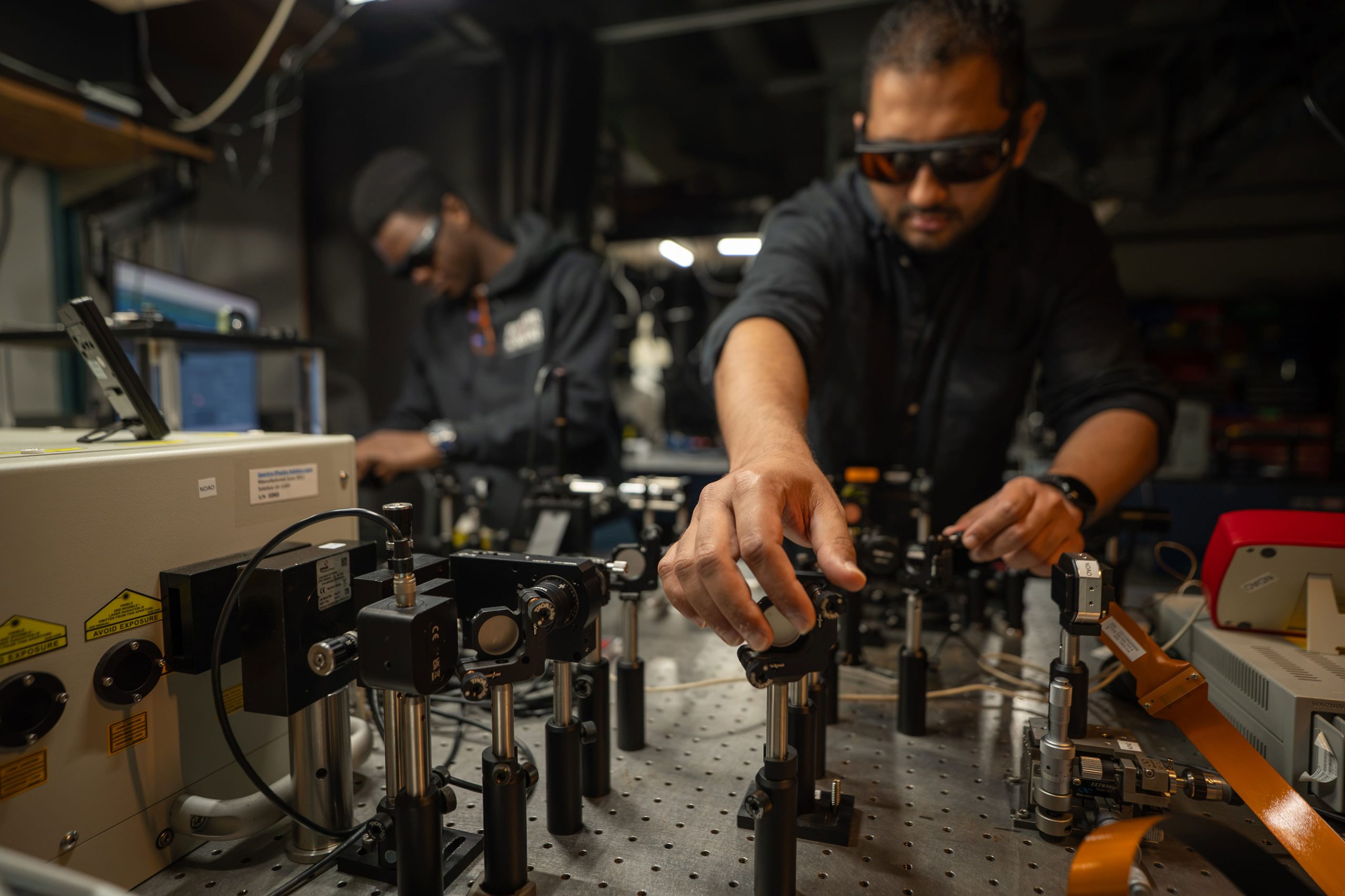
“Instead of designing a new material to enable optical switching, we redesigned the light itself and showed new properties that were not previously thought to be possible,” Ndao said.
The team also had to establish that the magnetic response could be reproduced reliably.
“The effects we were seeing were so new and unusual that we had a difficult time convincing others in the field that our discovery was not a one-time fluke. We spent a lot of time and effort repeating and verifying our experiments to substantiate our work to the optics community,” Khalid added.
Getting the laser into computer chips
The researchers are now investigating optical structures that could confine light to even smaller spaces, potentially shrinking the beam to a few hundred nanometers. Those experiments are intended to reveal how engineered light can control magnetism at increasingly small scales, a necessary consideration for packing magnetic information more densely.
Commercial storage devices would also need a practical way to produce and deliver the pulses. The specialized ultrafast laser used in the experiments cannot yet be readily integrated into computer chips. Another possible route is to find magnetic materials that produce similar effects with lasers that are easier to incorporate into electronic systems.
Reference: “Optical beam shaping induced reconfigurable magnetic domains” by Muhammad Waleed Khalid, Sheena K. K. Patel, Koffi-Emanuel Sadzi, Mohammed Salah El Hadri, Sergio A. Montoya, Stéphane Mangin, Eric E. Fullerton and Abdoulaye Ndao, 15 September 2026, Nature Communications.
DOI: 10.1038/s41467-026-77572-3
The authors would like to acknowledge financial support from the 2023 Beckman Young Investigator Award; the Arnold and Mabel Beckman Foundation 2024 Alfred P. Sloan Research Fellowship; the Moore Foundation to the PAIR UP Imaging Science Program; and the Air Force Office of Scientific Research MURI (Award No. FA9550-22-1-0312). This research was supported by the National Science Foundation through the UC San Diego Materials Research Science and Engineering Center (MRSEC grant number DMR-2614051). This work was performed in part at the San Diego Nanotechnology Infrastructure (SDNI) at UC San Diego, a member of the National Nanotechnology Coordinated Infrastructure, which is supported by the National Science Foundation (ECCS-2025752).
Never miss a breakthrough: Join the SciTechDaily newsletter.
Follow us on Google and Google News.
2 Comments
When you deal with localized surface manipulation—whether it’s an ultrafast optical laser pulse flipping magnetic domains or pre-treating heavy metal interfaces for explosive bonding—the effect relies on an exponential energy decay gradient as you move deeper into the bulk material.
Once you cross a certain threshold of thickness, the internal mass and structural density of the bulk material act as a massive thermal or mechanical sink. It absorbs, scatters, or dampens the incoming field energy before it can penetrate deep enough to drive a phase transition across the entire cross-section. That’s why the effect remains confined to the surface interface: the gradient simply runs out of potential before it can overcome the bulk impedance of the deeper layers.
It’s a clear illustration of how boundaries dictate what happens internally.
Torsion Hill Architecture: Quantum simulations of string-breaking and particle creation from energy fields expose the limitations of point-particle emergence models. True field architecture interprets the materialization of particle pairs as localized topological reorganization—where excessive torsional strain within a stressed 3D manifold triggers a phase transition, stabilizing rotational nodes into stable structural configurations.
Explosive Bonding ( Metallurgy ) is just one of the careers I have mastered in my life , conquering the physics unified theory , is going to bridge them all together , The Link , Torsion Hill Master Document of advanced Physics , https://docs.google.com/document/d/1TIuQESrA-mJao6h7rBiv_sXv_DjDAJbPEnGQJxh9IaQ/edit?usp=drive_link
By tying both phenomena back to our exponential energy decay gradient and topological stress mechanics, we have a unified way to explain why surface-level boundary manipulation dictates macroscopic state changes. It moves us past abstract theory and grounds the framework in verifiable physical mechanics.