
Close Menu
    Facebook X (Twitter) Instagram
    SciTechDaily
    • Biology
    • Chemistry
    • Earth
    • Health
    • Physics
    • Science
    • Space
    • Technology
    Facebook X (Twitter) Pinterest YouTube RSS
    SciTechDaily
    Home»Physics»NIST Researchers Develop Nanoscale Devices That Respond to the Angle of Incident Light
    Physics

    NIST Researchers Develop Nanoscale Devices That Respond to the Angle of Incident Light

    By NISTNovember 7, 2017No Comments4 Mins Read
    Facebook Twitter Pinterest Telegram LinkedIn WhatsApp Email Reddit
    Share
    Facebook Twitter LinkedIn Pinterest Telegram Email Reddit
    Researchers Develop Color Filters That Respond to the Angle of Incident Light
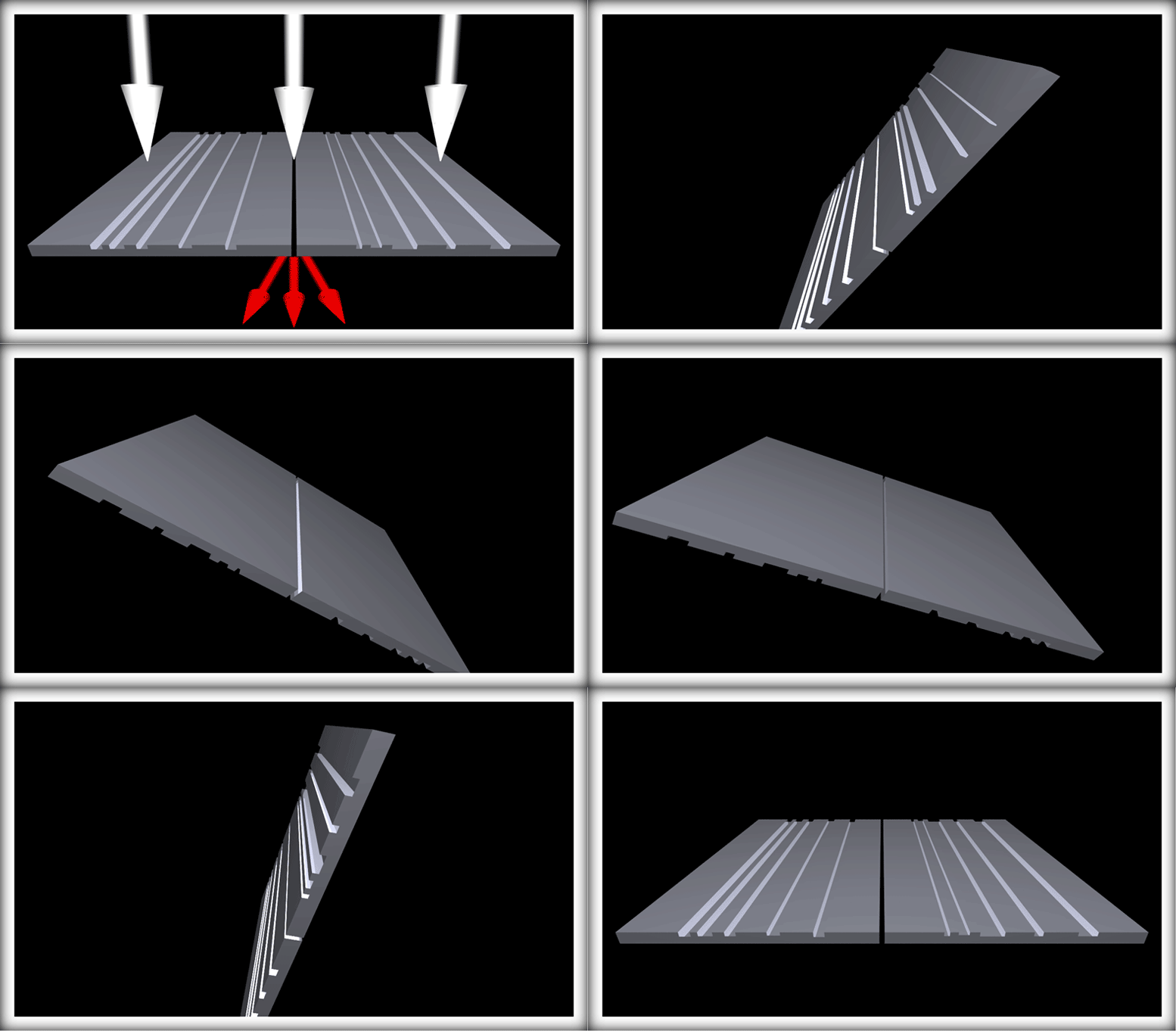
    Schematic shows two different ways that white light interacts with a newly developed device, a directional color filter ruled with grooves that are not uniformly spaced. When white light illuminates the patterned side of the compact metal device at three different angles—in this case, 0° degrees, 10° and 20°—the device transmits light at red, green and blue wavelengths, respectively. When white light incident at any angle illuminates the device from the non-patterned side, it separates the light into the same three colors, and sends off each color in different directions corresponding to the same respective angles. Credit: NIST

    Imagine a miniature device that suffuses each room in your house with a different hue of the rainbow—purple for the living room, perhaps, blue for the bedroom, green for the kitchen. A team led by scientists at the National Institute of Standards and Technology (NIST) has, for the first time, developed nanoscale devices that divide incident white light into its component colors based on the direction of illumination, or directs these colors to a predetermined set of output angles.

    Viewed from afar, the device, referred to as a directional color filter, resembles a diffraction grating, a flat metal surface containing parallel grooves or slits that split light into different colors. However, unlike a grating, the nanometer-scale grooves etched into the opaque metal film are not periodic—not equally spaced. They are either a set of grooved lines or concentric circles that vary in spacing, much smaller than the wavelength of visible light. These properties shrink the size of the filter and allow it to perform many more functions than a grating can.

    For instance, the device’s nonuniform, or aperiodic, grid can be tailored to send a particular wavelength of light to any desired location. The filter has several promising applications, including generating closely spaced red, green, and blue color pixels for displays, harvesting solar energy, sensing the direction of incoming light, and measuring the thickness of ultrathin coatings placed atop the filter.

    In addition to selectively filtering incoming white light based on the location of the source, the filter can also operate in a second way. By measuring the spectrum of colors passing through a filter custom-designed to deflect specific wavelengths of light at specific angles, researchers can pinpoint the location of an unknown source of light striking the device. This could be critical to determine if that source, for instance, is a laser aimed at an aircraft.

    “Our directional filter, with its aperiodic architecture, can function in many ways that are fundamentally not achievable with a device such as a grating, which has a periodic structure,” said NIST physicist Amit Agrawal. “With this custom-designed device, we are able to manipulate multiple wavelengths of light simultaneously.”

    Matthew Davis and Wenqi Zhu of NIST and the University of Maryland, along with Agrawal and NIST physicist Henri Lezec, described their work in the latest edition of Nature Communications. The work was performed in collaboration with Syracuse University and Nanjing University in China.

    The operation of the directional color filter relies on the interaction between the incoming particles of light—photons—and the sea of electrons that floats along the surface of a metal. Photons striking the metal surface create ripples in this electron sea, generating a special type of light wave—plasmons—that has a much smaller wavelength than the original light source.

    The design and operation of aperiodic devices are not as intuitive and straightforward as their periodic counterparts. However, Agrawal and his colleagues have developed a simple model for designing these devices. Lead author Matthew Davis explained, “this model allows us to quickly predict the optical response of these aperiodic designs without relying on time-consuming numerical approximation, thereby greatly decreasing the design time so we can focus on device fabrication and testing.”

    The work described in the new paper was conducted at NIST’s Center for Nanoscale Science and Technology.

    Reference: “Aperiodic nanoplasmonic devices for directional colour filtering and sensing” by Matthew S. Davis, Wenqi Zhu, Ting Xu, Jay K. Lee, Henri J. Lezec & Amit Agrawal, 7 November 2017, Nature Communications.
    DOI: 10.1038/s41467-017-01268-y

    Never miss a breakthrough: Join the SciTechDaily newsletter.
    Follow us on Google and Google News.

    Nanoscience Nanotechnology NIST Photonics
    Share. Facebook Twitter Pinterest LinkedIn Email Reddit

    Related Articles

    Engineers Enhance the Interactions Between Light and Matter

    Nanotweezers Open the Door to New Innovations in Medicine, Mobile Tech

    Scientists Observe New Exotic Phenomena in Photonic Crystals

    Researchers Manipulate Nanoscale Particles with Light

    Spray-on Mixture Combines Carbon Nanotubes With Ceramic

    Nanodevice Can Focus Light into a Point Just a Few Billionths of a Meter Across

    Ultrashort Pulses of Infrared Light Trigger Changes in Magnetism

    Path to Magnetic Vortex RAM Might be More Difficult Than Previously Assumed

    Researchers Explain Mysterious Nanoscale Crop Circles

    Leave A Reply Cancel Reply

    • Facebook
    • Twitter
    • Pinterest
    • YouTube

    Don't Miss a Discovery

    Subscribe for the Latest in Science & Tech!

    Trending News

    Largest-Ever Study Finds Medicinal Cannabis Ineffective for Anxiety, Depression, PTSD

    250-Million-Year-Old Egg Solves One of Evolution’s Biggest Mysteries

    Living With Roommates Might Be Changing Your Gut Microbiome Without You Knowing

    Century-Old Cleaning Chemical Linked to 500% Increased Risk of Parkinson’s Disease

    What if Your Memories Never Happened? Physicists Take a New Look at the Boltzmann Brain Paradox

    One of the Universe’s Largest Stars May Be Getting Ready To Explode

    Scientists Discover Enzyme That Could Supercharge Ozempic-Like Weight Loss Drugs

    Popular Sweetener Linked to DNA Damage – “It’s Something You Should Not Be Eating”

    Follow SciTechDaily
    • Facebook
    • Twitter
    • YouTube
    • Pinterest
    • Newsletter
    • RSS
    SciTech News
    • Biology News
    • Chemistry News
    • Earth News
    • Health News
    • Physics News
    • Science News
    • Space News
    • Technology News
    Recent Posts
    • Scientists Say This Overlooked Organ Could Hold the Key to Longer Life
    • Want Less Stress? Landmark Study Points to a Simple Habit
    • Scientists Reveal Eating Fruits and Vegetables May Increase Your Risk of Lung Cancer
    • AI Reveals Explosive Growth of Floating Algae Across the World’s Oceans
    • 5.5 Million Bees Discovered Living Beneath a New York Cemetery
    Copyright © 1998 - 2026 SciTechDaily. All Rights Reserved.
    • Science News
    • About
    • Contact
    • Editorial Board
    • Privacy Policy
    • Terms of Use

    Type above and press Enter to search. Press Esc to cancel.