
Particle collisions offer a new way to study interactions of hyperon particles with ordinary nuclear building blocks, potentially giving insight into the properties of neutron stars.
In a groundbreaking study, scientists at the RHIC observed the directed flow of hypernuclei during particle collisions. This rare matter, abundant in neutron stars, was examined via simulated conditions, providing insights into interactions crucial for understanding neutron star structures. The observations, mirroring regular nuclei flow patterns, will help enhance theoretical models of neutron stars.
Physicists studying particle collisions at the Relativistic Heavy Ion Collider (RHIC) have published the first observation of directed flow of hypernuclei. These short-lived, rare nuclei contain at least one “hyperon” in addition to ordinary protons and neutrons. Hyperons contain at least one “strange” quark in place of one of the up or down quarks that make up ordinary nucleons (the collective name for protons and neutrons). Such strange matter is thought to be abundant in the hearts of neutron stars, which are among the densest, most exotic objects in the universe. While blasting off to neutron stars to study this exotic matter is still the stuff of science fiction, particle collisions could give scientists insight into these celestial objects from a laboratory right here on Earth.
“The conditions in a neutron star may still be far from what we reach at this moment in the laboratory, but at this stage it’s the closest we can get,” said Xin Dong, a physicist from the U.S. Department of Energy’s Lawrence Berkeley National Laboratory (LBNL) who was involved in the study. “By comparing our data from this laboratory environment to our theories, we can try to infer what happens in the neutron star.”
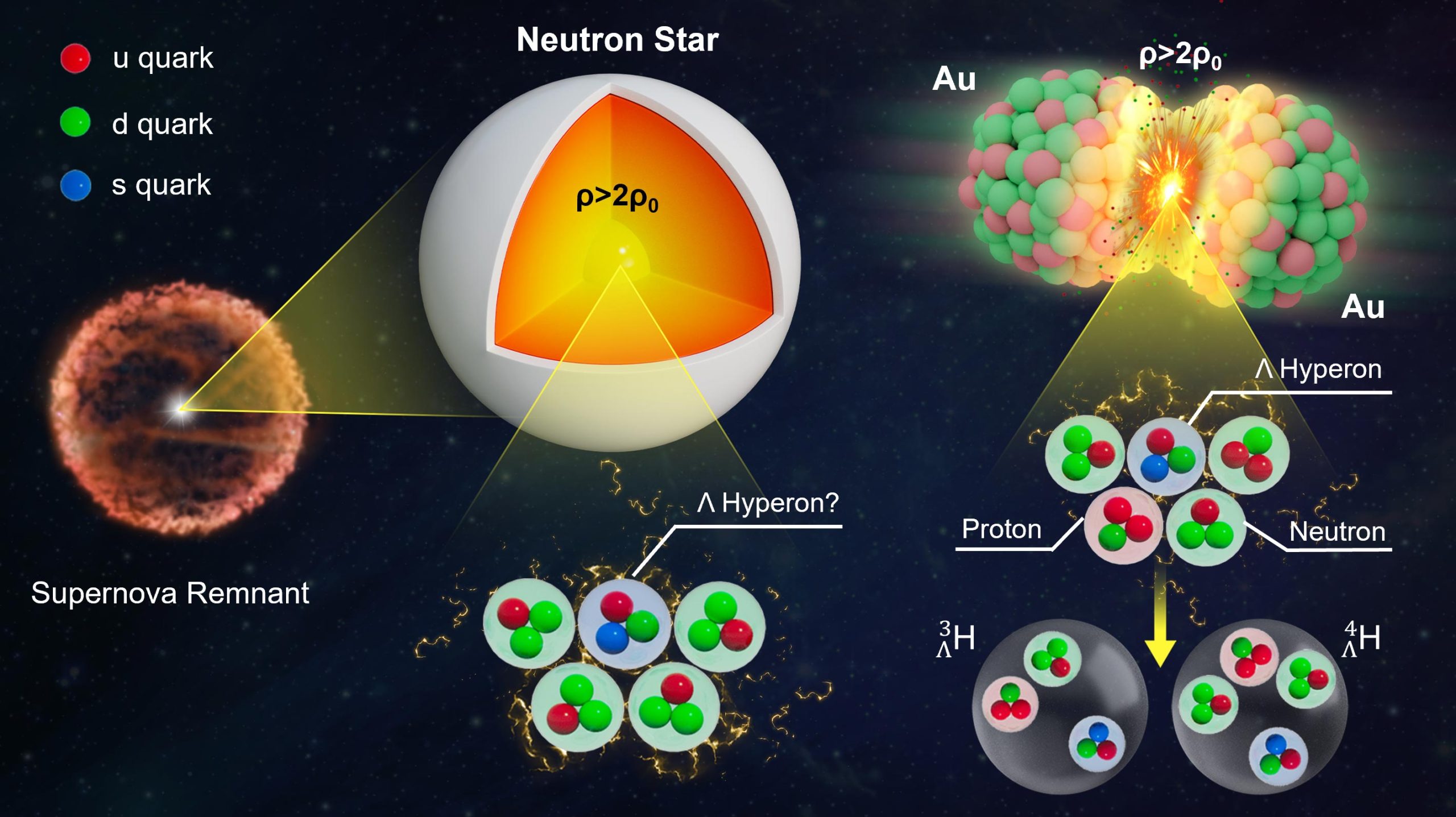
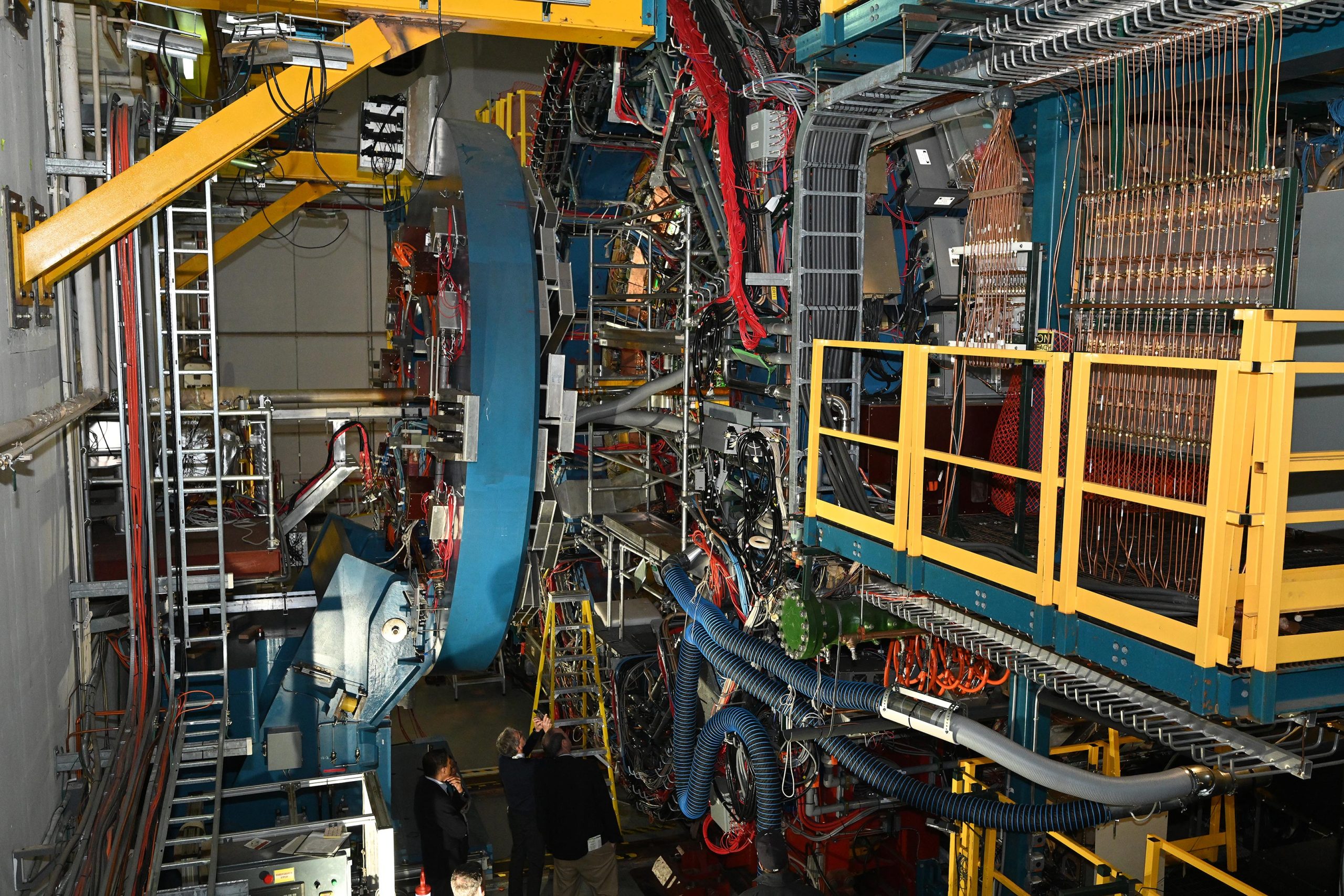
The scientists used the STAR detector at RHIC, a DOE Office of Science user facility for nuclear physics research at Brookhaven National Laboratory, to study the flow patterns of the debris emitted from collisions of gold nuclei. Those patterns are triggered by the enormous pressure gradients generated in the collisions. By comparing the flow of hypernuclei with that of similar ordinary nuclei made only of nucleons, they hoped to gain insight into interactions between the hyperons and nucleons.
“In our normal world, nucleon-nucleon interactions form normal atomic nuclei. But when we move into a neutron star, hyperon-nucleon interactions—which we don’t know much about yet—become very relevant to understanding the structure,” said Yapeng Zhang, another member of STAR from the Institute of Modern Physics of the Chinese Academy of Sciences, who led the data analysis together with his student Chenlu Hu. Tracking how hypernuclei flow should give the scientists insight into the hyperon-nucleon interactions that form these exotic particles.
The data, just published in the journal Physical Review Letters, will provide quantitative information theorists can use to refine their descriptions of the hyperon-nucleon interactions that drive the formation of hypernuclei—and the large-scale structure of neutron stars.
“There are no solid calculations to really establish these hyperon-nucleon interactions,” said Zhang. “This measurement may potentially constrain theories and provide a variable input for the calculations.”
Go With the Flow
Previous experiments have shown that the flow patterns of regular nuclei generally scale with mass—meaning the more protons and neutrons a nucleus has, the more the nuclei exhibit collective flow in a particular direction. This indicates that these nuclei inherit their flow from their constituent protons and neutrons, which coalesce, or come together, because of their interactions, which are governed by the strong nuclear force.
The STAR results reported in this paper show that hypernuclei follow this same mass-scaling pattern. That means hypernuclei most likely form via the same mechanism.
“In the coalescence mechanism, the nuclei (and hypernuclei) form this way depending on how strong the interactions are between the individual components,” Dong said. “This mechanism gives us information about the interaction between the nucleons (in nuclei) and nucleons and hyperons in hypernuclei.”
Seeing similar flow patterns and the mass scaling relationship for both normal nuclei and hypernuclei, the scientists say, implies that the nucleon-nucleon and hyperon-nucleon interactions are very similar.
The flow patterns also convey information about the matter generated in the particle smashups—including how hot and dense it is and other properties.
“The pressure gradient created in the collision will induce some asymmetry in the outgoing particle direction. So, what we observe, the flow, reflects how the pressure gradient is created inside the nuclear matter,” Zhang said.
“The measured flow of hypernuclei may open a new door to study hyperon-nucleon interactions under finite pressure at high baryon density.”
The scientists will use additional measurements of how hypernuclei interact with that medium to learn more about its properties.
The Benefits of Low Energy
This research would not have been possible without the versatility of RHIC to operate over such a wide range of collision energies. The measurements were made during Phase I of the RHIC Beam Energy Scan—a systematic study of gold-gold collisions ranging from 200 GeV per colliding particle pair down to 3 GeV.
To reach that lowest energy, RHIC operated in “fixed-target” mode: One beam of gold ions traveling around the 2.4-mile-circumference RHIC collider crashed into a foil made of gold placed inside the STAR detector. That low energy gives scientists access to the highest “baryon density,” a measure related to the pressure generated in the collisions.
“At this lowest collision energy, where the matter created in the collision is very dense, nuclei and hypernuclei are produced more abundantly than at higher collision energies,” said Yue-Hang Leung, a postdoctoral fellow from the University of Heidelberg, Germany. “The low-energy collisions are the only ones that produce enough of these particles to give us the statistics we need to do the analysis. Nobody else has ever done this before.”
How does what the scientists learned at RHIC relate to neutron stars?
The fact that hypernuclei appear to form via coalescence just like ordinary nuclei implies that they, like those ordinary nuclei, are created at a late stage of evolution of the collision system.
“At this late stage, the density for the hyperon-nucleon interaction we see is not that high,” Dong said. “So, these experiments may not be directly simulating the environment of a neutron star.”
But, he added, “This data is fresh. We need our theory friends to weigh in. And they need to include this new data on hyperon-nucleon interactions when they build a new neutron star model. We need both experimentalists and our theorists’ efforts to work towards understanding this data and making those connections.”
Reference: “Observation of Directed Flow of Hypernuclei 3ΛH and 4ΛH in √sNN=3 GeV Au+Au Collisions at RHIC” by B. E. Aboona et al. (STAR Collaboration), 24 May 2023, Physical Review Letters.
DOI: 10.1103/PhysRevLett.130.212301
This research was funded by the DOE Office of Science (NP), the U.S. National Science Foundation, and a range of international organizations and agencies listed in the scientific paper. The STAR team used computing resources at the Scientific Data and Computing Center at Brookhaven Lab, the National Energy Research Scientific Computing Center (NERSC) at DOE’s Lawrence Berkeley National Laboratory, and the Open Science Grid consortium.
Never miss a breakthrough: Join the SciTechDaily newsletter.
Follow us on Google and Google News.
2 Comments
The nuclei of any kind has a unique property of homogeneity in hydrodynamics;theoritical predictions following nature has been confirmed for first some nuclei in the periodic table.So,the present experiment has a good result in this path to extain the theory for some
more kind of nucĺei.Thus,star evolution process with formation can be known to extent.
Under the framework of topological vortex gravitational field, everything will become clearer.