

Close Menu
    Facebook X (Twitter) Instagram
    SciTechDaily
    • Biology
    • Chemistry
    • Earth
    • Health
    • Physics
    • Science
    • Space
    • Technology
    Facebook X (Twitter) Pinterest YouTube RSS
    SciTechDaily
    Home»Science»Big Surprises From Tiny Fish: Guppies Challenge “Volunteer’s Dilemma”
    Science

    Big Surprises From Tiny Fish: Guppies Challenge “Volunteer’s Dilemma”

    By University of ExeterJuly 21, 2023No Comments3 Mins Read
    Facebook Twitter Pinterest Telegram LinkedIn WhatsApp Email Reddit
    Share
    Facebook Twitter LinkedIn Pinterest Telegram Email Reddit
    Crowd Helpless Art Concept
    In a study conducted by the University of Exeter, Trinidadian guppies were observed to contradict the “volunteer’s dilemma” — a concept suggesting that individuals in larger groups are less likely to cooperate due to the assumption that others in the group will undertake necessary risks.

    Contrary to the “volunteer’s dilemma” suggesting less cooperation in larger groups, a new study found that Trinidadian guppies in larger shoals are more likely to take risks, such as approaching predators, for the collective benefit of the group. Researchers suggest this unexpected cooperation might be due to the presence of more cooperative individuals in larger groups.

    Tiny fish called Trinidadian guppies have surprised scientists when faced with the so-called “volunteer’s dilemma.”

    The idea of the dilemma is that individuals are less likely to cooperate if they are in a large group.

    Various studies have demonstrated this in humans – but guppies appear to buck the trend.

    In the new study, by the University of Exeter, guppies in larger groups were more likely to risk approaching a predator to gather information for the shoal.

    “When faced with a possible predator, guppies have to balance risks,” said Rebecca Padget, from Exeter’s Centre for Research in Animal Behaviour.

    “At least one guppy needs to approach, to find out if there is a threat. An individual that does this could get eaten. However, if none of the guppies take this risk, the whole group is in danger.

    Mathematical Models vs. Guppy Reality

    “In this ‘volunteer’s dilemma’, mathematical models suggest that individuals in larger groups should be less willing to cooperate.

    “In a larger group, there’s more chance another guppy will take the risk.”
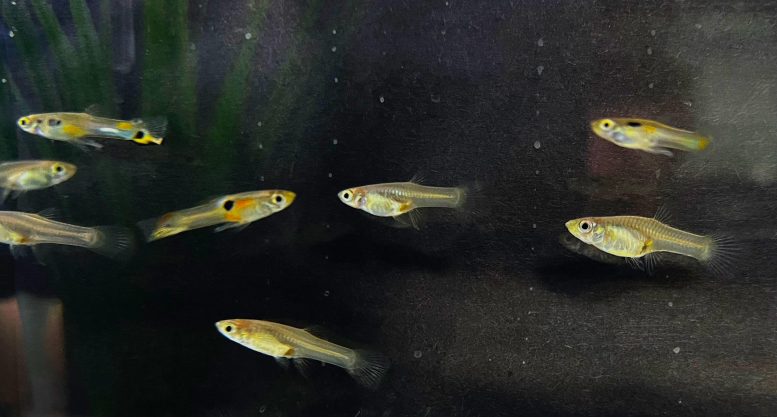
    Trinidadian Guppies
    Trinidadian guppies. Credit: Rebecca Padget

    To test this, the researchers placed a clay model of a pike cichlid (a natural predator of guppies) in a tank containing small (5), medium (10) and large (20) groups of guppies.

    Surprisingly, guppies in the large groups were most likely to approach and inspect the predator.

    Individuals in large groups inspected an average of 14 times in the seven-minute trials. Guppies in medium groups were least likely to approach – going an average of seven times each.

    Members of these medium groups also spent the most time in “refuges” (behind plants or near the gravel at the edge of the tank).

    Possible Explanations for More Cooperation

    “We can’t be sure why guppies in large groups cooperated more,” Padget said.

    “We know guppies have different personalities, so it could be that larger groups are more likely to contain more cooperative individuals – and others then follow their lead.”

    After inspecting a predator, guppies return to the group. Previous research has shown that their behavior then signals danger to the others.

    In the study, an “inspection” was recorded when a guppy went within 30 cm (12 inches) of the predator. This was usually done either by individuals or small sub-groups of the main shoal.

    The paper, published in the journal Proceedings of the Royal Society B, is entitled: “Guppies in large groups cooperate more frequently in an experimental test of the group size paradox.”

    Reference: “Guppies in large groups cooperate more frequently in an experimental test of the group size paradox” by Rebecca F. B. Padget, Tim W. Fawcett and Safi K. Darden, 12 July 2023, Proceedings of the Royal Society B.
    DOI: 10.1098/rspb.2023.0790

    Never miss a breakthrough: Join the SciTechDaily newsletter.
    Follow us on Google and Google News.

    Behavioral Science University of Exeter
    Share. Facebook Twitter Pinterest LinkedIn Email Reddit

    Related Articles

    Climate Catastrophe Forces Island Monkeys to Quickly Master New Social Skills

    Researchers Reveal the Simple Way to Help Social Media Users Spot Fake News

    Friendship, Food, and Feathers: Jackdaws Switch Friends To Gain Rewards – But Stick With Family

    When Is “Speciesism” Learned? Children Think Farm Animals Deserve Same Treatment as Pets

    Email Data Reveals Global Migration Trends

    Theoretical Model on the Evolution of Cooperation

    7 Million Year Old Footprints Reveal Elephant Social Structure from the Past

    Research Suggests First Plants Triggered Ice Ages

    The Less Birds Know, The Better

    Leave A Reply Cancel Reply

    • Facebook
    • Twitter
    • Pinterest
    • YouTube

    Don't Miss a Discovery

    Subscribe for the Latest in Science & Tech!

    Trending News

    These Toads Are Surviving a Deadly Fungus – Scientists May Finally Know Why

    These Brain Cells May Explain Why We Eventually Have To Sleep

    Tomatoes Contain an Invisible Ingredient With Surprising Effects on Liver Health

    World’s First Heat-Powered Cooling System Turns Waste Heat Into Cold

    Antarctica Gained a Record 695 Billion Tons of Ice in Just Two Years

    Don’t Miss: A Brilliant Venus and Glowing Harvest Moon Light Up the Sky

    New Twist on the Einstein Problem Reveals Unexpected Physics

    JWST Captures Stunning Evidence of How Supermassive Black Holes Feed

    Follow SciTechDaily
    • Facebook
    • Twitter
    • YouTube
    • Pinterest
    • Newsletter
    • RSS
    SciTech News
    • Biology News
    • Chemistry News
    • Earth News
    • Health News
    • Physics News
    • Science News
    • Space News
    • Technology News
    Recent Posts
    • Scientists Discover a Bacterial Molecule That “Disarms” a Dangerous Fungus
    • Bats May Hold the Secret to Fighting Aging, Cancer, and Infection
    • Scientists Discover a Hidden Defect That Could Explain Why IBD Keeps Coming Back
    • Millions Take Blood Pressure Drugs, but Many May Be Missing Their Heart-Protective Benefits
    • Could Alien Life Be Conscious in Ways We Can’t Imagine?
    Copyright © 1998 - 2026 SciTechDaily. All Rights Reserved.
    • Science News
    • About
    • Contact
    • Editorial Board
    • Privacy Policy
    • Terms of Use

    Type above and press Enter to search. Press Esc to cancel.