
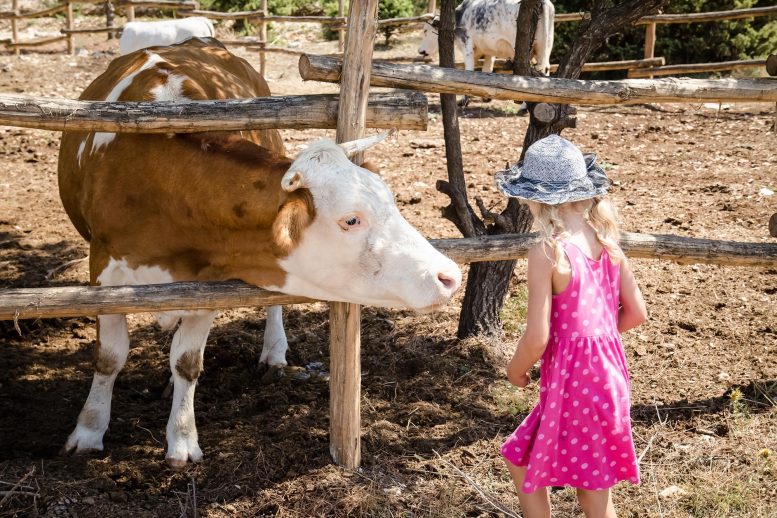
Research suggests that children’s moral views on animals are less speciesist than adults, with attitudes shifting during adolescence.
Children differ dramatically from adults in their moral views on animals, new research shows.
University of Exeter researchers asked children aged 9-11 about the moral status and treatment of farm animals (pigs), pets (dogs), and people.
Unlike adults, children say farm animals should be treated the same as people and pets, and think eating animals is less morally acceptable than adults do.
The findings suggest that “speciesism” – a moral hierarchy that gives different value to different animals – is learned during adolescence.
Ethical Double Standards in Human-Animal Relationships
“Humans’ relationship with animals is full of ethical double standards,” said Dr. Luke McGuire, from the University of Exeter.
“Some animals are beloved household companions, while others are kept in factory farms for economic benefit.
“Judgments seem to largely depend on the species of the animal in question: dogs are our friends, pigs are food.”
The research team – including the University of Oxford – surveyed 479 people, all living in England, from three age groups: 9-11, 18-21, and 29-59.
The two adult groups had relatively similar views – suggesting attitudes to animals typically change between the ages of 11 and 18.
Attitudes Shift as People Age
“Something seems to happen in adolescence, where that early love for animals becomes more complicated and we develop more speciesism,” said Dr. McGuire
“It’s important to note that even adults in our study thought eating meat was less morally acceptable than eating animal products like milk.
“So aversion to animals – including farm animals – being harmed does not disappear entirely.”
Moral Intelligence of Children and Environmental Impact
The study also found that, as people age, they are more likely to classify farm animals as “food” rather than “pets” – while children were equally likely to consider pigs to fall into either of these categories.
While adjusting attitudes is a natural part of growing up, Dr. McGuire said the “moral intelligence of children” is also valuable.
“If we want people to move towards more plant-based diets for environmental reasons, we have to disrupt the current system somewhere,” he said.
“For example, if children ate more plant-based food in schools, that might be more in line with their moral values, and might reduce the ‘normalization’ towards adult values that we identify in this study.”
The paper, published in the journal Social Psychological and Personality Science, is entitled: “The development of speciesism: Age-related differences in the moral view of animals.”
Reference: “The development of speciesism: Age-related differences in the moral view of animals” by Luke McGuire, Sally B. Palmer and Nadira S. Faber, 11 April 2022, Social Psychological and Personality Science.
DOI: 10.1177/19485506221086182
Never miss a breakthrough: Join the SciTechDaily newsletter.
Follow us on Google and Google News.
11 Comments
This might have more to do with the way children’s books so often anthropomorphize animals, especially farm animals. Most adults realize that animals aren’t like that in real life…
Social Studies was a major of mine in Psych, the mind of a child isn’t as exploitative as an adult. They look at things humanely, not how to prostitute things (animals or other humans) to their own advantage.
Anthropomorphization in books is unique to western culture and we see the humanity in children cross culturally.
You make an interesting point, another way to look at that is that children usually don’t have the burden of figuring out how to provide for themselves or those they love, so they don’t need to think in terms of how to “exploit” the world around them in order to do so. It is a level of naivety that we like for them to be able to hold on to as long as possible, but I would still argue it is more naivety than morality. It is not immoral to grow food so that we can eat and survive.
We can grow food but we shouldn’t be raising animals just so they can be cruelly exploited/killed. All of the nutrients we need in order to thrive can be obtained more healthfully, humanely, and environmentally responsibly from plant sources. There’s nothing naive about wanting animals to be treated with respect and compassion. It may have been necessary to eat animals as a matter of survival in the past but, fortunately, we no longer do. It’s irrational discrimination, like racism or sexism, that causes people to think that it’s alright to harmfully exploit nonhuman animals. It’s not alright: Needlessly harming animals for food, or for anything else, is animal abuse.
I should have know someone would use that absurdly naive “we can all live on plants” argument. Individuals can certainly, and if you choose to do so that is up to you, but we are omnivores, and you can’t feed billions of omnivores on just plants. It is certainly important to treat the animals well while they are alive though, we can treat them well and still eat them, no need to be cruel before then. It is not “irrational discrimination” for an omnivore to eat an animal. Comparing it to racism and sexism is doing those very real problems a massive disservice.
The mind of a child is full of humanity. The mind of an adult is full of exploitation.
Survey what you call “morality” among truly spiritual adults (NOT religious), you will find a respect for life similar to that of the child.
When people grow into worldly ways, they completely lose their humanity.
Very true
I used to visit a farm where two cousins lived, and the younger cousin and I were about the same age. One visit, when we were 12ish, ‘fun’ involved us building a little hut out of hay bales, and we snuck around the stack to find my uncle and older cousin butchering a hog, and when uncle saw us, he quickly shooed us away so we wouldn’t see the hog’s throat being cut. I knew where meat came from by the age of 12, and I was surprised at my uncle’s strong reaction to us seeing the butchering operation, and I always thought that even though he was much older than us, it was as if the reaction to the animal killing, was actually more his than what he thought ours might be, and despite killing and butchering several animals yearly, he actually had strong reservations about having to take the animals’ lives.
Thank you for this article. Children are constantly indoctrinated with speciesism. It’s the rare child who can transcend it, unless they have parents or other influential people who can help enlighten them against it. Fortunately, more and more people are realizing how wrong speciesism is. It’s as irrational as racism or sexism. Unfortunately, society in general strongly supports and promotes it, including government, industry and academia.
If I was a farmer, I would not want to consider my cows that need to be eaten by us as pets. I don’t know about anyone else, but I don’t want to eat my pets, they are my friends. When I make friends with an animal, it will never be invited to our dinner table. I grew up on a farm. You can raise beef cattle and treat them good but it is hard to eat the meat, you bring the live cows to the processing plant and it comes back in packages. You choose the packages for your own consumption that were not family pets, the few that are pets go to customers. I have bought an old milk cow that was retired from a friend, it made great hamburger, but it was too tough to make steaks or roasts. The cow was a pet of the farmer, they could not eat her.
… make peace not war, yeah… that sounds strange this days… adding fuel to a fire will make more fire, or there is a new view!