
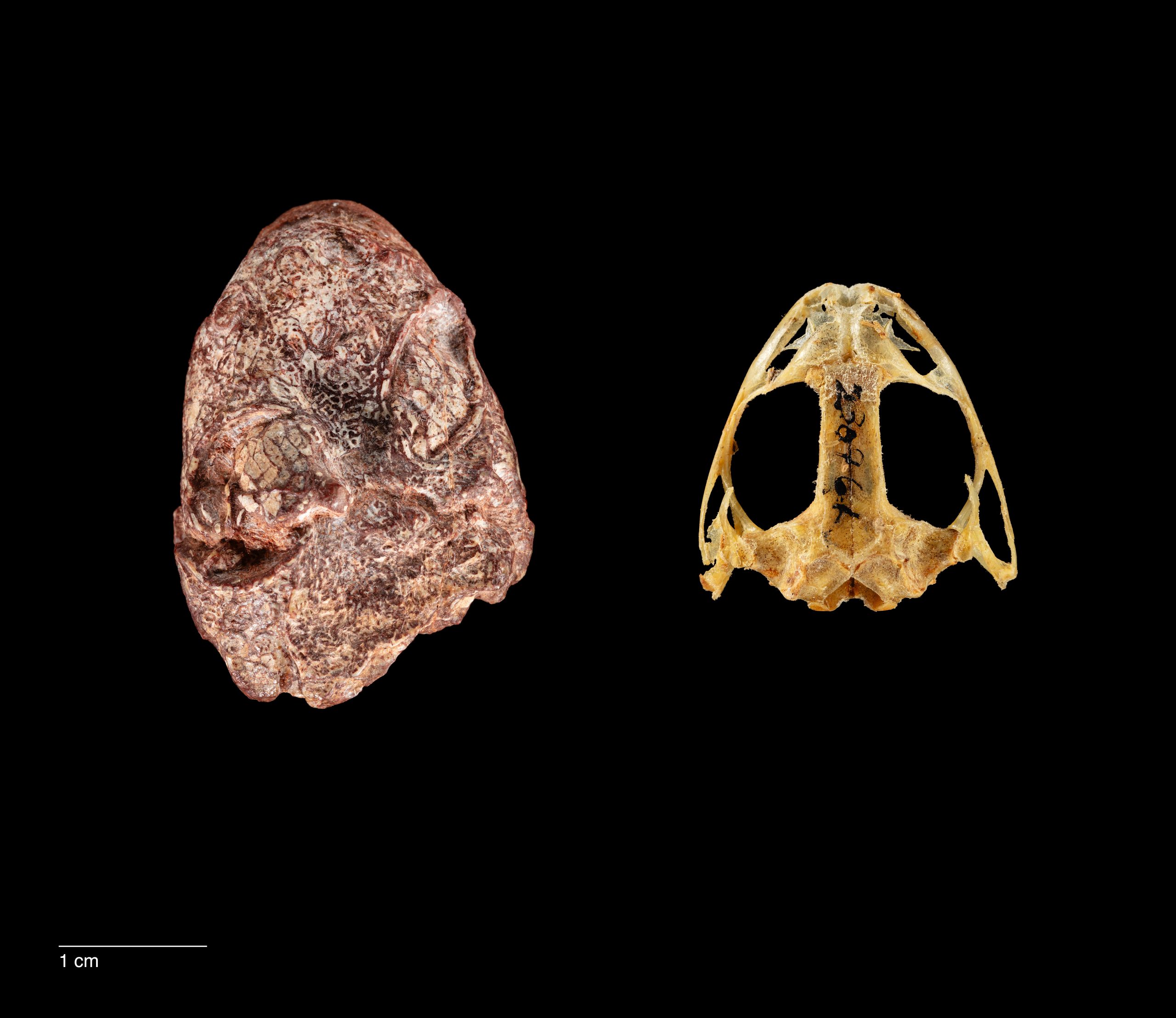
The discovery illuminates the origins of living frogs and other amphibians, while also paying tribute to the iconic Muppet.
Scientists have uncovered the fossilized skull of a 270-million-year-old ancient amphibian ancestor in the collection of the Smithsonian’s National Museum of Natural History. In a paper recently published in the Zoological Journal of the Linnean Society, the team of researchers described the fossil as a new species of proto-amphibian, which they named Kermitops gratus in honor of the iconic Muppet, Kermit the Frog.
According to Calvin So, a doctoral student at the George Washington University and the lead author on the new paper, naming the new creature after the beloved frog character, who was created by puppeteer Jim Henson in 1955, is an opportunity to get people excited about the discoveries scientists make using museum collections.
“Using the name Kermit has significant implications for how we can bridge the science that is done by paleontologists in museums to the general public,” So said. “Because this animal is a distant relative of today’s amphibians, and Kermit is a modern-day amphibian icon, it was the perfect name for it.”
Fossil Discovery and Analysis
The fossilized skull—which measures just over an inch long and possesses large, oval-shaped eye sockets—was originally unearthed by the late paleontologist Nicholas Hotton III, who served as a curator in the museum’s paleobiology department for nearly 40 years. Hotton spent several field seasons excavating fossils from rock outcrops in north central Texas known as the Red Beds. The area’s rust-colored rocks date back to the early Permian period more than 270 million years ago and contain the fossilized remains of ancient reptiles, amphibians and sail-backed synapsids, the precursors to modern mammals.

Hotton and his team collected so many fossils that they were not able to study all of them in detail. This included a small proto-amphibian skull, which the team had unearthed in a rock layer known as the Clear Fork Formation in 1984. The skull was deposited in the Smithsonian’s National Fossil Collection, where it spent decades waiting for a researcher to take a closer look.
In 2021, Arjan Mann, a postdoctoral paleontologist at the museum and a former Peter Buck Fellow, was sifting through Hotton’s trove of Texas fossils when one specimen labeled as an early amphibian caught his eye.
“One fossil immediately jumped out at me—this really well-preserved, mostly prepared skull,” said Mann, who serves as So’s mentor and is also a co-author on the new paper.
Mann and So teamed up to determine what kind of prehistoric creature the fossil belonged to. The skull possessed a mishmash of traits that were different from features seen in the skulls of older tetrapods, the ancient ancestors of amphibians and other living four-legged vertebrates. For example, the region of the skull behind the animal’s eyes was much shorter than its elongated, curved snout. These skull proportions helped the animal, which likely resembled a stout salamander, snap up tiny grub-like insects.
A New Genus: Kermitops
The researchers identified the fossil as a temnospondyl, a diverse group of primitive amphibian relatives that lived for over 200 million years from the Carboniferous to the Triassic periods. But because the animal’s skull sported such unique features, the scientists concluded that it belonged in an entirely new genus, which they named Kermitops.
The moniker is a play on the creature’s cartoonishly wide-eyed face and is derived from a mashup of the words “Kermit” and the Greek suffix “-ops,” which means face. The researchers also christened the new animal with the species name gratus to represent their gratitude for Hotton and the rest of the team that originally unearthed the fossil.

Kermitops is notable for more than just its namesake puppet persona. The early fossil record of amphibians and their ancestors is largely fragmentary, which makes it difficult to understand how frogs, salamanders, and their kin originated. Adding relatives like Kermitops into the fold is essential for fleshing out the early branches of the amphibian family tree.
“Kermitops offers us clues to bridge this huge fossil gap and start to see how frogs and salamanders developed these really specialized traits,” So said.
Mann agrees and hopes that the discovery of a previously unknown amphibian ancestor hiding in plain sight will inspire other paleontologists to take a closer look at their own museum’s fossil collections.
“This is an active area of research that a lot more paleontologists need to dive back into,” Mann said. “Paleontology is always more than just dinosaurs, and there are lots of cool evolutionary stories and mysteries still waiting to be answered. We just need to keep looking.”
Reference: “A new amphibamiform from the Early Permian of Texas elucidates patterns of cranial diversity among terrestrial amphibamiforms” by Calvin So, Jason D Pardo and Arjan Mann, 21 March 2024, Zoological Journal of the Linnean Society.
DOI: 10.1093/zoolinnean/zlae012
The study was funded by the Natural Sciences and Engineering Research Council of Canada, George Washington University, and the Smithsonian Institution.
The new project is the latest example of the Smithsonian’s history of collaboration with George Washington University. This collaboration provides the university’s students with access to the collections and resources of the world’s largest museum and research complex. The new paper also includes a coauthor from the Field Museum of Natural History.
Never miss a breakthrough: Join the SciTechDaily newsletter.
Follow us on Google and Google News.