
Neptune Is Cooler Than We Thought
New research led by space scientists at the University of Leicester has revealed how temperatures in Neptune’s atmosphere have unexpectedly fluctuated over the past two decades.
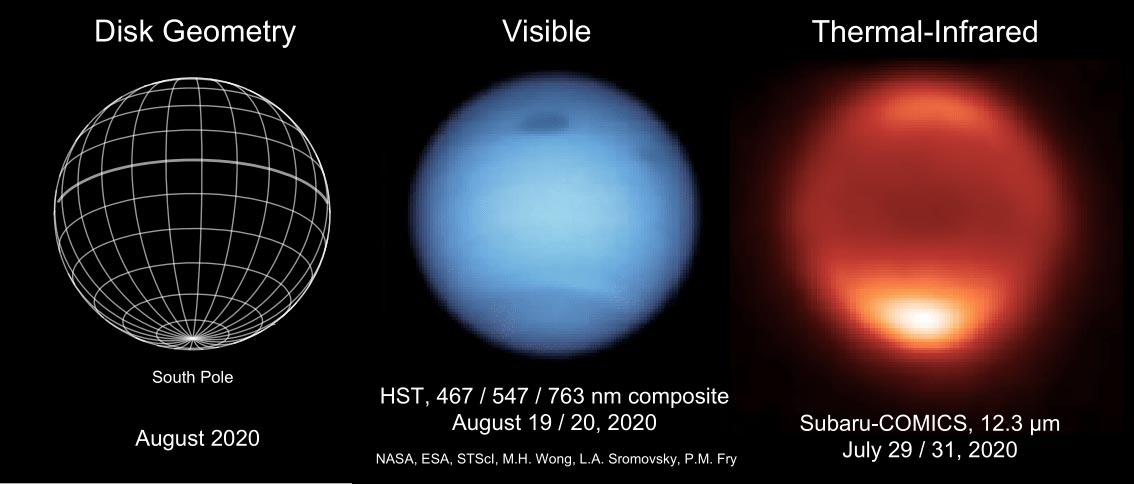
The study, published today (Monday, April 11, 2022) in Planetary Science Journal, used observations in thermal-infrared wavelengths beyond the visible light spectrum, effectively sensing heat emitted from the planet’s atmosphere.
An international team of researchers, including scientists from Leicester and NASA’s Jet Propulsion Laboratory (JPL), combined all existing thermal infrared images of Neptune gathered from multiple observatories over almost two decades. These include the European Southern Observatory’s Very Large Telescope and Gemini South telescope in Chile, together with the Subaru Telescope, Keck Telescope, and the Gemini North telescope, all in Hawai’i, and spectra from NASA’s Spitzer Space Telescope.
By analyzing the data, the researchers were able to reveal a more complete picture of trends in Neptune’s temperatures than ever before.
Unexpected Cooling in Neptune’s Stratosphere
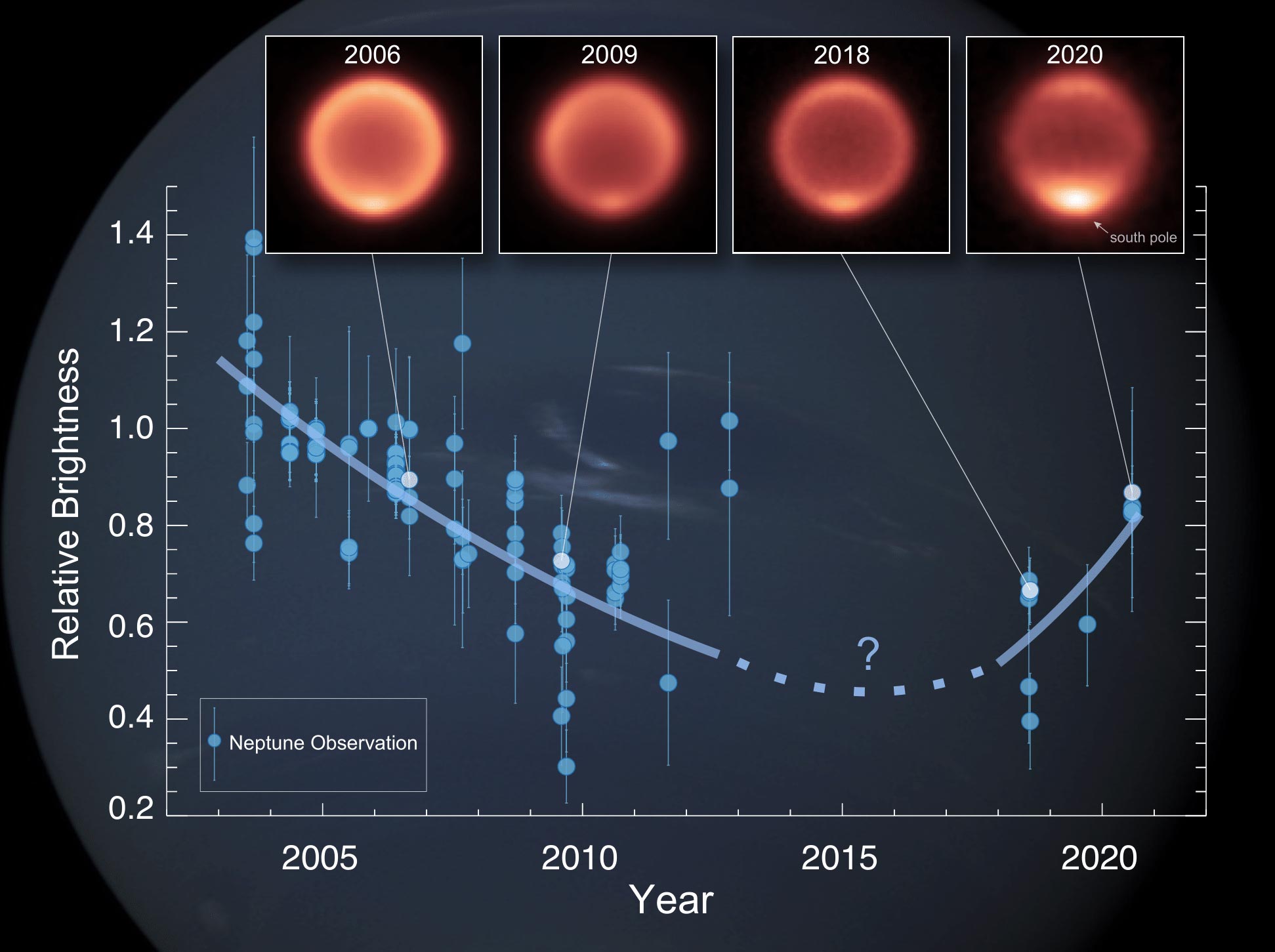
But to the researchers’ surprise, these collective datasets show a decline in Neptune’s thermal brightness since reliable thermal imaging began in 2003, indicating that globally-averaged temperatures in Neptune’s stratosphere – the layer of the atmosphere just above its active weather layer – have dropped by roughly 8 degrees Celsius (14 degrees Fahrenheit) between 2003 and 2018.
Dr. Michael Roman, a Postdoctoral Research Associate at the University of Leicester and lead author on the paper, said:
“This change was unexpected. Since we have been observing Neptune during its early southern summer, we would expect temperatures to be slowly growing warmer, not colder.”
Neptune has an axial tilt, and so it experiences seasons, just like Earth. However, given its great distance from the Sun, Neptune takes over 165 years to complete an orbit around its host star, and so its seasons change slowly, lasting over 40 Earth-years each.
Dr. Glenn Orton, Senior Research Scientist at JPL and co-author on the study, noted:
“Our data cover less than half of a Neptune season, so no one was expecting to see large and rapid changes.”
Polar Stratosphere Warming Reverses Trend
Yet, at Neptune’s south pole, the data reveal a different and surprisingly dramatic change. A combination of observations from Gemini North in 2019 and Subaru in 2020 reveal that Neptune’s polar stratosphere warmed by roughly 11°C (~20°F) between 2018 and 2020, reversing the previous globally-averaged cooling trend. Such polar warming has never been observed on Neptune before.
The cause of these unexpected stratospheric temperature changes is currently unknown, and the results challenge scientists’ understanding of Neptune’s atmospheric variability.
Dr. Roman continued:
“Temperature variations may be related to seasonal changes in Neptune’s atmospheric chemistry, which can alter how effectively the atmosphere cools.
“But random variability in weather patterns or even a response to the 11-year solar activity cycle may also have an effect.”
The 11-year solar cycle (marked by periodic variation in the Sun’s activity and sunspots) has been previously suggested to affect Neptune’s visible brightness, and the new study reveals a possible, but tentative, correlation between the solar activity, stratospheric temperatures, and the number of bright clouds seen on Neptune.
Follow-up observations of the temperature and cloud patterns are needed to further assess any possible connection in the years ahead.
Answers to these mysteries and more will come from the James Webb Space Telescope (JWST), which is set to observe both ice giants, Uranus and Neptune, later this year.
Leigh Fletcher, Professor of Planetary Science at the University of Leicester, will lead such observations with allocated time of JWST’s suite of instruments. Professor Fletcher, also a co-author on this study, said:
“The exquisite sensitivity of the space telescope’s mid-infrared instrument, MIRI, will provide unprecedented new maps of the chemistry and temperatures in Neptune’s atmosphere, helping to better identify the nature of these recent changes.”
Reference: “Sub-Seasonal Variation in Neptune’s Mid-Infrared Emission” by Michael T. Roman, Leigh N. Fletcher, Glenn S. Orton, Thomas K. Greathouse, Julianne I. Moses, Naomi Rowe-Gurney, Patrick G. J. Irwin, Arrate Antuñano, James Sinclair, Yasumasa Kasaba, Takuya Fujiyoshi, Imke de Pater and Heidi B. Hammel, 11 April 2022, Planetary Science Journal.
DOI: 10.3847/PSJ/ac5aa4
This study was funded by a European Research Council grant to the University of Leicester, known as GIANTCLIMES. This project has previously discovered long-term changes in atmospheric temperatures and clouds on the gas giants, Jupiter and Saturn, and it provided the first maps of the stratospheric temperatures of Uranus. GIANTCLIMES has paved the way for new discoveries on all four giant planets from JWST in the years to come.
Additional co-authors on this work include Thomas Greathouse (Southwest Research Institute), Julianne Moses (Space Science Institute), Naomi Rowe-Gurney (Howard University / NASA Goddard Space Flight Center), Patrick Irwin (Oxford), Arrate Antuñano (UPV/EHU), James Sinclair (JPL), Yasumasa Kasaba (Tohoku University), Takuya Fujiyoshi (Subaru Telescope), Imke de Pater (UC Berkeley), and Heidi Hammel (Association of Universities for Research in Astronomy).
Never miss a breakthrough: Join the SciTechDaily newsletter.
Follow us on Google and Google News.
5 Comments
Planetary warming alert
So let me get this straight… Pluto has had a large portion of its atmosphere disappear in the last few years… Mars is showing signs of long term polar ice melting. Jupiter is experiencing massive changes in its atmospheric storms. Neptune is showing signs of atmospheric warming… But climate change here on Earth is totally man made… LOL!
Damn humans ruining planets we haven’t even been to yet. Maybe the sun expanding has something to do with everything warming up? Its a known fact tha the sun will continue to expand until poof, its gone. Therefore, everything around the sun will continue to warm until, poof. Not to say we aren’t f*#@ing some s*#t up BUT there is alot we do not control or even understand yet.
Sounds like a endothermic process (physics, not biology) is taking place in the atmosphere. Chemical bonds break, which seems logical if the planet is entering a period of maximum solar exposure, and the heat exchange results in a portion of the gases in the atmosphere cooling.
This is getting tiresome. When are we going to talk about the reasons for this, which enough of us know that it is time to start talking about it. These planetary changes are due to the location of our solar system relative the galactic equator. When our system goes through this region, we experience a series of magnetic reconnection events, which cause the sun to adjust its charge, causing it to go into a period of hyperactivity. This event happens every 12,000 years.
This is what is coming. If you don’t believe me, then just go check the three closest stars to the solar system, you’ll find that each one of them has recently undergone large flaring events. The rulers of this planet have always known about this, it is part of the secret knowledge that keeps them where they are. Do you know all that missing 9/11 money? That went to go build a massive network of underground shelters. They probably won’t let us in there though cause they’re reserving the thing for only their people.