
Close Menu
    Facebook X (Twitter) Instagram
    SciTechDaily
    • Biology
    • Chemistry
    • Earth
    • Health
    • Physics
    • Science
    • Space
    • Technology
    Facebook X (Twitter) Pinterest YouTube RSS
    SciTechDaily
    Home»Space»Starling CubeSats Deployed: NASA’s Swarm Satellite Mission Launches on Electron Rocket
    Space

    Starling CubeSats Deployed: NASA’s Swarm Satellite Mission Launches on Electron Rocket

    By NASAJuly 18, 2023No Comments2 Mins Read
    Facebook Twitter Pinterest Telegram LinkedIn WhatsApp Email Reddit
    Share
    Facebook Twitter LinkedIn Pinterest Telegram Email Reddit
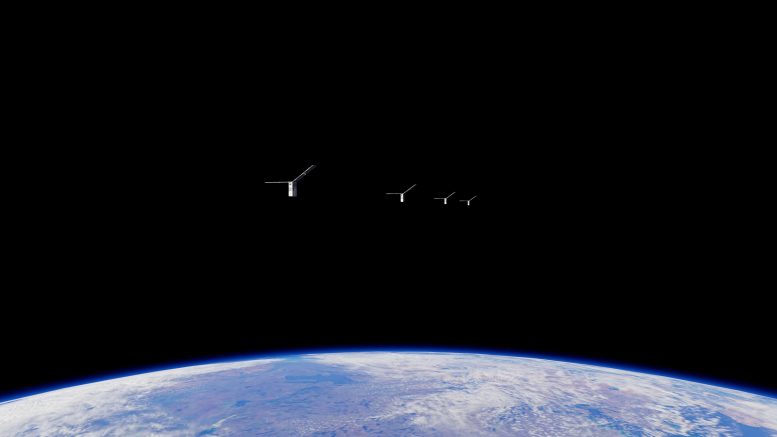
    NASA Starling CubeSats in Low Earth Orbit
    NASA’s Starling six-month mission will use a team of four CubeSats in low Earth orbit to test technologies that let spacecraft operate in a synchronized manner without resources from the ground. The technologies will advance capabilities in swarm maneuver planning and execution, communications networking, relative navigation, and autonomous coordination between spacecraft. Credit: NASA/Conceptual Image Lab/Ross Walter

    NASA’s Starling mission lifted off from the launch pad aboard Rocket Lab’s Electron rocket from Pad B and Launch Complex 1 in Mahia, New Zealand, at 1:27 p.m. local time.

    Subsequently, the four Starling CubeSats were confirmed to have deployed from the Rocket Lab’s Electron kick stage. The spacecraft, which are designed to work together as a “swarm,” have reached low Earth orbit to begin their mission to test technologies for autonomous positioning, networking, maneuvering, and decision-making.

    Now, the Starling swarm will power up and attempt initial contact with the ground; a process that may occur overnight or in the next several days.


    NASA is sending a team of four CubeSats into orbit around Earth to see if they’re able to cooperate on their own, without real-time updates from mission control. While that kind of autonomous cooperation may not sound too difficult for humans, this team will be robotic – composed of small satellites to test out key technologies for the future of deep space missions. Credit: NASA’s Ames Research Center

    NASA’s Starling mission is a project involving four CubeSats, specifically created to assess various technologies that are vital for facilitating future ‘swarm’ missions. The term ‘swarm’ in the context of space exploration is used to describe a group of spacecraft working together autonomously to fulfill specific objectives. The Starling mission aims to showcase various advancements in space technology, such as inter-spacecraft network communications, onboard relative navigation between spacecraft, and autonomous maneuver planning and execution. The mission will also experiment with distributed spacecraft autonomy, a concept that enables small spacecraft to react independently based on their observations. This represents a significant stride towards enhancing the efficiency of future scientific missions.

    Never miss a breakthrough: Join the SciTechDaily newsletter.
    Follow us on Google and Google News.

    NASA Rocket Lab
    Share. Facebook Twitter Pinterest LinkedIn Email Reddit

    Related Articles

    NASA’s CAPSTONE Spacecraft: Mission Team Determines Cause of Communications Issue

    NASA Restores Contact With CAPSTONE Spacecraft – Prepares for Trajectory Correction Maneuver

    CAPSTONE Leaves Earth Orbit, Headed to the Moon

    Rocket Lab Launches NASA’s CAPSTONE Mission to the Moon

    NASA CAPSTONE Launches Successfully – Will Test New Lunar Orbit for Artemis Moon Missions

    NASA’s CAPSTONE Launch to Moon Delayed – Spacecraft Will Be First To Fly Unique Lunar Orbit

    NASA’s CAPSTONE Spacecraft Ships to Launch Site

    What is NASA’s CAPSTONE Mission?

    Innovative Propulsion System Gets Ready to Study Moon Orbit for NASA’s Artemis Program

    Leave A Reply Cancel Reply

    • Facebook
    • Twitter
    • Pinterest
    • YouTube

    Don't Miss a Discovery

    Subscribe for the Latest in Science & Tech!

    Trending News

    Scientists May Have Discovered How To Heal Damaged Kidneys

    Interstellar Visitor 3I/ATLAS Is Bursting With an Unexpected Chemical

    Scientists Just Found All 5 Genetic “Letters” of DNA and RNA on an Asteroid

    The 4,000-Year-Old City That Defied History’s Rules on Wealth and Power

    The World’s Biggest Population Fear Has Flipped – and It Could Change Everything

    This “Fake” Pill Improved Memory and Physical Performance in Just 3 Weeks

    Scientists Say Frequent Ejaculation May Improve Sperm Quality and Fertility

    Scientists Have Found “The Heaven Sword” After Years of Looking

    Follow SciTechDaily
    • Facebook
    • Twitter
    • YouTube
    • Pinterest
    • Newsletter
    • RSS
    SciTech News
    • Biology News
    • Chemistry News
    • Earth News
    • Health News
    • Physics News
    • Science News
    • Space News
    • Technology News
    Recent Posts
    • Watch What Happened When a Lost Elephant Calf Returned to Her Family
    • 17,000 Brain Scans Reveal Surprising Ethnic Differences in Alzheimer’s Biology
    • New Autism Treatment Strategy Restores Key Brain Receptor Function
    • Younger Generations Are Aging Faster – and It May Be Fueling a Surge in Cancer
    • Scientists Turn Ordinary Sunlight Into UV Light in Major Energy Breakthrough
    Copyright © 1998 - 2026 SciTechDaily. All Rights Reserved.
    • Science News
    • About
    • Contact
    • Editorial Board
    • Privacy Policy
    • Terms of Use

    Type above and press Enter to search. Press Esc to cancel.