
Close Menu
    Facebook X (Twitter) Instagram
    SciTechDaily
    • Biology
    • Chemistry
    • Earth
    • Health
    • Physics
    • Science
    • Space
    • Technology
    Facebook X (Twitter) Pinterest YouTube RSS
    SciTechDaily
    Home»Space»Innovative Propulsion System Gets Ready to Study Moon Orbit for NASA’s Artemis Program
    Space

    Innovative Propulsion System Gets Ready to Study Moon Orbit for NASA’s Artemis Program

    By NASAMarch 25, 20211 Comment2 Mins Read
    Facebook Twitter Pinterest Telegram LinkedIn WhatsApp Email Reddit
    Share
    Facebook Twitter LinkedIn Pinterest Telegram Email Reddit
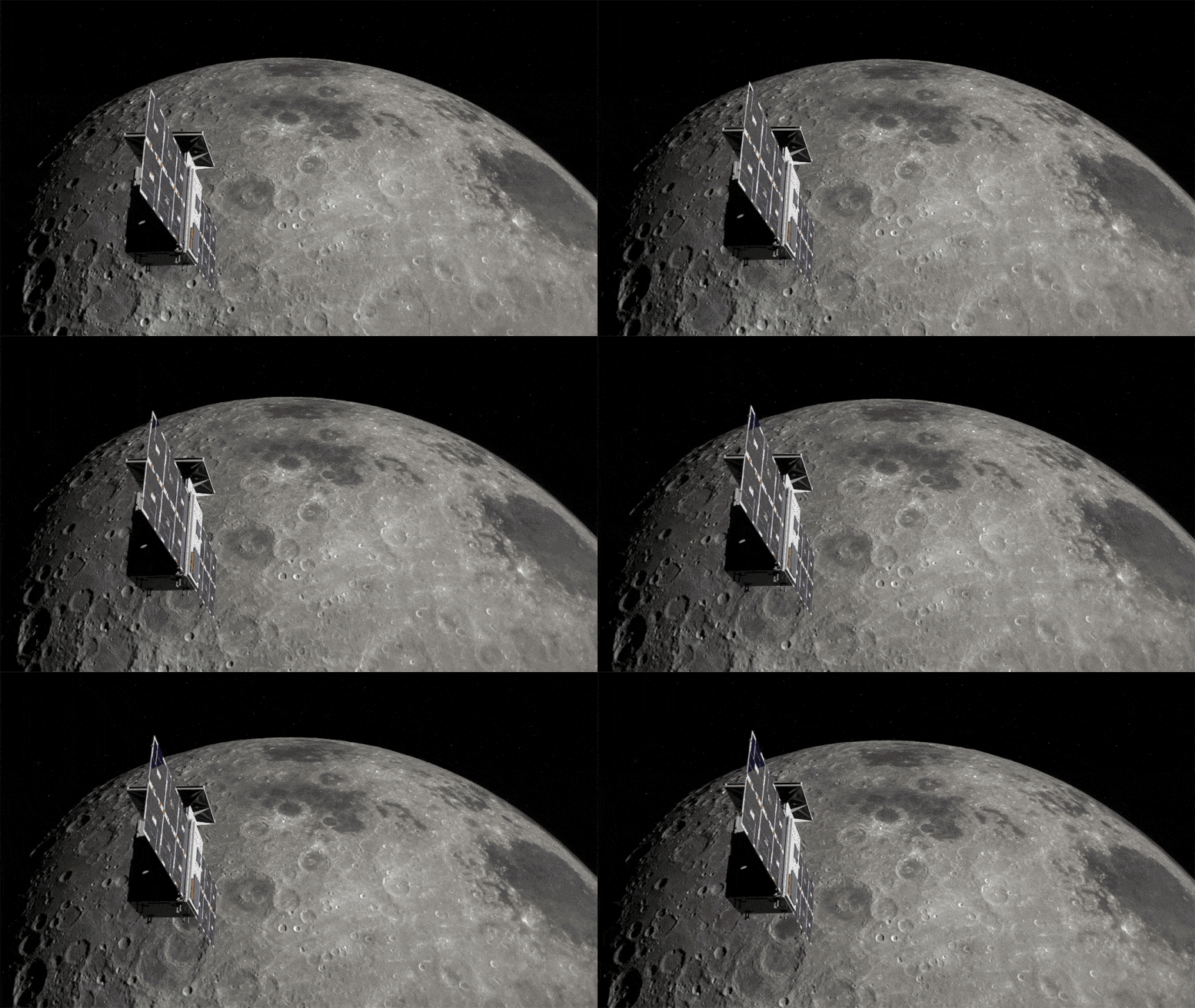
    CAPSTONE Mission
    The CAPSTONE mission is planned for launch in 2021. Rocket Lab’s Photon satellite bus will deliver CAPSTONE into a trajectory toward the Moon. Credit: NASA/Rocket Lab/Advanced Space/Tyvak Nano-Satellite Systems

    NASA’s CAPSTONE CubeSat is set to pave the way for the Artemis program by testing a never-before-used lunar orbit known as a near rectilinear halo orbit.

    In 2021, NASA’s Cislunar Autonomous Positioning System Technology Operations and Navigation Experiment, or CAPSTONE, CubeSat will launch into a never-before-used cislunar orbit near the Moon.

    As a pathfinder for Gateway, a Moon-orbiting outpost that is part of NASA’s Artemis program, CAPSTONE will help reduce the risk for future spacecraft by verifying the dynamics of a unique halo-shaped orbit. The mission will also demonstrate innovative spacecraft-to-spacecraft navigation technology and communications capabilities with Earth.

    CAPSTONE’s journey to the Moon will take about three months, starting with its launch to low-Earth orbit on a Rocket Lab Electron. Rocket Lab’s Photon spacecraft will take over next and conduct a series of orbit-raising maneuvers to prepare the CubeSat for its transfer path to the Moon. After separating from Photon, CAPSTONE will utilize an energy-efficient ballistic lunar transfer using its onboard propulsion system and enter into a near rectilinear halo orbit in the vicinity of and around the Moon. There, it will maintain the orbit to inform future spacecraft and demonstrate new technologies.
    CAPSTONE Propulsion System
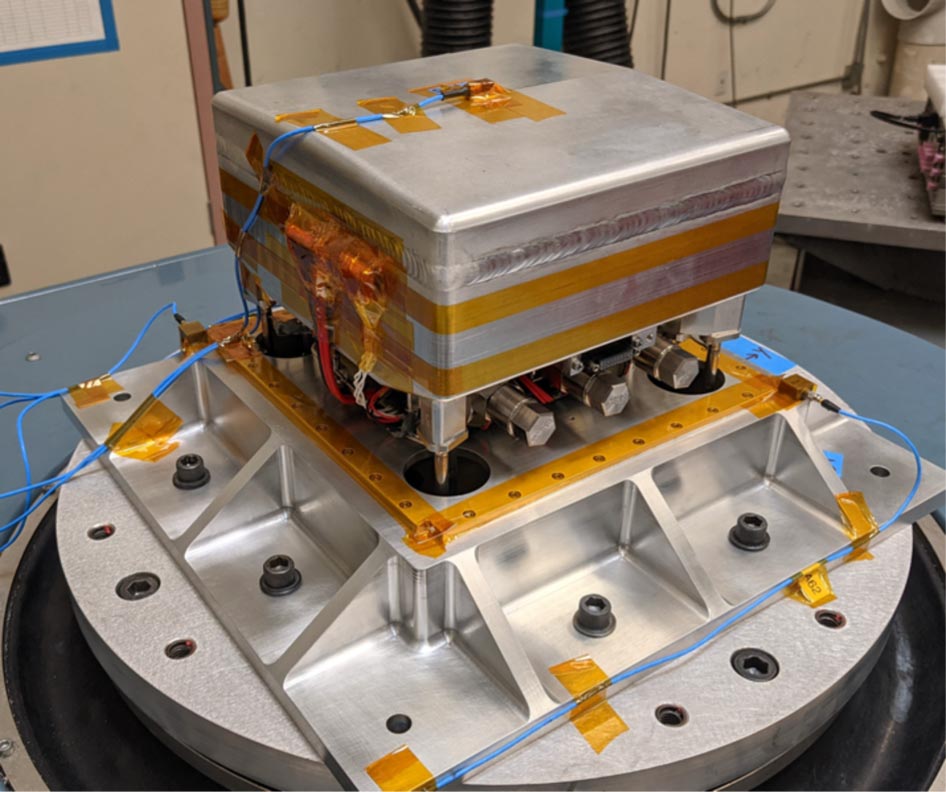
    CAPSTONE’s propulsion system undergoes environmental testing. Environmental testing ensures that spacecraft systems can operate after being launched into space and in the space environment. Credit: Stellar Exploration Inc.

    CAPSTONE’s propulsion system is designed and built by Stellar Exploration Inc. of San Luis Obispo, California. Initially funded by NASA’s Small Business Innovation Research program, the system is approximately 8-inch (20-centimeter) square by 4-inch (10-centimeter) deep. The system’s eight thrusters are fed hydrazine propellant from an unpressurized tank. CAPSTONE’s super small, high-performance thrusters integrate proven NASA technology with state-of-the-art industry fabrication techniques.

    CAPSTONE is led by Advanced Space of Westminster, Colorado. Tyvak Nano-Satellite Systems of Irvine, California, is building the microwave oven-sized CubeSat platform. NASA’s Small Spacecraft Technology program within the agency’s Space Technology Mission Directorate funds the demonstration mission. The program is based at NASA’s Ames Research Center in California’s Silicon Valley. The Launch Services Program at NASA’s Kennedy Space Center in Florida manages the launch service.

    Never miss a breakthrough: Join the SciTechDaily newsletter.
    Follow us on Google and Google News.

    Ames Research Center ARTEMIS Mission Moon NASA NASA CAPSTONE Rocket Lab
    Share. Facebook Twitter Pinterest LinkedIn Email Reddit

    Related Articles

    From Apollo to Artemis: Advancing Moon Landings With NASA Supercomputers

    NASA’s CAPSTONE Spacecraft Arrives to Orbit at the Moon

    Rocket Lab Launches NASA’s CAPSTONE Mission to the Moon

    NASA CAPSTONE Launches Successfully – Will Test New Lunar Orbit for Artemis Moon Missions

    NASA’s CAPSTONE Launch to Moon Delayed – Spacecraft Will Be First To Fly Unique Lunar Orbit

    NASA’s CAPSTONE Spacecraft Ships to Launch Site

    NASA’s VIPER Moon Rover To Land Near Nobile Crater at the Lunar South Pole

    Exploring the Moon: CAPSTONE’s CubeSat Prepares for Lunar Flight

    Astrobotic Selected by NASA to Fly VIPER Rover to the Moon [Video]

    1 Comment

    1. Ned Goldreyer on March 25, 2021 2:13 pm

      An article titled “Innovative Propulsion System… to Study Moon Orbit for Nasa’s Artemis Program” should at some point describe an innovative propulsion system.
      The phrase “cislunar orbit near the moon” is redundant. Cislunar means “near the moon.”

      Reply
    Leave A Reply Cancel Reply

    • Facebook
    • Twitter
    • Pinterest
    • YouTube

    Don't Miss a Discovery

    Subscribe for the Latest in Science & Tech!

    Trending News

    Scientists May Have Found the Key to Jupiter and Saturn’s Moon Mystery

    Scientists Uncover Brain Changes That Link Pain to Depression

    Saunas May Do More Than Raise Body Temperature – They Activate Your Immune System

    Exercise in a Pill? Metformin Shows Surprising Effects in Cancer Patients

    Hidden Oceans of Magma Could Be Protecting Alien Life

    New Study Challenges Alzheimer’s Theories: It’s Not Just About Plaques

    Artificial Sweeteners May Harm Future Generations, Study Suggests

    Splashdown! NASA Artemis II Returns From Record-Breaking Moon Mission

    Follow SciTechDaily
    • Facebook
    • Twitter
    • YouTube
    • Pinterest
    • Newsletter
    • RSS
    SciTech News
    • Biology News
    • Chemistry News
    • Earth News
    • Health News
    • Physics News
    • Science News
    • Space News
    • Technology News
    Recent Posts
    • Scientists Discover 430,000-Year-Old Wooden Tools, Rewriting Human History
    • Scientists Make Breakthrough on 40-Year-Old 2D Physics Puzzle
    • As Cities Invade the Amazon, Yellow Fever Makes a Dangerous Comeback
    • “Asian Flush” May Be a Hidden Trigger for Deadly Heart Damage
    • AI Could Detect Early Signs of Alzheimer’s in Under a Minute – Far Before Traditional Tests
    Copyright © 1998 - 2026 SciTechDaily. All Rights Reserved.
    • Science News
    • About
    • Contact
    • Editorial Board
    • Privacy Policy
    • Terms of Use

    Type above and press Enter to search. Press Esc to cancel.