
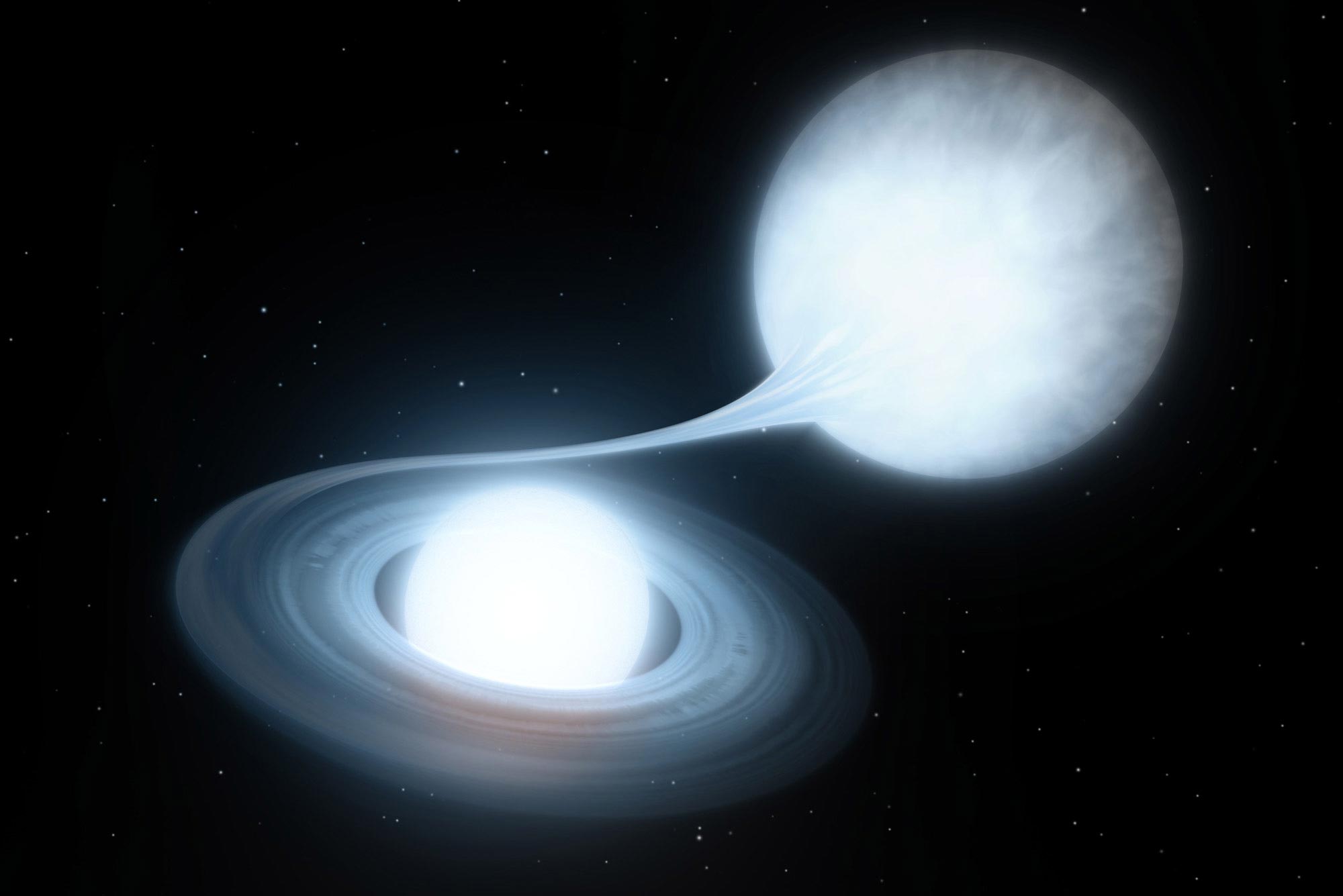
A rare star remnant, LP 40-365, speeds out of the galaxy after surviving a supernova. Its metal-rich composition and motion reveal clues about how mass transfer in binary star systems triggers supernovas.
About 2,000 light-years away from Earth, there is a star catapulting toward the edge of the Milky Way. This particular star, known as LP 40−365, is one of a unique breed of fast-moving stars—remnant pieces of massive white dwarf stars—that have survived in chunks after a gigantic stellar explosion.
“This star is moving so fast that it’s almost certainly leaving the galaxy…[it’s] moving almost two million miles (3.2 million kilometers) an hour,” says JJ Hermes, Boston University College of Arts & Sciences assistant professor of astronomy. But why is this flying object speeding out of the Milky Way? Because it’s a piece of shrapnel from a past explosion—a cosmic event known as a supernova—that’s still being propelled forward.
A Unique Survivor of Cosmic Destruction
“To have gone through partial detonation and still survive is very cool and unique, and it’s only in the last few years that we’ve started to think this kind of star could exist,” says Odelia Putterman, a former BU student who has worked in Hermes’ lab.
In a new paper published in The Astrophysical Journal Letters, Hermes and Putterman uncover new observations about this leftover “star shrapnel” that gives insight to other stars with similar catastrophic pasts.
“What we’re seeing are the by-products of violent nuclear reactions that happen when a star blows itself up.”
JJ Hermes
Putterman and Hermes analyzed data from NASA’s Hubble Space Telescope and Transiting Exoplanet Survey Satellite (TESS), which surveys the sky and collects light information on stars near and far. By looking at various kinds of light data from both telescopes, the researchers and their collaborators found that LP 40−365 is not only being hurled out of the galaxy, but based on the brightness patterns in the data, is also rotating on its way out.
“The star is basically being slingshotted from the explosion, and we’re [observing] its rotation on its way out,” says Putterman, who is the second author on the paper.
“We dug a little deeper to figure out why that star [was repeatedly] getting brighter and fainter, and the simplest explanation is that we’re seeing something at [its] surface rotate in and out of view every nine hours,” suggesting its rotation rate, Hermes says. All stars rotate—even our sun slowly rotates on its axis every 27 days. But for a star fragment that’s survived a supernova, nine hours is considered relatively slow.
Supernovas occur when a white dwarf gets too massive to support itself, eventually triggering a cosmic detonation of energy. Finding the rotation rate of a star like LP 40−365 after a supernova can lend clues into the original two-star system it came from. It’s common in the universe for stars to come in close pairs, including white dwarfs, which are highly dense stars that form toward the end of a star’s life. If one white dwarf gives too much mass to the other, the star being dumped on can self-destruct, resulting in a supernova. Supernovas are commonplace in the galaxy and can happen in many different ways, according to the researchers, but they are usually very hard to see. This makes it hard to know which star did the imploding and which star dumped too much mass onto its star partner.
Based on LP 40−365’s relatively slow rotation rate, Hermes and Putterman feel more confident that it is shrapnel from the star that self-destructed after being fed too much mass by its partner, when they were once orbiting each other at high speed. Because the stars were orbiting each other so quickly and closely, the explosion slingshotted both stars, and now we only see LP 40–365.
Learning From a Rare Cosmic Relic
“This [paper] adds one more layer of knowledge into what role these stars played when the supernova occurred,” and what can happen after the explosion, Putterman says. “By understanding what’s happening with this particular star, we can start to understand what’s happening with many other similar stars that came from a similar situation.”
“These are very weird stars,” Hermes says. Stars like LP 40–365 are not only some of the fastest stars known to astronomers, but also the most metal-rich stars ever detected. Stars like our sun are composed of helium and hydrogen, but a star that has survived a supernova is primarily composed of metal material, because “what we’re seeing are the by-products of violent nuclear reactions that happen when a star blows itself up,” Hermes says, making star shrapnel like this especially fascinating to study.
Reference: “8.9 hr Rotation in the Partly Burnt Runaway Stellar Remnant LP 40-365 (GD 492)” by J. J. Hermes, Odelia Putterman, Mark A. Hollands, David J. Wilson, Andrew Swan, Roberto Raddi, Ken J. Shen and Boris T. Gänsicke, 7 June 2021, The Astrophysical Journal Letters.
DOI: 10.3847/2041-8213/ac00a8
This research was supported by a NASA TESS Cycle 2 grant; the European Research Council; a UK Science and Technology Facilities Council grant; the postdoctoral fellowship program Beatriu de Pinós, funded by the Secretary of Universities and Research (Government of Catalonia); the Horizon 2020 program of research and innovation of the European Union under a Maria Skłodowska-Curie grant; NASA’s Astrophysics Theory Program; and by a Leverhulme Research Fellowship.
Never miss a breakthrough: Join the SciTechDaily newsletter.
Follow us on Google and Google News.
23 Comments
That may be fast compared to us, but it’s actually less than 1/3 of 1% of the speed of light!
That is one heck of a mass driver projectile.
How do you spot something moving many times the speed of light? You do need light to see it, no?
What are you talking about? Who said anything about something moving many times the speed of light?
Is Giperium available in other countries? Like Pakistan?
Speed of light is roughly 186000 miles per second… If you convert that to miles per hour that is around 669,600,000 mph.. so even at 2,000,000 mph this star is traveling a bit under 1/3 of 1 percent of the speed of light. To be exact 0.002986857 the speed of light. It’s moving fast… But nowhere close to light speed.
Cosmic pinball, minus the bounce.
If we’re just seeing it now, how long ago did you think the supernova happened?
What a view. if only there was a satellite within gravity 2millions miles an hour. 🚴♀️Eat my dust🚴♀️
He’s fleeing his galactic relationship
Thank you Paul, I was wondering that specifically.
That might seem fast… but it’s not as fast as your mom.
Still slower than my There Gen Camaro.
That’s not a star. There are passengers.
My mom’s faster than your mom. 🐢
“I perceive with my processing unit that they finally did it!” – Strange Planet guy
(They would obviously be too specific to articulate what was achieved in a panel) lol
I AM SCOTTIE ARMONIE
Leaving our milky way galaxy???? At that speed it will take about 150 million years to get half way across our galaxy.
Lol Michael try harder next time
That’s just one of many of Jehovah Gods creations the bible even talks about stars the bible is science also ..No I’m not one of Jehovah Witnesses either just wanted to clear that up wished I could say I was , wanted to comment on this post bc no one ever gives credit where credit is due..thanks y’all be safe ..
Nothing travels faster than the speed of light…oh really my thoughts say hold my beer
That’s not even close to speed of light
Thanks for doing the math for us, Ben. I was wondering why the writer didn’t see fit to do so in the story.