
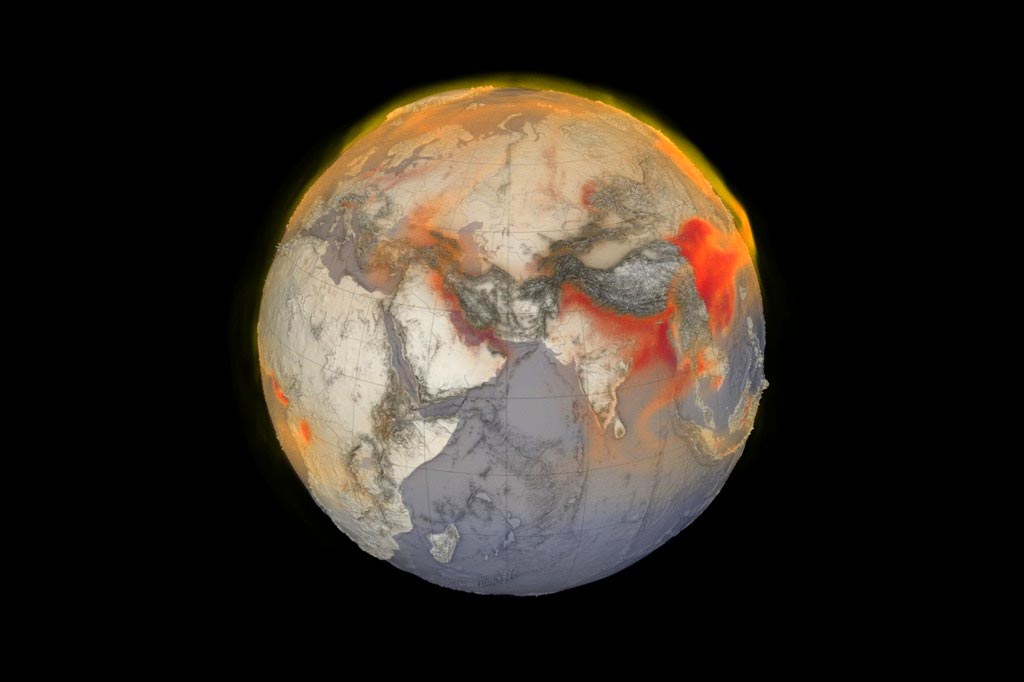
The pandemic has tugged carbon emissions down, temporarily. But levels of the powerful heat-trapping gas methane continue to climb, dragging the world further away from a path that skirts the worst effects of global warming.
Global emissions of methane have reached the highest levels on record. Increases are being driven primarily by the growth of emissions from coal mining, oil, and natural gas production, cattle and sheep ranching, and landfills.
Between 2000 and 2017, levels of the potent greenhouse gas barreled up toward pathways that climate models suggest will lead to 3-4 degrees Celsius of warming before the end of this century. This is a dangerous temperature threshold at which scientists warn that natural disasters, including wildfires, droughts, and floods, and social disruptions such as famines and mass migrations become almost commonplace. The findings are outlined in two papers published today (July 14, 2020) in Earth System Science Data and Environmental Research Letters by researchers with the Global Carbon Project, an initiative led by Stanford University scientist Rob Jackson.
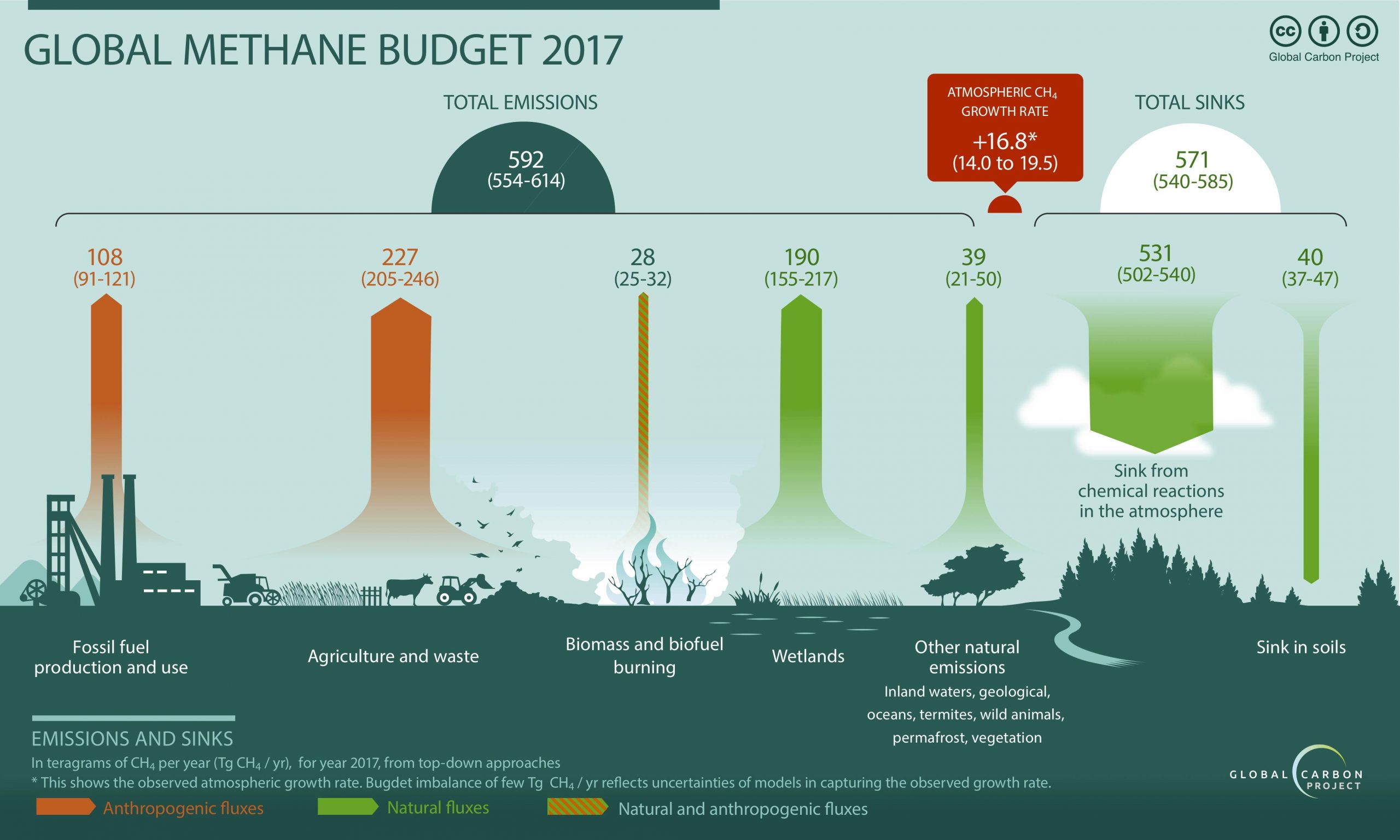
In 2017, the last year when complete global methane data are available, Earth’s atmosphere absorbed nearly 600 million tons of the colorless, odorless gas that is 28 times more powerful than carbon dioxide at trapping heat over a 100-year span. More than half of all methane emissions now come from human activities. Annual methane emissions are up 9 percent, or 50 million tons per year, from the early 2000s, when methane concentrations in the atmosphere were relatively stable.
In terms of warming potential, adding this much extra methane to the atmosphere since 2000 is akin to putting 350 million more cars on the world’s roads or doubling the total emissions of Germany or France. “We still haven’t turned the corner on methane,” said Jackson, a professor of Earth system science in Stanford’s School of Earth, Energy & Environmental Sciences (Stanford Earth).
Growing sources of methane
Globally, fossil fuel sources and cows are twin engines powering methane’s upward climb. “Emissions from cattle and other ruminants are almost as large as those from the fossil fuel industry for methane,” Jackson said. “People joke about burping cows without realizing how big the source really is.”
Throughout the study period, agriculture accounted for roughly two-thirds of all methane emissions related to human activities; fossil fuels contributed most of the remaining third. However, those two sources have contributed in roughly equal measure to the increases seen since the early 2000s.
Methane emissions from agriculture rose to 227 million tons of methane in 2017, up nearly 11 percent from the 2000-2006 average. Methane from fossil fuel production and use reached 108 million tons in 2017, up nearly 15 percent from the earlier period.
Amid the coronavirus pandemic, carbon emissions plummeted as manufacturing and transportation ground to a halt. “There’s no chance that methane emissions dropped as much as carbon dioxide emissions because of the virus,” Jackson said. “We’re still heating our homes and buildings, and agriculture keeps growing.”
Emissions around the globe
Methane emissions rose most sharply in Africa and the Middle East; China; and South Asia and Oceania, which includes Australia and many Pacific islands. Each of these three regions increased emissions by an estimated 10 to 15 million tons per year during the study period. The United States followed close behind, increasing methane emissions by 4.5 million tons, mostly due to more natural gas drilling, distribution, and consumption.
“Natural gas use is rising quickly here in the U.S. and globally,” Jackson said. “It’s offsetting coal in the electricity sector and reducing carbon dioxide emissions, but increasing methane emissions in that sector.” The U.S. and Canada are also producing more natural gas. “As a result, we’re emitting more methane from oil and gas wells and leaky pipelines,” said Jackson, who is also a senior fellow at Stanford’s Woods Institute for the Environment and Precourt Institute for Energy.
Europe stands out as the only region where methane emissions have decreased over the last two decades, in part by tamping down emissions from chemical manufacturing and growing food more efficiently. “Policies and better management have reduced emissions from landfills, manure, and other sources here in Europe. People are also eating less beef and more poultry and fish,” said Marielle Saunois of the Université de Versailles Saint-Quentin in France, lead author of the paper in Earth System Science Data.
Possible solutions
Tropical and temperate regions have seen the biggest jump in methane emissions. Boreal and polar systems have played a lesser role. Despite fears that melting in the Arctic may unlock a burst of methane from thawing permafrost, the researchers found no evidence for increasing methane emissions in the Arctic – at least through 2017.
Human-driven emissions are in many ways easier to pin down than those from natural sources. “We have a surprisingly difficult time identifying where methane is emitted in the tropics and elsewhere because of daily to seasonal changes in how waterlogged soils are,” said Jackson, who also leads a group at Stanford working to map wetlands and waterlogged soils worldwide using satellites, flux towers, and other tools.
According to Jackson and colleagues, curbing methane emissions will require reducing fossil fuel use and controlling fugitive emissions such as leaks from pipelines and wells, as well as changes to the way we feed cattle, grow rice, and eat. “We’ll need to eat less meat and reduce emissions associated with cattle and rice farming,” Jackson said, “and replace oil and natural gas in our cars and homes.”
Feed supplements such as algae may help to reduce methane burps from cows, and rice farming can transition away from permanent waterlogging that maximizes methane production in low-oxygen environments. Aircraft, drones, and satellites show promise for monitoring methane from oil and gas wells. Jackson said, “I’m optimistic that, in the next five years, we’ll make real progress in that area.”
References:
“The Global Methane Budget 2000–2017” by Marielle Saunois, et. al., 15 July 2020, Earth System Science Data.
DOI: 10.5194/essd-12-1561-2020
“Increasing anthropogenic methane emissions arise equally from agricultural and fossil fuel sources” by R B Jackson, M Saunois, P Bousquet, J G Canadell, B Poulter, A R Stavert, P Bergamaschi, Y Niwa, A Segers and A Tsuruta, 15 July 2020, Environmental Research Letters.
DOI: 10.1088/1748-9326/ab9ed2
Rob Jackson is Stanford’s Michelle and Kevin Douglas Provostial Professor. Co-authors of the paper in Environmental Research Letters are affiliated with Laboratoire des Sciences du Climat et de l’Environnement at Universite Paris-Saclay; the Commonwealth Scientific and Industrial Research Organization (CSIRO) in Canberra, Australia; the NASA Goddard Space Flight Center; the European Commission Joint Research Centre; the Center for Global Environmental Research at the National Institute for Environmental Studies and the Meteorological Research Institute in Ibaraki, Japan; the TNO Department of Climate Air & Sustainability in Utrecht, The Netherlands; and the Finnish Meteorological Institute in Helsinki, Finland.
The research received support from the Gordon and Betty Moore Foundation, Stanford University, the Australian Government’s National Environmental Science Programme’s Earth Systems and Climate Change Hub (JGC) and Future Earth.
Never miss a breakthrough: Join the SciTechDaily newsletter.
Follow us on Google and Google News.
4 Comments
Interestingly the video failed to show North America as a source? All is good in USA,Canada Mexico. Nothing to see here.
Boo Hoo. The world is coming to an end.
A comet flies by mother earth and says “You don’t look so good, I think you have a fever” Mother earth replies “Yes, I got humans”. Comet says “That’ll pass”. So I think the world will overcome humans at some point. Really sad for life.
I like this, but its not that Mother Earth wants to overcome mankind,, its mankind is ignorantly destroying her thru selfishness n greed. The Industrial Revoluton was the start of the fall of mankind and our extinction. All because the top 2% wanted to become ridiculously wealthy when they already had more than enough. Like I said, greed, selfishness, carelessness n overpopulation is simply gonna cause mankind to become extinct.. Studies show that by 2050 we would need 3 Mother Earth’s to sustain our population. Were running out of time… watch “The Lost Century” by Dr. Steven Greer..