
Close Menu
    Facebook X (Twitter) Instagram
    SciTechDaily
    • Biology
    • Chemistry
    • Earth
    • Health
    • Physics
    • Science
    • Space
    • Technology
    Facebook X (Twitter) Pinterest YouTube RSS
    SciTechDaily
    Home»Science»Exploring the Moon: CAPSTONE’s CubeSat Prepares for Lunar Flight
    Science

    Exploring the Moon: CAPSTONE’s CubeSat Prepares for Lunar Flight

    By NASA Ames Research CenterAugust 10, 2021No Comments4 Mins Read
    Facebook Twitter Pinterest Telegram LinkedIn WhatsApp Email Reddit
    Share
    Facebook Twitter LinkedIn Pinterest Telegram Email Reddit
    CAPSTONE Mission
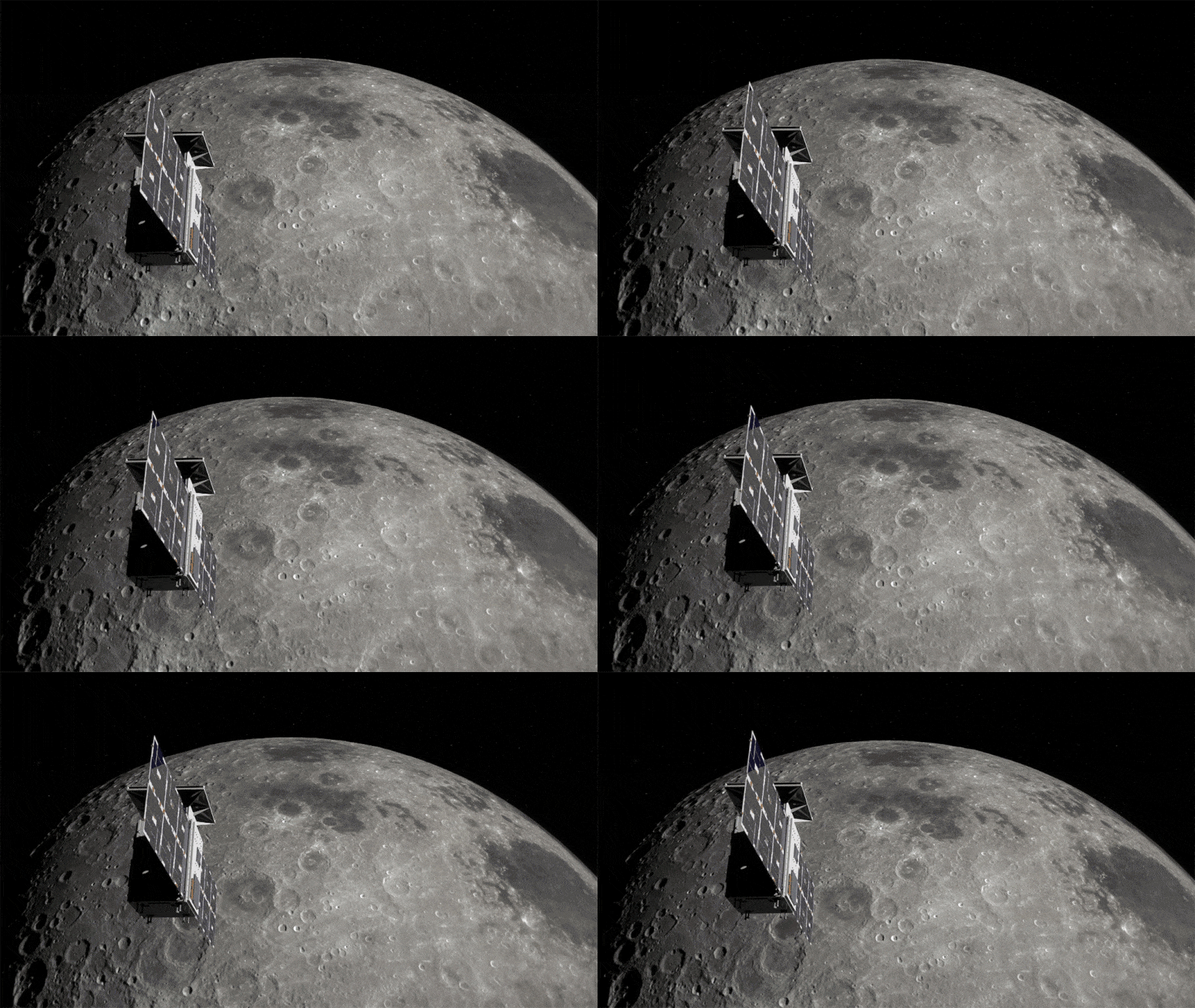
    The CAPSTONE mission is planned for launch in 2021. Rocket Lab’s Photon satellite bus will deliver CAPSTONE into a trajectory toward the Moon. Credit: NASA/Rocket Lab/Advanced Space/Tyvak Nano-Satellite Systems

    Small spacecraft will play a big role in lunar exploration, including a Moon-bound CubeSat launching later this year.

    The Cislunar Autonomous Positioning System Technology Operations and Navigation Experiment, or CAPSTONE, mission team is making the final preparations for the spacecraft that will make CubeSat history over a series of technological and operational firsts for the small platform.

    Planned for launch in 2021, CAPSTONE will fly in cislunar space – the orbital area near and around the Moon – and demonstrate an innovative spacecraft-to-spacecraft navigation technology. CAPSTONE also will test out a unique lunar orbit that Gateway will use as the Moon-orbiting outpost for NASA’s Artemis program.

    CAPSTONE Team
    The CAPSTONE team performs the full mission rehearsal of the propulsion hardware, with the qualification unit located in middle of the test stand. First, the propulsion tank is fueled with hydrazine propellant which requires the specialized protection for the operator (Level A encapsulated suits provide breathing and vapor protection for the Stellar engineers, Andrew Carlson and Sean Liston). Once the tank is filled with propellant, the full mission sequence is executed using the simulated satellite avionics and software. Credit: Stellar Exploration

    Hydrazine Propulsion for Deep Space Maneuvers

    CAPSTONE will use a hydrazine-fueled propulsion system during most of its three- to four- month journey to the Moon. This line of propulsion system, developed by Stellar Exploration Inc. of San Luis Obispo, California, is a recently developed and flight-proven system developed for use on CubeSats. The team recently completed a fueling and final test-fire of CAPSTONE’s propulsion system at Stellar Exploration’s facility and is integrating the system with the spacecraft.
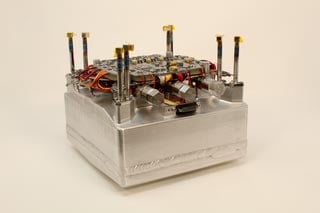
    CAPSTONE Propulsion Flight Hardware
    The CAPSTONE propulsion flight hardware, integrated with its dedicated controller. This assembly is designed for a tight fit within the 12-unit CubeSat envelope. Eight thrusters protrude through four open ports of the CubeSat in order to minimize plume interactions and heat transmission to the spacecraft during operations. Credit: Stellar Exploration

    But before CAPSTONE fires its own thrusters, Rocket Lab’s Electron rocket will launch the mission from Earth carrying the CAPSTONE spacecraft integrated onto its new Lunar Photon upper stage/spacecraft. For the mission, Lunar Photon will serve as an upper stage to get CAPSTONE to a highly efficient ballistic lunar transfer trajectory designed by Advanced Space of Colorado. About seven days after launch, after a series of orbit raising maneuvers and the final trans-lunar injection burn, Photon will release CAPSTONE. After the deep space, low energy transfer, the CAPSTONE spacecraft will insert itself into the near rectilinear halo orbit. At the same time, Lunar Photon will continue to a separate orbit for its safe disposal.

    The CAPSTONE spacecraft is fast approaching completion. Near-term plans include continued integration, testing, and international shipment of the spacecraft in late September. Rocket Lab has identified its Launch Complex 1 in New Zealand as the CAPSTONE launch site. Onsite launch preparations will include checkouts and fueling of the CAPSTONE spacecraft and its subsequent integration with Photon.
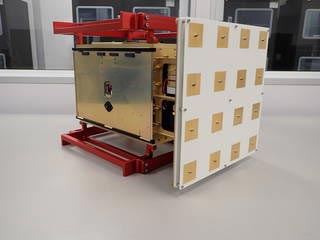
    CAPSTONE’s 12 Unit CubeSat
    CAPSTONE’s 12-Unit CubeSat nears completion. The spacecraft’s S-Band antenna is shown on the right side of the spacecraft. The 16 square-shaped elements on the surface of the flat plate are low-profile antennas, called patch antennas, that make up the S-Band antenna array. The antenna is integrated with the communications system structure. The red structures are handling fixtures that will be removed from the spacecraft prior to testing. Credit: Tyvak Nano-Satellite Systems, Inc.

    In May 2021, New Zealand signed the Artemis Accords with NASA – a set of principles that reinforce and implement the 1967 Outer Space Treaty. The agency aims to assemble the broadest and most diverse international space exploration coalition in history. To date, 12 nations have signed the accords, and conversations with other nations are ongoing.

    A Public-Private Collaboration

    CAPSTONE is commercially owned and operated by Advanced Space in Westminster, Colorado. It represents an innovative collaboration between NASA and industry to provide rapid results and feedback to inform future exploration and science missions. Tyvak Nano-Satellite Systems of Irvine, California, is building the microwave oven-sized 12-unit CubeSat platform.

    NASA’s Small Spacecraft Technology program within the agency’s Space Technology Mission Directorate funds the demonstration mission. The program is based at NASA’s Ames Research Center in California’s Silicon Valley. Advanced Exploration Systems (AES) within NASA’s Human Exploration and Operations Mission Directorate funds the launch and supports mission operations. The Launch Services Program at NASA’s Kennedy Space Center in Florida manages the launch service.

    Never miss a breakthrough: Join the SciTechDaily newsletter.
    Follow us on Google and Google News.

    Ames Research Center CubeSat Moon NASA NASA CAPSTONE Rocket Lab
    Share. Facebook Twitter Pinterest LinkedIn Email Reddit

    Related Articles

    NASA’s CAPSTONE Spacecraft Arrives to Orbit at the Moon

    Rocket Lab Launches NASA’s CAPSTONE Mission to the Moon

    NASA CAPSTONE Launches Successfully – Will Test New Lunar Orbit for Artemis Moon Missions

    NASA’s CAPSTONE Launch to Moon Delayed – Spacecraft Will Be First To Fly Unique Lunar Orbit

    NASA’s CAPSTONE Spacecraft Ships to Launch Site

    Innovative Propulsion System Gets Ready to Study Moon Orbit for NASA’s Artemis Program

    How Light Looks Different on the Moon and What NASA Is Doing About It

    Lunar Reconnaissance Orbiter Reveals Apollo 16 Booster Rocket Impact Site

    NASA to Provide a Live Feed of Supermoon Eclipse

    Leave A Reply Cancel Reply

    • Facebook
    • Twitter
    • Pinterest
    • YouTube

    Don't Miss a Discovery

    Subscribe for the Latest in Science & Tech!

    Trending News

    Millions Take These IBS Drugs, But a New Study Finds Serious Risks

    Scientists Unlock Hidden Secrets of 2,300-Year-Old Mummies Using Cutting-Edge CT Scanner

    Bread Might Be Making You Gain Weight Even Without Eating More Calories

    Scientists Discover Massive Magma Reservoir Beneath Tuscany

    Europe’s Most Active Volcano Just Got Stranger – Here’s Why Scientists Are Rethinking It

    Alzheimer’s Symptoms May Start Outside the Brain, Study Finds

    Millions Take This Popular Supplement – Scientists Discover a Concerning Link to Heart Failure

    The Universe Is Expanding Too Fast and Scientists Can’t Explain Why

    Follow SciTechDaily
    • Facebook
    • Twitter
    • YouTube
    • Pinterest
    • Newsletter
    • RSS
    SciTech News
    • Biology News
    • Chemistry News
    • Earth News
    • Health News
    • Physics News
    • Science News
    • Space News
    • Technology News
    Recent Posts
    • Doctors Surprised by the Power of a Simple Drug Against Colon Cancer
    • Why Popular Diabetes Drugs Like Ozempic Don’t Work for Everyone: The “Genetic Glitch”
    • Scientists Create Improved Insulin Cells That Reverse Diabetes in Mice
    • Scientists Stunned After Finding Plant Thought Extinct for 60 Years
    • A Common Diabetes Drug May Hold the Key to Stopping HIV From Coming Back
    Copyright © 1998 - 2026 SciTechDaily. All Rights Reserved.
    • Science News
    • About
    • Contact
    • Editorial Board
    • Privacy Policy
    • Terms of Use

    Type above and press Enter to search. Press Esc to cancel.