
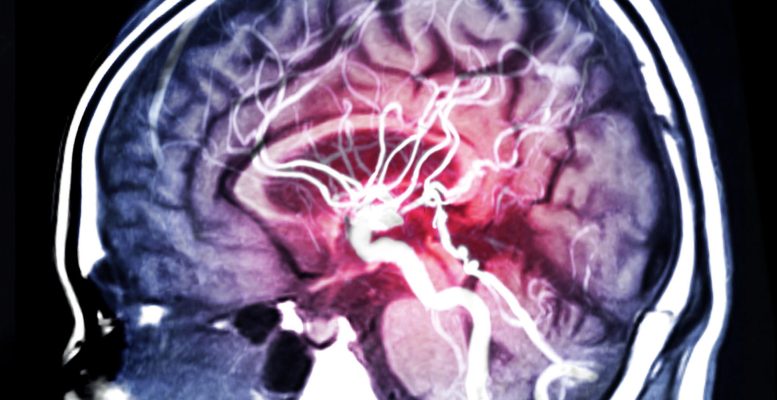
New research suggests that CAA-linked brain hemorrhages may spread via transfusions.
A major study published in JAMA led by experts from the Karolinska Institute indicates that spontaneous brain hemorrhage might be transferrable through blood transfusion. However, the likelihood of someone experiencing a brain hemorrhage after a blood donation is extremely low.
Cerebral amyloid angiopathy (CAA), a vascular condition where proteins build up in the brain’s minute blood vessels, is a known factor behind spontaneous and recurring brain hemorrhages. Numerous studies have illustrated that CAA can be passed from one person to another via neurosurgical procedures and possibly through treatments involving specific growth hormones.
Few Affected Individuals
A new study by researchers from Karolinska Institute, Södersjukhuset, Karolinska University Hospital in Sweden, the University of Copenhagen in Denmark, KU Leuven in Belgium, and other institutions shows that patients who have received blood from donors who later suffered recurring brain hemorrhages are more than twice as likely to suffer a brain hemorrhage themselves.
The findings suggest that some factors that can give rise to spontaneous brain hemorrhages can be spread through blood transfusion. However, as only 0.1 percent of the donors in the study subsequently suffered recurring brain hemorrhages there were consequently only a few affected patients.
“Blood transfusions are relatively common, which makes possible negative effects an important public health issue,” says the study’s last author Gustaf Edgren, researcher at the Department of Medicine, Karolinska Institute (Solna) and specialist physician at Södersjukhuset. “However, in this case, it’s very unlikely that you’d suffer a brain hemorrhage from something transmitted through a transfusion.”
CAA Could Be Transmissible
According to the researchers, the most important implication of the study is instead that it adds further support to the hypothesis that CAA can be transmitted between individuals, which, if true, can have consequences in several fields.
The study drew on the Swedish-Danish transfusion database SCANDAT, which contains data on blood donors and patients receiving a transfusion from the 1970s onwards. A total of more than a million patients were included. The primary analyses were conducted in Sweden and then repeated with the Danish data, with almost identical results.
Confirmation Needed
The researchers now hope to corroborate the hypothesis that the link between brain hemorrhage and blood transfusion concerns CAA. They will therefore be examining samples from the Danish Blood Donor Study biobank to see if they can identify aberrant proteins associated with the disease.
The plan is also to obtain CAT and MR scans from the affected donors and patients to see if they might also be able to support the hypothesis.
“This study does not demonstrate causality, so the observed increase in risk could depend on other factors,” says the study’s first author Jingcheng Zhao from Dr. Edgren’s group at Karolinska Institute. “More research is needed to confirm our findings and understand the potential underlying mechanism.”
Reference: “Intracerebral Hemorrhage Among Blood Donors and Their Transfusion Recipients” by Jingcheng Zhao, Klaus Rostgaard, Elsa Lauwers, Torsten Dahlén, Sisse Rye Ostrowski, Christian Erikstrup, Ole Birger Pedersen, Bart de Strooper, Robin Lemmens, Henrik Hjalgrim, and Gustaf Edgren, 12 September 2023, JAMA.
DOI: 10.1001/jama.2023.14445
The study was mainly financed by the Swedish Research Council and Region Stockholm (ALF funding).
Never miss a breakthrough: Join the SciTechDaily newsletter.
Follow us on Google and Google News.