
Sustainable chemistry requires a shift toward efficiency, safety, and circularity to reduce pollution and environmental harm.
In a comment in Nature Reviews Chemistry, Ph.D. student Hannah Flerlage and associate professor Chris Slootweg of the University of Amsterdam’s Van ‘t Hoff Institute for Molecular Sciences argue that modern-day chemists need to broaden their horizons and consider the effects of chemistry “beyond the reaction vessel and the fume hood.” In order to combat ever-worsening environmental crises, and to achieve real sustainability, chemistry needs to develop a combined focus on efficiency, safety, and circularity.
Modern chemistry is quite literally rubbish, Flerlage and Slootweg write, as it facilitates the path of matter from extraction to pollution. All sorts of waste, both stemming from chemical manufacturing processes and from their often short-lived end products, have resulted in human health problems and environmental disasters at varying scales.
Admittedly, over the past decades more and more sustainable synthetic methods have become available, minimizing or even eliminating the use of hazardous substances and waste. But, Flerlage and Slootweg rhetorically ask, is chemistry there yet? Their answer: “Not at all!”
In their view, chemists have to start looking beyond “cool molecules,” and “awesome chemistry.” Sure, it can be fun and rewarding to create aesthetically pleasing molecules. But this ignores the role of chemistry in the modern world.
As an example, they refer to perfluorocubane, a molecule that in 2022 was designated ‘Molecule of the Year’. Its synthesis might be a stellar achievement, and there will probably be potential future applications. But its structure, containing multiple carbon-fluorine bonds, suggests that perfluorocubane will persist in the environment and bioaccumulate.
Flerlage and Slootweg argue that modern chemistry needs to take such environmental concerns to heart, and right from the start. They even go so far as to consider it unethical to develop chemistry that will lead to chemical pollution. They call for an end to poorly designed compounds, in particular “forever chemicals” such as per- and polyfluorinated alkyl substances and brominated flame retardants.
Systems Thinking
As chemistry is the science of the transformation of matter, not just of the creation of novel molecules, Flerlage and Slootweg point out the responsibility to develop safe chemistry and chemicals that use the world’s resources most effectively and improve sustainability.
This requires an approach of systems thinking that is grounded in the recognition of sustainability as an emergent property, and guided by an understanding of the molecular basis of sustainability. This means that chemistry should not only focus on using renewable resources and reducing production waste. It also has to consider the life-cycle environmental footprints and overall environmental implications of (novel) chemicals.
As an example, Flerlage and Slootweg mention drop-in bio-based polymers such as bioPE, which are made from bioethanol. These polymers reduce the use of fossil resources but don’t improve recyclability or biodegradability. And thus they continue to contribute to plastic pollution.
More Challenging, More Rewarding
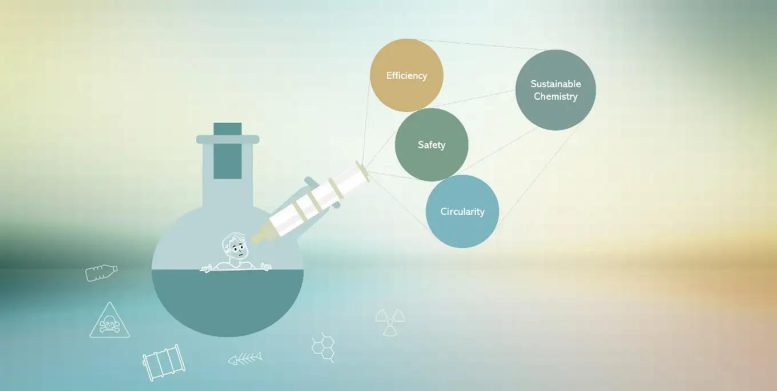
In their paper, Flerlage and Slootweg advocate a triple focus on efficiency, safety, and circularity, both regarding chemical processes (synthesis) and products (chemical structure). These three core values of modern chemistry are described by the paradigms of green chemistry, safe and sustainable-by-design, and circular chemistry. These must all be complied with simultaneously if chemistry is to make a real contribution to sustainability.
All this will render chemistry more challenging, but also more rewarding, Flerlage and Slootweg write. “We need to broaden our horizons and consider our chemistry beyond the reaction vessel and the fume hood: how do the molecules and materials we make interact with the technosphere (industrial systems and society) and the biosphere (nature)?” To them, chemistry will only have a real and positive impact on sustainability when it fully embraces circular design, life-cycle thinking, human and environmental toxicology, and environmental and social impact assessment.
Reference: “Modern chemistry is rubbish” by Hannah Flerlage and J. Chris Slootweg, 31 July 2023, Nature Reviews Chemistry.
DOI: 10.1038/s41570-023-00523-9
Never miss a breakthrough: Join the SciTechDaily newsletter.
Follow us on Google and Google News.
4 Comments
Idiot Savants would be the historical term. I would simply say LOW IQ.
Modern chemistry is not rubbish. It is what you do with it that counts. I say, “better living through chemistry” is what we should be saying.
This is what happens when you have a lot of time on your hands because you have no work. While Asians and most Americans are getting things done, Europeans are busy finding out ways how not to do any work at all.
This is what happens when you have a lot of time on your hands because you have no work to do. While Asians and most Americans are busy getting things done, Europeans are finding out ways how not to do any work.