
A new study sheds light on which animal groups evolved from life on land to living in the water again.
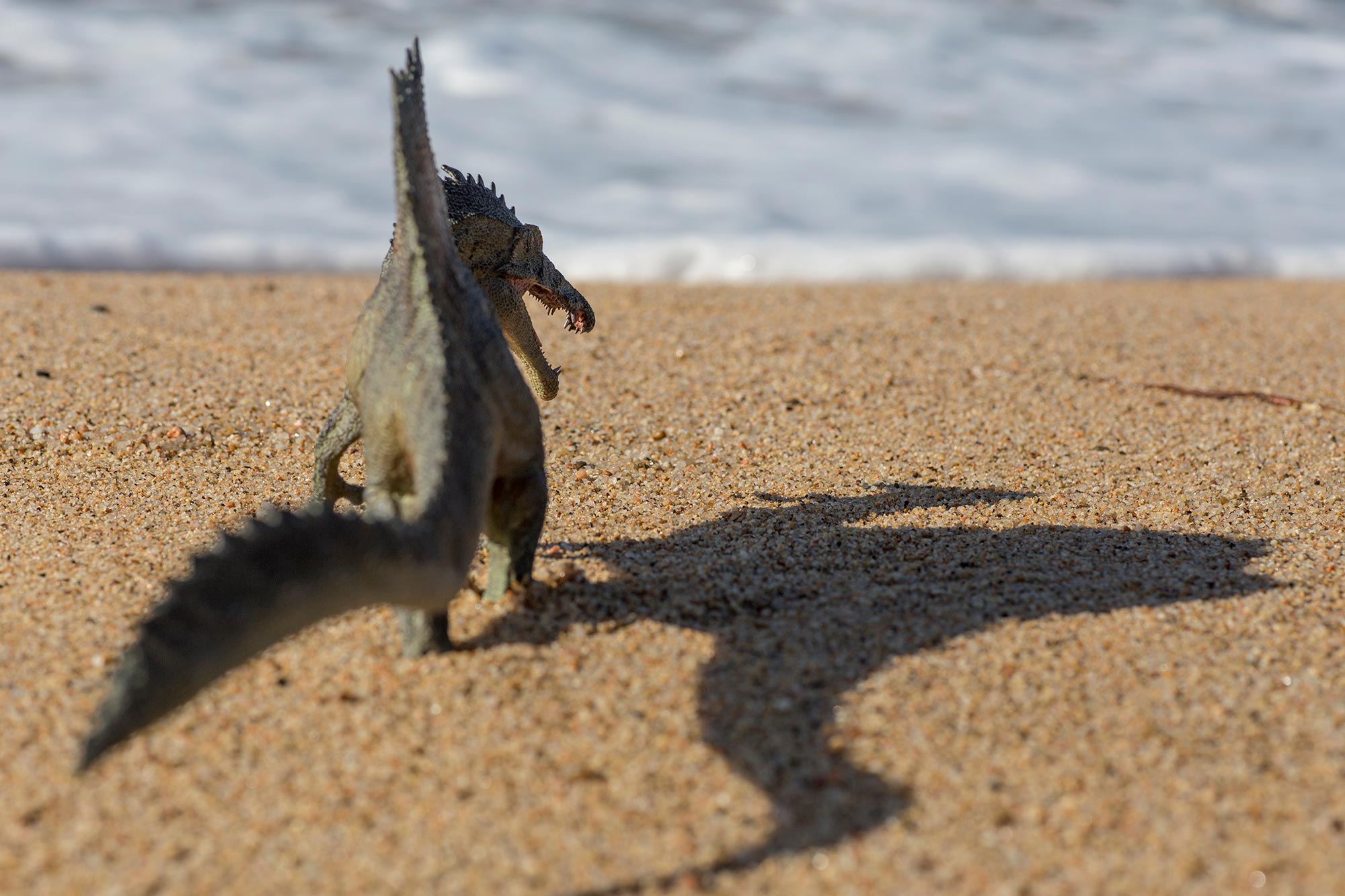
Spinosaurus, one of the most debated dinosaurs in paleontology, may have spent the vast majority of its time submerged rather than simply hunting along the water’s edge, according to an analysis of how extinct vertebrates adapted to life in water.
The finding comes from a broader effort to reconstruct one of evolution’s repeated reversals. After vertebrates moved from water onto land, dozens of major mammal and reptile groups later returned to aquatic environments. Some remained tied to land, while others became highly specialized swimmers.
Researchers developed a method for distinguishing between those lifestyles by comparing the anatomy of extinct species with that of modern animals whose behavior is known. Their analysis, published in Current Biology, drew on more than 11,000 new measurements, photographs, CT scans, traditional paleontological methods, machine-learning models, and a statistical technique developed during World War II.
The approach allowed the researchers to revisit species whose lifestyles have been particularly difficult to determine from fossils.
Spinosaurus emerges as highly aquatic
Spinosaurus, which lived roughly 113 to 94 million years ago in what is now northern Africa, is one of the most prominent examples. Some evidence suggests that the dinosaur frequently dived and hunted prey underwater, similar to a seal or penguin. Other evidence supports a more shorebound lifestyle in which it walked and foraged near the water’s edge, more like a modern heron.
“Our results shed new light on how much time Spinosaurus spent submerged, which could support the underwater hunting view,” said lead author Caleb Gordon, who earned his doctorate at Yale earlier this year and is now a postdoctoral researcher at the Florida Museum of Natural History. “We confidently recovered highly aquatic habits for Spinosaurus, indicating that it spent the vast majority of its time submerged in the water.”
The same approach produced a very different picture of mesosaurs, small marine reptiles that lived between 290 and 274 million years ago in what is now South Africa and eastern South America. Because mesosaurs gave birth to live young, some scientists have interpreted that as evidence of a fully aquatic lifestyle. Their limb proportions instead pointed to a semi-terrestrial lifestyle.
“They spent a lot of time on land, like a modern-day alligator or platypus does,” Gordon said. “Mesosaurs didn’t completely leave the land behind.”
Fossils can point to conflicting lifestyles
The contrast highlights a broader problem in paleontology. Fossils are often fragmentary, and different anatomical features can point toward different lifestyles. The evolutionary relationships among fossil specimens can also be uncertain.
“In these cases, paleontologists are often stuck, as different lines of evidence disagree about what the ancient animal was like,” Gordon said.
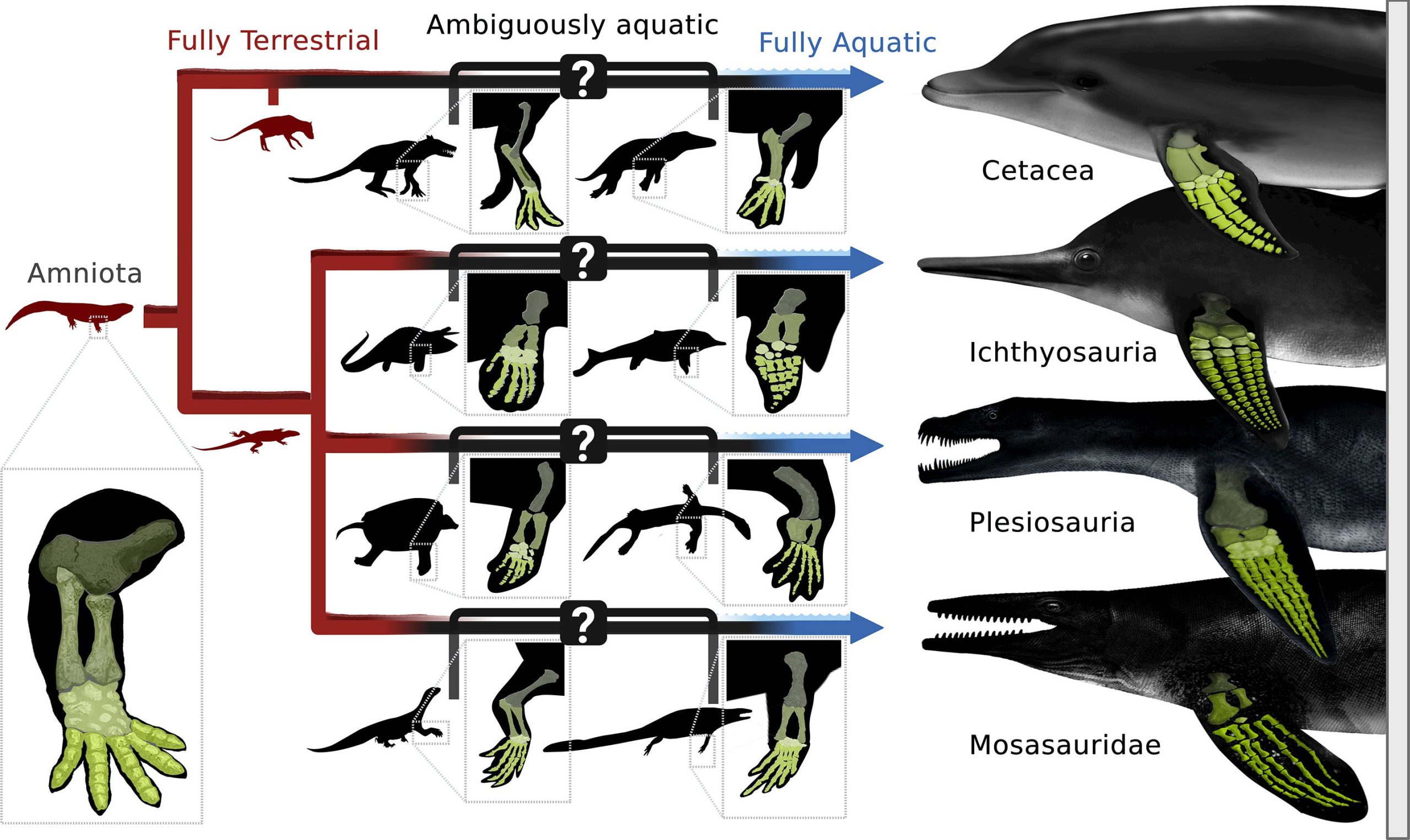
To address that problem, Gordon developed machine-learning models trained on modern species, whose anatomy and lifestyles are much better understood. The researchers then applied relationships identified in living animals to extinct species, allowing them to predict aquatic habits and soft-tissue adaptations that are rarely preserved in fossils.
Forelimb proportions proved especially informative. Based on those measurements, the team could predict with more than 90% accuracy whether an animal had soft-tissue flippers and whether it had highly or fully aquatic habits.
Paleozoic reptiles never fully left land
The analysis also revealed a broader pattern among marine reptiles from the Paleozoic Era, before dinosaurs appeared. The researchers concluded that all Paleozoic marine reptiles regularly returned to land and lived, at most, an amphibious lifestyle rather than becoming completely aquatic.
Reconstructing behavior from fossils requires scientists to combine evidence from extinct animals with the much more detailed knowledge available from living species.
“Reconstructing the lives of extinct life forms in a scientifically rigorous way, as opposed to just telling stories, is a precise and delicate undertaking,” said Bhart-Anjan Bhullar, senior author of the study and an associate professor of Earth and planetary sciences at Yale.
“It requires a careful interweaving of data from modern organisms, of which our understanding is necessarily far deeper, and knowledge of these living organisms’ genealogy relative to fossil forms,” he said. “Caleb’s work accomplishes all of this and more, and on a massive evolutionary scale.”
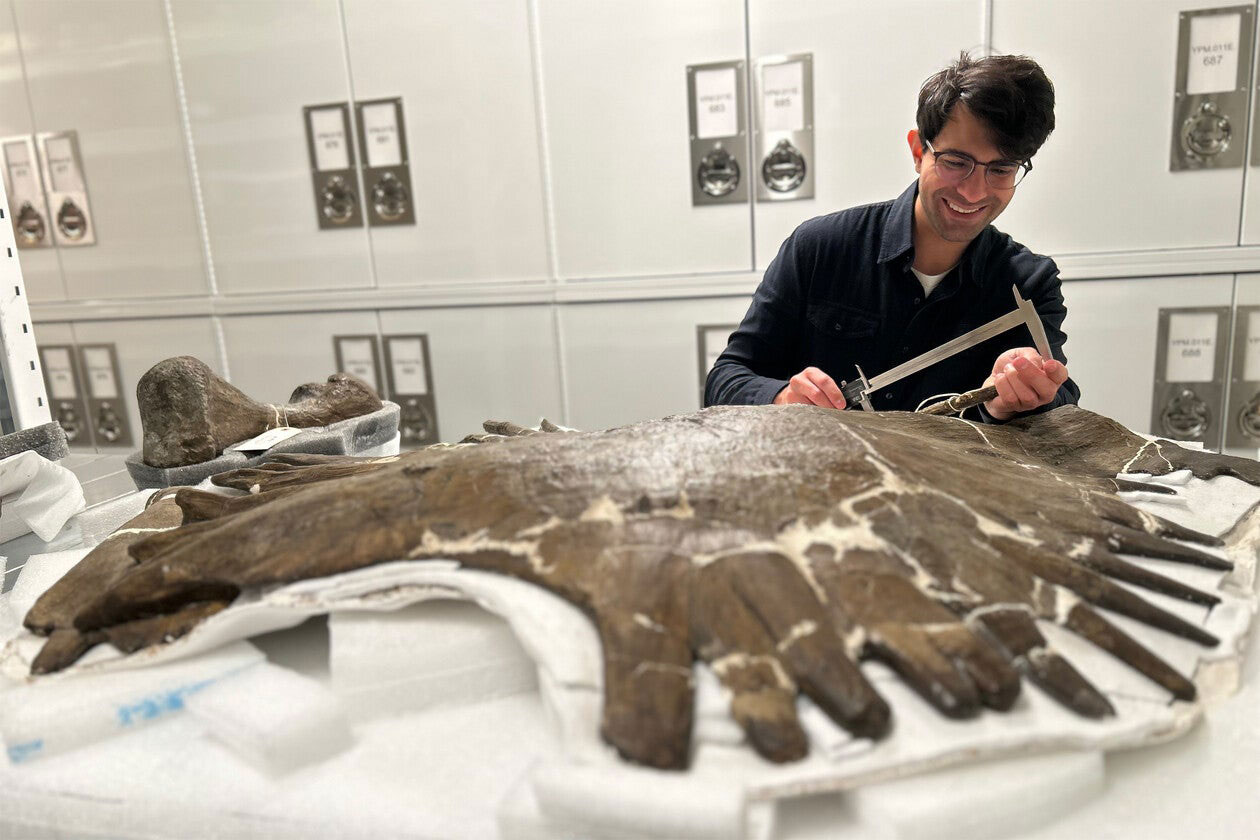
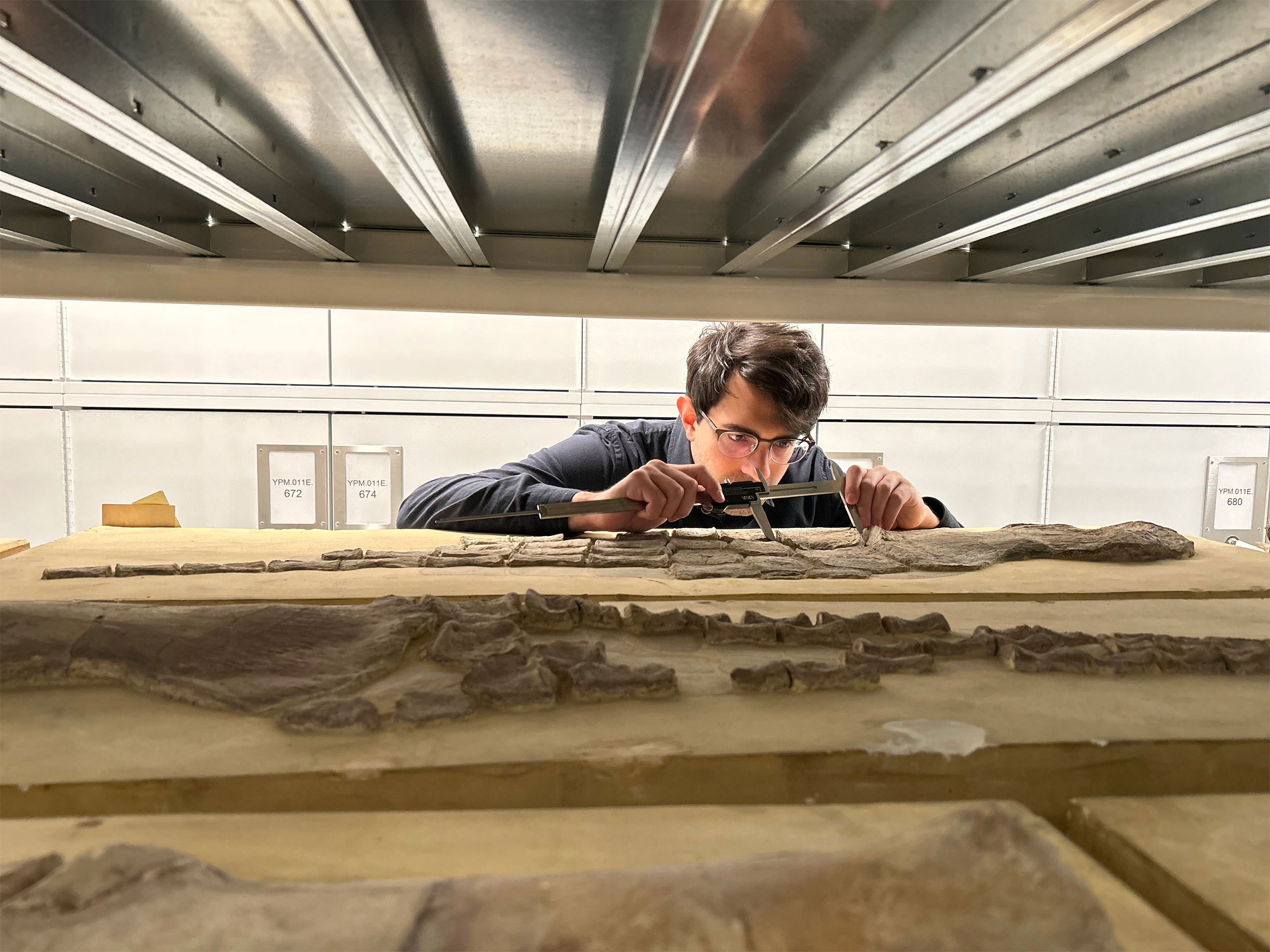
The team analyzed hundreds of specimens from the Yale Peabody Museum and dozens of other institutions around the world. Researchers collected measurements, photographs, and CT scans, and combined those data with traditional paleontological methods and information about the evolutionary relationships among species.
They also revived a statistical technique developed in the 1940s for a very different purpose.
“Caleb resurrected a statistical technique from a bygone era,” said co-author Jacques Gauthier, a professor of Earth and planetary sciences at Yale and curator-in-charge for vertebrate paleontology at the Peabody Museum. “It was developed during WWII to estimate the probability that an approaching blip on the radar screen was an enemy plane. Caleb cleverly used it to get at whether or not an extinct animal had limbs modified for swimming.”
Returning to water produced similar adaptations
These repeated returns to aquatic environments also illustrate convergent evolution, in which separate evolutionary lineages independently develop similar traits in response to similar environmental pressures.
“These secondarily aquatic groups adapted in strikingly similar ways to their new aquatic home — evolving flippers and a suite of other features that made them better swimmers,” Gordon said. “As a result, they’ve become textbook examples of convergent evolution, which can tell us a lot about the processes driving and constraining adaptive change in response to similar environmental cues.”
The researchers say the method could also be applied to other major evolutionary transitions, including the development of two-legged walking in human ancestors and flight in the dinosaur ancestors of birds.
“Bones are all that is left to us of the vast majority of vertebrate animals that have lived on Earth,” Bhullar said. “We want to know so very much about these creatures and the succession of lost worlds they inhabited, but we have so little on which to base our conclusions. From skeletal remains, people have tried to discern life habits, generally making an argument on the basis of one preferred set of features or another. Caleb’s method removes the subjectivity from this process and allows the data to speak for themselves.”
Reference: “Limb proportions predict aquatic habits and soft-tissue flippers in extinct amniotes” by Caleb M. Gordon, Lisa S. Freisem, Christopher T. Griffin, Jacques A. Gauthier and Bhart-Anjan S. Bhullar, 20 November 2025, Current Biology.
DOI: 10.1016/j.cub.2025.10.068
Funding for the study came from the Yale Institute for Biospheric Studies, the International Union for Conservation of Nature’s Crocodile Specialist Group, and the National Science Foundation.
Never miss a breakthrough: Join the SciTechDaily newsletter.
Follow us on Google and Google News.