
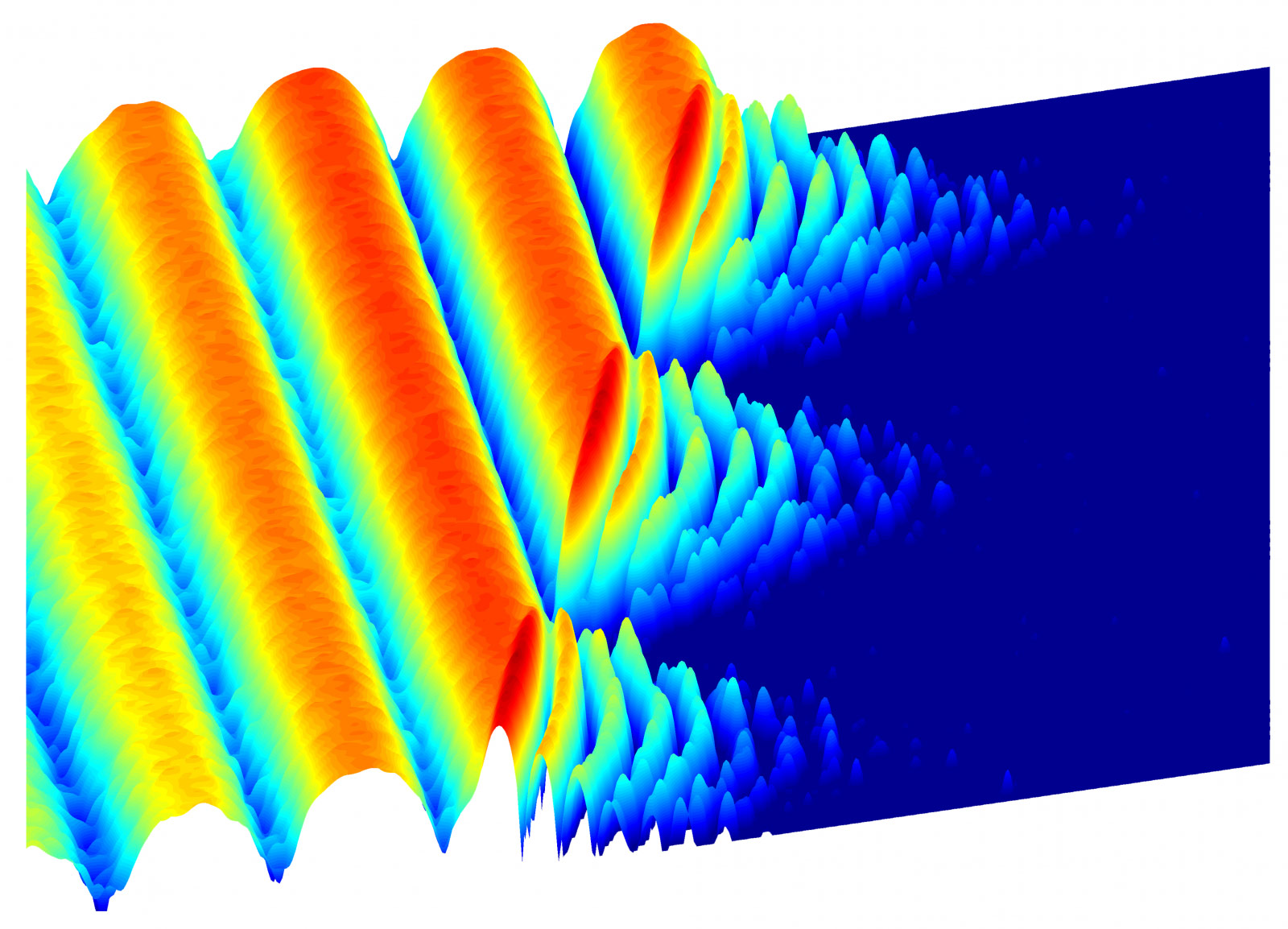
By crystallizing light, Princeton University researchers have begun to address questions about the fundamental study of matter.
The researchers are not shining light through crystal – they are transforming light into crystal. As part of an effort to develop exotic materials such as room-temperature superconductors, the researchers have locked together photons, the basic element of light, so that they become fixed in place.
“It’s something that we have never seen before,” said Andrew Houck, an associate professor of electrical engineering and one of the researchers. “This is a new behavior for light.”
The results raise intriguing possibilities for a variety of future materials. However, the researchers also intend to use the method to address questions about the fundamental study of matter, a field called condensed matter physics.
“We are interested in exploring – and ultimately controlling and directing – the flow of energy at the atomic level,” said Hakan Türeci, an assistant professor of electrical engineering and a member of the research team. “The goal is to better understand current materials and processes and to evaluate materials that we cannot yet create.”
The team’s findings, reported online on September 8 in the journal Physical Review X, are part of an effort to answer fundamental questions about atomic behavior by creating a device that can simulate the behavior of subatomic particles. Such a tool could be an invaluable method for answering questions about atoms and molecules that are not answerable even with today’s most advanced computers.
In part, that is because current computers operate under the rules of classical mechanics, which is a system that describes the everyday world containing things like bowling balls and planets. But the world of atoms and photons obeys the rules of quantum mechanics, which include a number of strange and very counterintuitive features. One of these odd properties is called “entanglement” in which multiple particles become linked and can affect each other over long distances.
The difference between the quantum and classical rules limits a standard computer’s ability to efficiently study quantum systems. Because the computer operates under classical rules, it simply cannot grapple with many of the features of the quantum world. Scientists have long believed that a computer based on the rules of quantum mechanics could allow them to crack problems that are currently unsolvable. Such a computer could answer the questions about materials that the Princeton team is pursuing, but building a general-purpose quantum computer has proven to be incredibly difficult and requires further research.
Another approach, which the Princeton team is taking, is to build a system that directly simulates the desired quantum behavior. Although each machine is limited to a single task, it would allow researchers to answer important questions without having to solve some of the more difficult problems involved in creating a general-purpose quantum computer. In a way, it is like answering questions about airplane design by studying a model airplane in a wind tunnel – solving problems with a physical simulation rather than a digital computer.
In addition to answering questions about currently existing material, the device also could allow physicists to explore fundamental questions about the behavior of matter by mimicking materials that only exist in physicists’ imaginations.
To build their machine, the researchers created a structure made of superconducting materials that contain 100 billion atoms engineered to act as a single “artificial atom.” They placed the artificial atom close to a superconducting wire containing photons.
By the rules of quantum mechanics, the photons on the wire inherit some of the properties of the artificial atom – in a sense linking them. Normally photons do not interact with each other, but in this system the researchers are able to create new behavior in which the photons begin to interact in some ways like particles.
“We have used this blending together of the photons and the atom to artificially devise strong interactions among the photons,” said Darius Sadri, a postdoctoral researcher and one of the authors. “These interactions then lead to completely new collective behavior for light – akin to the phases of matter, like liquids and crystals, studied in condensed matter physics.”
Türeci said that scientists have explored the nature of light for centuries; discovering that sometimes light behaves like a wave and other times like a particle. In the lab at Princeton, the researchers have engineered a new behavior.
“Here we set up a situation where light effectively behaves like a particle in the sense that two photons can interact very strongly,” he said. “In one mode of operation, light sloshes back and forth like a liquid; in the other, it freezes.”
The current device is relatively small, with only two sites where an artificial atom is paired with a superconducting wire. However, the researchers say that by expanding the device and the number of interactions, they can increase their ability to simulate more complex systems – growing from the simulation of a single molecule to that of an entire material. In the future, the team plans to build devices with hundreds of sites with which they hope to observe exotic phases of light such as superfluids and insulators.
“There is a lot of new physics that can be done even with these small systems,” said James Raftery, a graduate student in electrical engineering and one of the authors. “But as we scale up, we will be able to tackle some really interesting questions.”
Besides Houck, Türeci, Sadri, and Raftery, the research team included Sebastian Schmidt, a senior researcher at the Institute for Theoretical Physics at ETH Zurich, Switzerland. Support for the project was provided by: the Eric and Wendy Schmidt Transformative Technology Fund; the National Science Foundation; the David and Lucile Packard Foundation; the U.S. Army Research Office; and the Swiss National Science Foundation.
Reference: “Observation of a Dissipation-Induced Classical to Quantum Transition” by James Raftery, Darius Sadri, Sebastian Schmidt, Hakan E. Türeci and Andrew A. Houck, 8 September 2014, Physical Review X.
DOI: 10.1103/PhysRevX.4.031043
arXiv: 1312.2963
Never miss a breakthrough: Join the SciTechDaily newsletter.
Follow us on Google and Google News.
2 Comments
This is total advancement, if it is true.
LOVELY WRITE-UP, just read for the first time, see my feed back to other quantum write ups for why I love this article, check out win life,win32, golly, m cell.CONWAY’S GAME OF LIFE etc., ENJOY