

Close Menu
    Facebook X (Twitter) Instagram
    SciTechDaily
    • Biology
    • Chemistry
    • Earth
    • Health
    • Physics
    • Science
    • Space
    • Technology
    Facebook X (Twitter) Pinterest YouTube RSS
    SciTechDaily
    Home»Technology»Soaring Beyond GPS: How Quantum Photonic Chips Can Revolutionize Drone Navigation
    Technology

    Soaring Beyond GPS: How Quantum Photonic Chips Can Revolutionize Drone Navigation

    By University of RochesterOctober 15, 2023No Comments2 Mins Read
    Facebook Twitter Pinterest Telegram LinkedIn WhatsApp Email Reddit
    Share
    Facebook Twitter LinkedIn Pinterest Telegram Email Reddit

    Drone Over City New Chip Art Concept

    Researchers aim to leverage the quantum technique of weak value amplification to replace the gyroscopes in drones.

    Researchers at the University of Rochester are developing photonic chips that could replace the gyroscopes currently used in unmanned aerial vehicles or drones, enabling them to fly where GPS signals are jammed or unavailable. Using a quantum technique called weak value amplification, the scientists aim to provide the same sensitivity level of bulk optical gyroscopes on small, handheld photonic chips, potentially transforming navigation for drones.

    Research Funding and Gyroscope Challenges

    Jaime Cardenas, an associate professor at the Institute of Optics, received a new National Science Foundation grant to develop the chips through 2026. Cardenas says the optical fiber gyroscopes used in the most advanced drones today contain spools of fiber several kilometers long or have limited dynamic range.
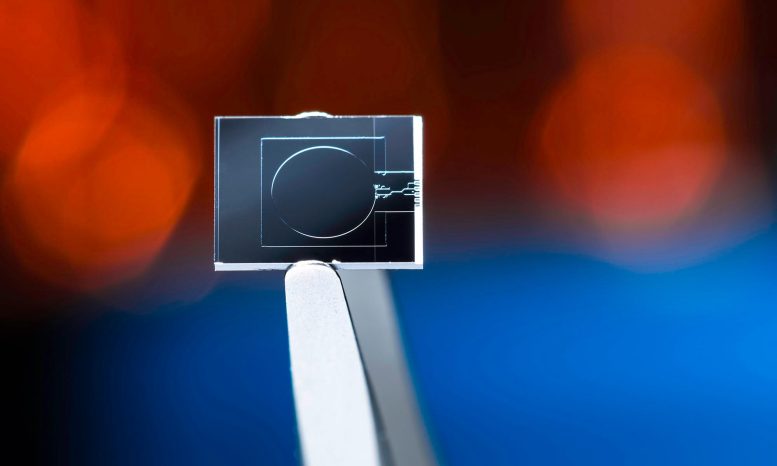
    Quantum Photonic Chips for Navigation
    With a grant from the National Science Foundation, Rochester researchers are developing photonic chips that use a quantum technique called weak value amplification to replace the mechanical gyroscopes used in drones. Credit: University of Rochester / J. Adam Fenster

    “Right now, the sensitivity and stability of a gyroscope must be fundamentally traded off between its size and weight,” he says. “As drones, UAVs, and satellites become smaller and more ubiquitous, the need for ultracompact navigation-grade gyroscopes will become critical. State-of-the-art miniaturized gyroscopes are compact and robust but suffer from a performance deficit that hinders their use in navigation.”

    Weak Value Amplification and Collaborations

    According to Cardenas, weak value amplification provides advantages over traditional methods because it boosts the signal of an interferometric measurement without the cost of amplifying several forms of technical noise. However, previous demonstrations of weak value amplification have required complex lab setups with precise alignment; Cardenas strives to implement weak value amplification on a tiny photonic chip with a high-quality factor ring resonator.

    Cardenas’ collaborators on the project include physicist Andrew Jordan, formerly a faculty member at Rochester and now at Chapman University. Cardenas says he will also work with the University’s David T. Kearns Center for Leadership and Diversity to broaden the participation of underrepresented groups through research experiences for high school students from the Rochester City School District that spark their desire for a career in STEM.

    Never miss a breakthrough: Join the SciTechDaily newsletter.
    Follow us on Google and Google News.

    Electrical Engineering GPS Navigation Photonics Popular University of Rochester
    Share. Facebook Twitter Pinterest LinkedIn Email Reddit

    Related Articles

    Pioneering Quantum Simulations on Photonic Chips: A New Era in Quantum Computing

    More Accurate Than GPS: New Navigation System With 10 Centimeter Accuracy

    Caltech’s New Optical Switch Could Lead to Ultrafast Signal Processing

    Ultrafast Computers Are Coming: Laser Bursts Drive Fastest-Ever Logic Gates

    Photonic Chip Breakthrough Opens a Path Toward Quantum Computing in Real-World Conditions

    A Laser Breakthrough: First Commercially Scalable Integrated Laser and Microcomb on a Single Chip

    MIT Develops Nanostructured Device That Stops Light in Its Tracks

    AI Boosted by Parallel Convolutional Light-Based Processors

    Revolutionary Light-Emitting Silicon – “Holy Grail” Breakthrough After 50 Years of Work

    Leave A Reply Cancel Reply

    • Facebook
    • Twitter
    • Pinterest
    • YouTube

    Don't Miss a Discovery

    Subscribe for the Latest in Science & Tech!

    Trending News

    Scientists Recreate a Nuclear Fireball and Uncover Fallout’s Hidden Chemistry

    These Tiny Gut Particles Could Be Accelerating Aging Throughout the Body

    Doctors Changed One Thing and Weight Gain Stopped

    Magnetic Fields May Solve a Longstanding Binary Star Mystery

    The Probiotic Breakthrough for Natural Anxiety Relief and Better Mental Health

    Animal vs. Plant Protein: Scientists Found a Surprising Nutritional Difference

    According to Scientists, This Simple Dietary Change Is Linked to Lower Depression Scores

    Researchers Discover a Hidden Vitamin D Problem That Persists Year-Round

    Follow SciTechDaily
    • Facebook
    • Twitter
    • YouTube
    • Pinterest
    • Newsletter
    • RSS
    SciTech News
    • Biology News
    • Chemistry News
    • Earth News
    • Health News
    • Physics News
    • Science News
    • Space News
    • Technology News
    Recent Posts
    • Scientists Recommend Doing This To Reduce Anxiety During Pregnancy
    • Scientists Reveal What Happened When 12 People Were Trapped Together in Antarctica for 10 Months
    • Buried for 1.7 Billion Years: These Ancient Fossils May Rewrite the Story of Complex Life
    • NASA Spots Giant Ocean Swell Signaling a Potential El Niño Comeback
    • The “Impossible” Earthquake Beneath Utah Was Real After All
    Copyright © 1998 - 2026 SciTechDaily. All Rights Reserved.
    • Science News
    • About
    • Contact
    • Editorial Board
    • Privacy Policy
    • Terms of Use

    Type above and press Enter to search. Press Esc to cancel.