
Close Menu
    Facebook X (Twitter) Instagram
    SciTechDaily
    • Biology
    • Chemistry
    • Earth
    • Health
    • Physics
    • Science
    • Space
    • Technology
    Facebook X (Twitter) Pinterest YouTube RSS
    SciTechDaily
    Home»Science»Boxwood Fungus Blight Invades North America After Taking Europe and New Zealand by Storm
    Science

    Boxwood Fungus Blight Invades North America After Taking Europe and New Zealand by Storm

    By SciTechDailyJanuary 24, 2012No Comments2 Mins Read
    Facebook Twitter Pinterest Telegram LinkedIn WhatsApp Email Reddit
    Share
    Facebook Twitter LinkedIn Pinterest Telegram Email Reddit
    boxwood-blight
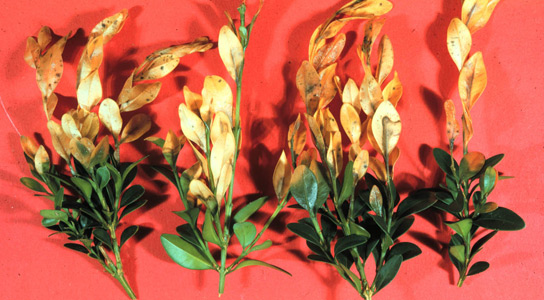
    Boxwood blight, caused by an aggressive fungal disease, is spreading across the North American continent. Credit: University of Georgia

    A boxwood blight, caused by an aggressive fungus disease, has started to invade the North American continent, after it had spread throughout Europe and New Zealand. Last October, US authorities confirmed that the blight had jumped continents, and started infections in North Carolina and Connecticut.

    The boxwood blight, caused by the Cylindrocladium fungus, was unknown before the year 2000. By mid-January, the fungus has turned up in at least five more states in the US — Virginia, Maryland, Rhode Island, Massachusetts and Oregon — and in British Columbia in Canada.
    boxwood-affected-blight-fungus
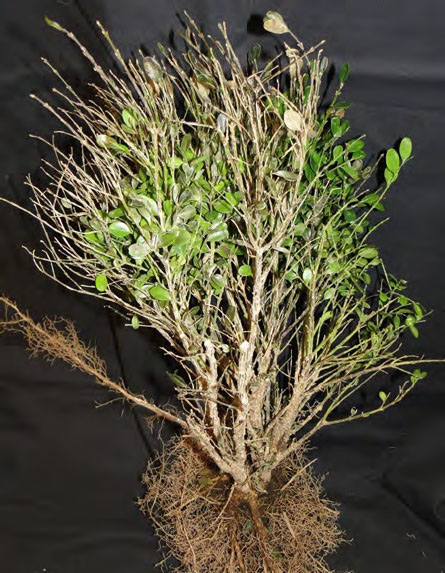
    Credit: University of Georgia

    The blight starts with spots on leaves, as well as black streaks on twigs. In a few weeks, a plump shrub can be transformed into a clump of bare sticks. Younger plants will die while older ones, which do survive, will regrow their leaves for a few cycles of attack by the fungus.  However, topiaries and hedges will probably be ruined.

    Once the fungus, either C. pseudonaviculatum or C. buxicola, strikes a garden, plant pathologists recommend drastic measures to fight off long-lasting fungal residue. In North Carolina, a grower burned 15,000 infected boxwood plants as well as 15,000 uninfected ones. Boxwood plants haven’t evolved much resistance to this fungus, so it might come from an unfamiliar source. The fungus is difficult to trace, since all samples belong to just two lineages of clones, making a trace not very significant.

    However, boxwood has managed to weather the storm in Europe and New Zealand, so the same will most probably apply to North America.

    Never miss a breakthrough: Join the SciTechDaily newsletter.
    Follow us on Google and Google News.

    Europe Fungus New Zealand Pathology Plants
    Share. Facebook Twitter Pinterest LinkedIn Email Reddit

    Related Articles

    Frozen in Time: Scientists Discover 45-Million-Year-Old Ancient Walnuts on Remote Arctic Island

    The Oldest Scandinavian Legal Text: New Study Challenges Traditional Views of Viking Age Economy

    Giant Fossil Beans Unlock Secrets of Ancient Rainforests

    Unearthing History: Ancient Potatoes Reveal Indigenous Agricultural Genius

    Discovery of 2,300-Year-Old Ancient Crops Challenges Modern Views on African Farming

    Scientists Reveal Millennia-Old Secrets of the World’s Most Popular Coffee Species

    Plants’ Secret Glow: NASA’s Key to Predicting Sudden Droughts

    Study Reveals That Organic Farming Changes Plants’ Genetic Code

    A Growing Threat: Harmful Fungal Toxins Spreading in Wheat

    Leave A Reply Cancel Reply

    • Facebook
    • Twitter
    • Pinterest
    • YouTube

    Don't Miss a Discovery

    Subscribe for the Latest in Science & Tech!

    Trending News

    The Brain Makes New Neurons Even in Adulthood. Depression May Stop It

    Scientists Discover a Hidden “Immune Organ” Inside the Skull

    Sugary Drinks Linked to 145% Higher Risk of Gastric Cancer

    Thousands of Giant Whales Are Suddenly Flooding Into an Arctic “Feeding Frenzy”

    NASA’s Roman Telescope Begins a Million-Mile Journey Into Deep Space

    Researchers Have Discovered a New Way To Reduce Chronic Nerve Pain

    JWST Finds Giant Planets Face a Cosmic Race Against Time

    Brain Cells Once Thought Protective May Actually Drive Cognitive Decline With Age

    Follow SciTechDaily
    • Facebook
    • Twitter
    • YouTube
    • Pinterest
    • Newsletter
    • RSS
    SciTech News
    • Biology News
    • Chemistry News
    • Earth News
    • Health News
    • Physics News
    • Science News
    • Space News
    • Technology News
    Recent Posts
    • New Twist on the Einstein Problem Reveals Unexpected Physics
    • Scientists Just Challenged a Century-Old Theory of How Crystals Form
    • Researchers Reveal the Hidden High Cost of “Free-To-Play” Video Games
    • Scientists Expose Unexpected Driver of the May 2024 Superstorm
    • Scientists Find a New Way To Hear the Faint “Ringing” of Black Holes
    Copyright © 1998 - 2026 SciTechDaily. All Rights Reserved.
    • Science News
    • About
    • Contact
    • Editorial Board
    • Privacy Policy
    • Terms of Use

    Type above and press Enter to search. Press Esc to cancel.