
Close Menu
    Facebook X (Twitter) Instagram
    SciTechDaily
    • Biology
    • Chemistry
    • Earth
    • Health
    • Physics
    • Science
    • Space
    • Technology
    Facebook X (Twitter) Pinterest YouTube RSS
    SciTechDaily
    Home»Science»A New Birth Story for Gigantic Marine Lizards That Once Roamed the Oceans
    Science

    A New Birth Story for Gigantic Marine Lizards That Once Roamed the Oceans

    By Jim Shelton, Yale UniversityApril 10, 2015No Comments3 Mins Read
    Facebook Twitter Pinterest Telegram LinkedIn WhatsApp Email Reddit
    Share
    Facebook Twitter LinkedIn Pinterest Telegram Email Reddit
    A New Birth Story for a Gigantic Marine Lizard That Once Roamed the Oceans
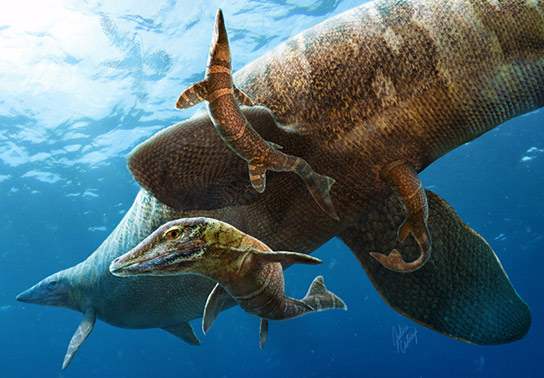
    Artist’s illustration of mosasaurs giving birth to their young in the open ocean. Credit: Julius T. Csotonyi

    Paleontologists now believe that mosasaurs gave birth to their young in the open ocean, not on or near shore.

    They weren’t in the delivery room, but researchers at Yale University and the University of Toronto have discovered a new birth story for a gigantic marine lizard that once roamed the oceans.

    Thanks to recently identified specimens at the Yale Peabody Museum of Natural History, paleontologists now believe that mighty mosasaurs — which could grow to 50 feet (15 meters) long — gave birth to their young in the open ocean, not on or near shore.

    The findings answer long-held questions about the initial environment of an iconic predator that lived during the time of the dinosaurs. Mosasaurs populated most waters of the Earth before their extinction 65 million years ago.

    “Mosasaurs are among the best-studied groups of Mesozoic vertebrate animals, but evidence regarding how they were born and what baby mosasaur ecology was like has historically been elusive,” said Daniel Field, lead author of a study published online April 10 in the journal Paleontology. Field is a doctoral candidate in the lab of Jacques Gauthier in Yale’s Department of Geology and Geophysics.

    In their study, Field and his colleagues describe the youngest mosasaur specimens ever found. Field had come across the fossils in the Yale Peabody Museum’s extensive collections. “These specimens were collected over 100 years ago,” Field said. “They had previously been thought to belong to ancient marine birds.”

    Field and Aaron LeBlanc, a doctoral candidate at the University of Toronto at Mississauga, concluded that the specimens showed a variety of jaw and teeth features that are only found in mosasaurs. Also, the fossils were found in deposits in the open ocean.

    “Really, the only bird-like feature of the specimens is their small size,” LeBlanc said. “Contrary to classic theories, these findings suggest that mosasaurs did not lay eggs on beaches and that newborn mosasaurs likely did not live in sheltered nearshore nurseries.”

    The other co-authors of the study are Adam Behlke and Adrien Gau of Yale’s Department of Geology and Geophysics.

    Support for the research came from the Smithsonian Institution and the Natural Sciences and Engineering Research Council of Canada.

    Reference: “Pelagic neonatal fossils support viviparity and precocial life history of Cretaceous mosasaurs” by Daniel J. Field, Aaron LeBlanc, Adrienne Gau and Adam D. Behlke, 10 April 2020, Palaeontology.
    DOI: 10.1111/pala.12165

    Never miss a breakthrough: Join the SciTechDaily newsletter.
    Follow us on Google and Google News.

    Ecology Paleobiology Paleontology Yale University
    Share. Facebook Twitter Pinterest LinkedIn Email Reddit

    Related Articles

    Turtles Share a Recent Common Ancestor with Birds and Crocodiles

    Yale Study Reveals Connection Between Genes That Contribute to Autism

    Earth’s Earliest Primates Lived in Trees

    Study Reveals the Importance of Tiny Creatures in Structure of Grasslands

    Study Explains Prevalence of Hadrosaur Skin Among All Known Dinosaur Skin Fossils

    The Preservation of Colors in Fossil Insects

    Scientists Reconstruct the Ancestor of Placental Mammals

    Jawless Vertebrate Conodont Had Sharpest Yet Minuscule Teeth

    Researchers Conclude Torosaurus and Triceratops Are Different Species of Horned Dinosaurs

    Leave A Reply Cancel Reply

    • Facebook
    • Twitter
    • Pinterest
    • YouTube

    Don't Miss a Discovery

    Subscribe for the Latest in Science & Tech!

    Trending News

    This Experimental Drug Repaired the Gut and Reversed Severe Fatty Liver Disease

    Physicists Just Turned a Black Hole Energy Theory Into Reality

    Stanford Scientists Solve a 252-Million-Year-Old Mass Extinction Mystery

    The Ancient Survival Mechanism Making Weight Loss So Difficult

    Just 3,000 Steps a Day May Help Protect the Brain From Alzheimer’s

    “Weird Clams” Reveal a New Invasion Along the U.S. Northeast Coast

    Archaeologists Decapitated Tutankhamun and Glued His Body Back Together

    New Black Hole Theory Solves a 50-Year-Old Problem

    Follow SciTechDaily
    • Facebook
    • Twitter
    • YouTube
    • Pinterest
    • Newsletter
    • RSS
    SciTech News
    • Biology News
    • Chemistry News
    • Earth News
    • Health News
    • Physics News
    • Science News
    • Space News
    • Technology News
    Recent Posts
    • Scientists Restore the Sense of Touch With Electrical Brain Stimulation
    • New Study Reveals Herpesvirus Infection May Accelerate Alzheimer’s Disease
    • Microplastics Found in 84% of Serious Heart Attack Patients
    • The Oldest Known Right-Handed Animal May Have Lived 550 Million Years Ago
    • MIT’s Tiny Flying Robot Just Learned To Move Like a Real Insect
    Copyright © 1998 - 2026 SciTechDaily. All Rights Reserved.
    • Science News
    • About
    • Contact
    • Editorial Board
    • Privacy Policy
    • Terms of Use

    Type above and press Enter to search. Press Esc to cancel.