
Close Menu
    Facebook X (Twitter) Instagram
    SciTechDaily
    • Biology
    • Chemistry
    • Earth
    • Health
    • Physics
    • Science
    • Space
    • Technology
    Facebook X (Twitter) Pinterest YouTube RSS
    SciTechDaily
    Home»Science»Scientists Reconstruct the Ancestor of Placental Mammals
    Science

    Scientists Reconstruct the Ancestor of Placental Mammals

    By Bill Hathaway, Yale UniversityFebruary 12, 2013No Comments2 Mins Read
    Facebook Twitter Pinterest Telegram LinkedIn WhatsApp Email Reddit
    Share
    Facebook Twitter LinkedIn Pinterest Telegram Email Reddit


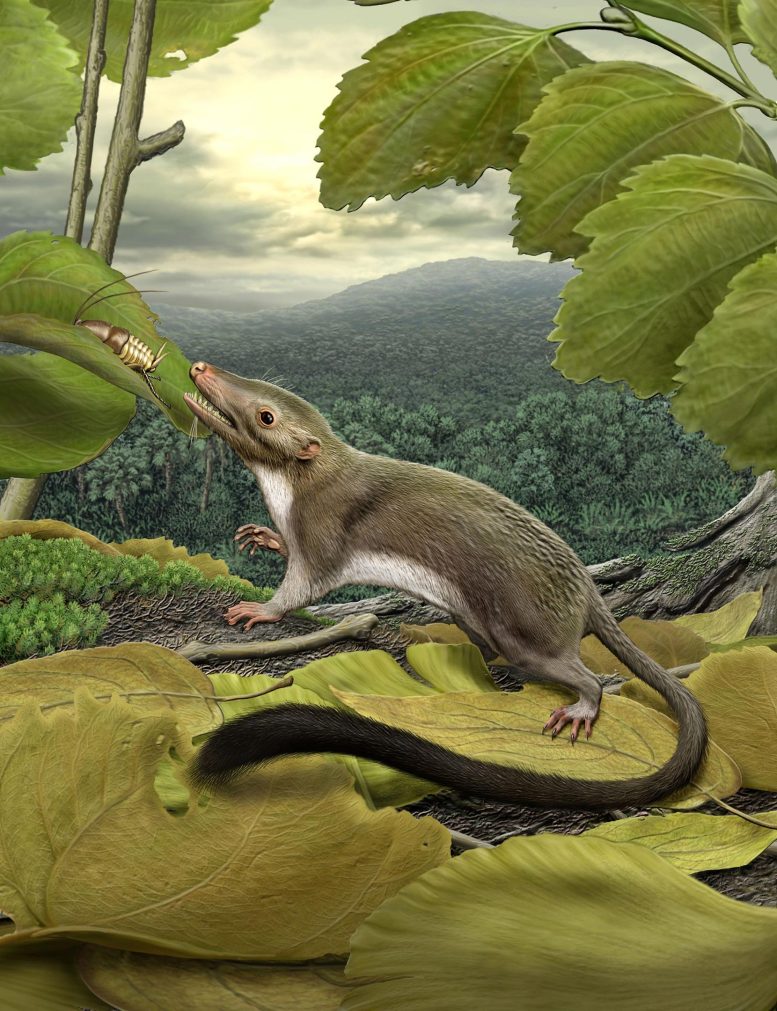
    Ancestor of Placental Mammals
    According to a new study, the common ancestor of more than 5,000 contemporary placental mammals such as rats, whales, and humans was a small, insect-eating animal that appeared after the dinosaurs went extinct 65 million years ago. Credit: Yale University

    More than twenty scientists collaborated on a recently published study that reconstructed the ancestor of placental mammals.

    The common ancestor of more than 5,000 contemporary placental mammals such as rats, whales, and humans was a small, insect-eating animal that appeared after the dinosaurs went extinct 65 million years ago, an international team of researchers report in the February 8 issue of the journal Science.

    Our evolutionary ancestor appeared about 36 million years more recently than molecular data had predicted, according to the analysis of more than 4,500 anatomical features analyzed by the team of scientists under the National Science Foundation’s Assembling the Tree of Life program.

    “It would not have been possible to reconstruct the ancestral placental mammal or assess the relationships of extinct mammals without the large anatomical database we compiled in MorphoBank,” said Eric Sargis, professor of anthropology at Yale University, curator of mammalogy and vertebrate paleontology at the Peabody Museum of Natural History, and one of more than 20 scientists to collaborate on the project.

    Reference: “The Placental Mammal Ancestor and the Post–K-Pg Radiation of Placentals” by Maureen A. O’Leary, Jonathan I. Bloch, John J. Flynn, Timothy J. Gaudin, Andres Giallombardo, Norberto P. Giannini, Suzann L. Goldberg, Brian P. Kraatz, Zhe-Xi Luo, Jin Meng, Xijun Ni, Michael J. Novacek, Fernando A. Perini, Zachary S. Randall, Guillermo W. Rougier, Eric J. Sargis, Mary T. Silcox, Nancy B. Simmons, Michelle Spaulding, Paúl M. Velazco, Marcelo Weksler, John R. Wible and Andrea L. Cirranello, 8 February 2013, Science.
    DOI: 10.1126/science.1229237

    Never miss a breakthrough: Join the SciTechDaily newsletter.
    Follow us on Google and Google News.

    Anthropology Paleontology Yale University
    Share. Facebook Twitter Pinterest LinkedIn Email Reddit

    Related Articles

    Turtles Share a Recent Common Ancestor with Birds and Crocodiles

    Oldest Known Human Ancestors May Have Had Precision Grip Capabilities

    A New Birth Story for Gigantic Marine Lizards That Once Roamed the Oceans

    Earth’s Earliest Primates Lived in Trees

    Study Explains Prevalence of Hadrosaur Skin Among All Known Dinosaur Skin Fossils

    The Preservation of Colors in Fossil Insects

    Jaw Structures of Fossils Seems to Suggest That Three Homo Species Roamed Africa Concurrently

    7 Million Year Old Footprints Reveal Elephant Social Structure from the Past

    Researchers Conclude Torosaurus and Triceratops Are Different Species of Horned Dinosaurs

    Leave A Reply Cancel Reply

    • Facebook
    • Twitter
    • Pinterest
    • YouTube

    Don't Miss a Discovery

    Subscribe for the Latest in Science & Tech!

    Trending News

    Artificial Sweeteners May Harm Future Generations, Study Suggests

    Splashdown! NASA Artemis II Returns From Record-Breaking Moon Mission

    What If Consciousness Exists Beyond Your Brain

    Scientists Finally Crack the 100-Million-Year Evolutionary Mystery of Squid and Cuttlefish

    Beyond “Safe Levels”: Study Challenges What We Know About Pesticides and Cancer

    Researchers Have Found a Dietary Compound That Increases Longevity

    Scientists Baffled by Bizarre “Living Fossil” From 275 Million Years Ago

    Your IQ at 23 Could Predict Your Wealth at 27, Study Finds

    Follow SciTechDaily
    • Facebook
    • Twitter
    • YouTube
    • Pinterest
    • Newsletter
    • RSS
    SciTech News
    • Biology News
    • Chemistry News
    • Earth News
    • Health News
    • Physics News
    • Science News
    • Space News
    • Technology News
    Recent Posts
    • Scientists Discover New Way To Make Protein Shakes Taste Better
    • Scientists Break Optical Limits With Quantum Dot-Powered Nanoscopy
    • Scientists Shrink a Lab Spectrometer to the Size of a Grain of Sand
    • Quantum Reality Gets Stranger: Physicists Put a Lump of Metal in Two Places at Once
    • 34-Million-Year-Old Snake Found in Wyoming Rewrites Our Understanding of Evolution
    Copyright © 1998 - 2026 SciTechDaily. All Rights Reserved.
    • Science News
    • About
    • Contact
    • Editorial Board
    • Privacy Policy
    • Terms of Use

    Type above and press Enter to search. Press Esc to cancel.