
Close Menu
    Facebook X (Twitter) Instagram
    SciTechDaily
    • Biology
    • Chemistry
    • Earth
    • Health
    • Physics
    • Science
    • Space
    • Technology
    Facebook X (Twitter) Pinterest YouTube RSS
    SciTechDaily
    Home»Science»Oldest Known Human Ancestors May Have Had Precision Grip Capabilities
    Science

    Oldest Known Human Ancestors May Have Had Precision Grip Capabilities

    By Jim Shelton, Yale UniversityApril 20, 20151 Comment3 Mins Read
    Facebook Twitter Pinterest Telegram LinkedIn WhatsApp Email Reddit
    Share
    Facebook Twitter LinkedIn Pinterest Telegram Email Reddit
    Oldest Human Ancestors May Have Had Precision Grip Capabilities
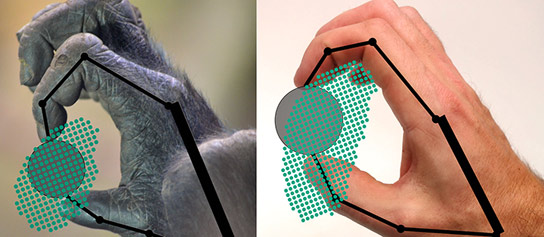
    This figure shows samples of the ability of a gorilla and a human to grip and move an object. The kinetic model estimates the ability to grip and manipulate a circular object. The dots indicate positions in which the object can be gripped. Credit: Yale University

    Researchers present a kinematic model of thumb–index precision grip and manipulative movement based on bony hand morphology in a broad sample of extant primates and fossil hominins, revealing that even the oldest available fossil hominins may have shared comparable precision grip manipulation with modern humans.

    Scientists are coming to grips with the superior grasping ability of humans and other primates throughout history.

    In a new study, a research team led by Yale University found that even the oldest known human ancestors may have had precision grip capabilities comparable to modern humans. This includes Australopithecus afarensis, which appears in the fossil record a million years before the first evidence of stone tools.

    Yale robotics engineers Thomas Feix and Aaron Dollar collaborated on the research with anthropologist Tracy Kivell of the University of Kent and the Max Planck Institute for Human Anthropology, and primatologist Emmanuelle Pouydebat of the French National Center for Scientific Research. Their findings appear in the Journal of the Royal Society Interface.

    Using measurements of the digits’ segments, the team created a kinematic model of the thumb and index finger of the skeletons of living primates and fossil remains of human ancestors. It is the first such model of digit movement during precision grasping and manipulation in a broad sample of humans, non-human primates, and fossil hominins.

    “The model reveals that a long thumb or great joint mobility alone does not necessarily yield good precision manipulation,” said Feix, who is the corresponding author of the study. “Compared to living primates, the human hand has the largest manipulation potential, in particular for small objects.”

    Past studies of precision grasping in primates have focused on digit posture — contact between the hand and the object — or the length of the thumb relative to the fingers. The new study introduces a novel method for analyzing the interaction between the thumb and index finger, which is the foundation of stable grasping of small objects.

    Manual dexterity is traditionally viewed as a key adaptation that separated the earliest primates from other early mammals. It is thought that such abilities evolved in response to no longer needing hands for locomotion, as well as the mechanical demands of using tools.

    Yet there remains debate about the gripping capabilities of early fossil hominins, especially regarding the use of tools. The new study may shed light on some of those issues. For instance, the study suggests that the early human species Australopithecus afarensis may have had greater dexterity than what was required for cutting with a stone, including manipulative and tool-related behaviors that may not have been preserved in the archaeological record.

    Reference: “Estimating thumb–index finger precision grip and manipulation potential in extant and fossil primates” by Thomas Feix, Tracy L. Kivell, Emmanuelle Pouydebat and Aaron M. Dollar, 6 May 2015, Journal of the Royal Society Interface.
    DOI: 10.1098/rsif.2015.0176


    Never miss a breakthrough: Join the SciTechDaily newsletter.
    Follow us on Google and Google News.

    Anthropology Hominin Max Planck Institute Yale University
    Share. Facebook Twitter Pinterest LinkedIn Email Reddit

    Related Articles

    Researchers Discover Oldest Images to Date of Dogs on Leashes

    Scientists Discover A New Species of Hominin

    Earth’s Earliest Primates Lived in Trees

    Discovery Reveals That Neanderthals Were the First in Europe to Make Specialized Bone Tools

    Scientists Reconstruct the Ancestor of Placental Mammals

    400,000 Year Old Fossil Helps Shed New Light on Human Evolution

    Jaw Structures of Fossils Seems to Suggest That Three Homo Species Roamed Africa Concurrently

    Million-Year-Old Ash in South African Cave Yields Evidence of Cooking

    7 Million Year Old Footprints Reveal Elephant Social Structure from the Past

    1 Comment

    1. rob on January 23, 2026 11:40 pm

      I reckon that gorilla could play the violin and other stringed instruments, based on its arching of its fingers.

      Reply
    Leave A Reply Cancel Reply

    • Facebook
    • Twitter
    • Pinterest
    • YouTube

    Don't Miss a Discovery

    Subscribe for the Latest in Science & Tech!

    Trending News

    Your Blood Pressure Reading Could Be Wrong Because of One Simple Mistake

    Astronomers Stunned by Ancient Galaxy With No Spin

    Physicists May Be on the Verge of Discovering “New Physics” at CERN

    Scientists Solve 320-Million-Year Mystery of Reptile Skin Armor

    Scientists Say This Daily Walking Habit May Be the Secret to Keeping Weight Off After Dieting

    New Therapy Rewires the Brain To Restore Joy in Depression Patients

    Giant Squid Detected off Western Australia in Stunning Deep-Sea Discovery

    Popular Sugar-Free Sweetener Linked to Liver Disease, Study Warns

    Follow SciTechDaily
    • Facebook
    • Twitter
    • YouTube
    • Pinterest
    • Newsletter
    • RSS
    SciTech News
    • Biology News
    • Chemistry News
    • Earth News
    • Health News
    • Physics News
    • Science News
    • Space News
    • Technology News
    Recent Posts
    • Hidden Warm Water Beneath Antarctica Could Rapidly Raise Global Sea Levels
    • Scientists Revive Ancient Chemistry Trick To Engineer Next-Generation Glass
    • Scientists Use AI To Supercharge Ultrafast Laser Simulations by More Than 250x
    • Scientists Just Found a Surprising Way To Destroy “Forever Chemicals”
    • Popular Supplement Ingredient Linked to Shorter Lifespan in Men
    Copyright © 1998 - 2026 SciTechDaily. All Rights Reserved.
    • Science News
    • About
    • Contact
    • Editorial Board
    • Privacy Policy
    • Terms of Use

    Type above and press Enter to search. Press Esc to cancel.