
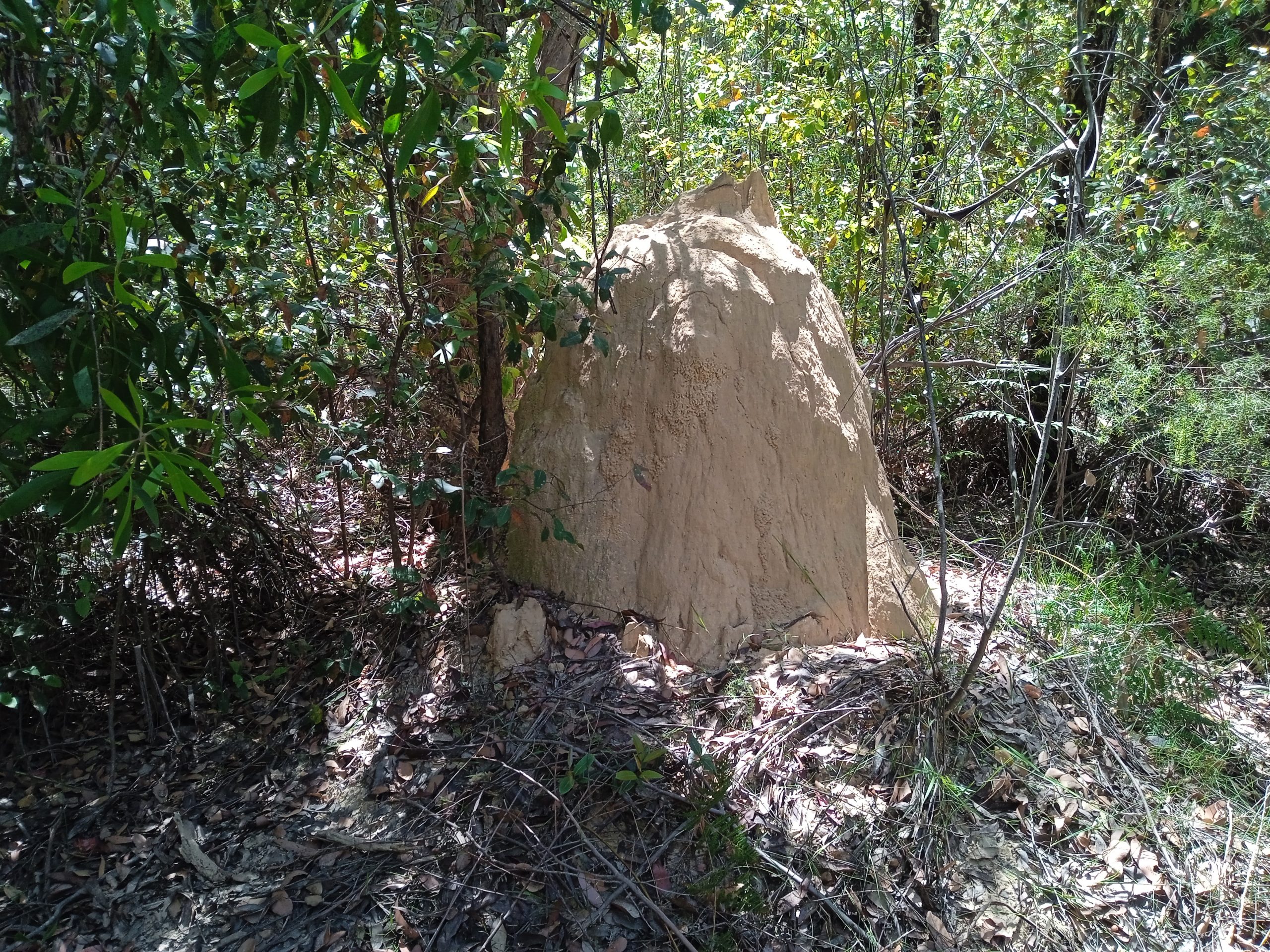
The new study indicates that humidity helps guide insects in their tasks.
Termites are often referred to as nature’s architects. Their nests, which can tower several meters high, with complex and elaborate structures, galleries that ensure efficient communication and that automatically ventilate the nest interior in a way that would make the envy of human engineers. How can thousands or millions of insects coordinate their work to build solid and functional nests for the colony?
A new study coordinated by Andrea Perna, professor in complex systems at the IMT School for Advanced Studies Lucca, and published in the journal eLife, has now identified the unique mechanism used by termites to accomplish such extraordinary tasks.
Termites have almost finished to build an arched structure. The red lights are the light beam used by the 3D scanner to quantify construction progress. Credit: Giulio Facchini
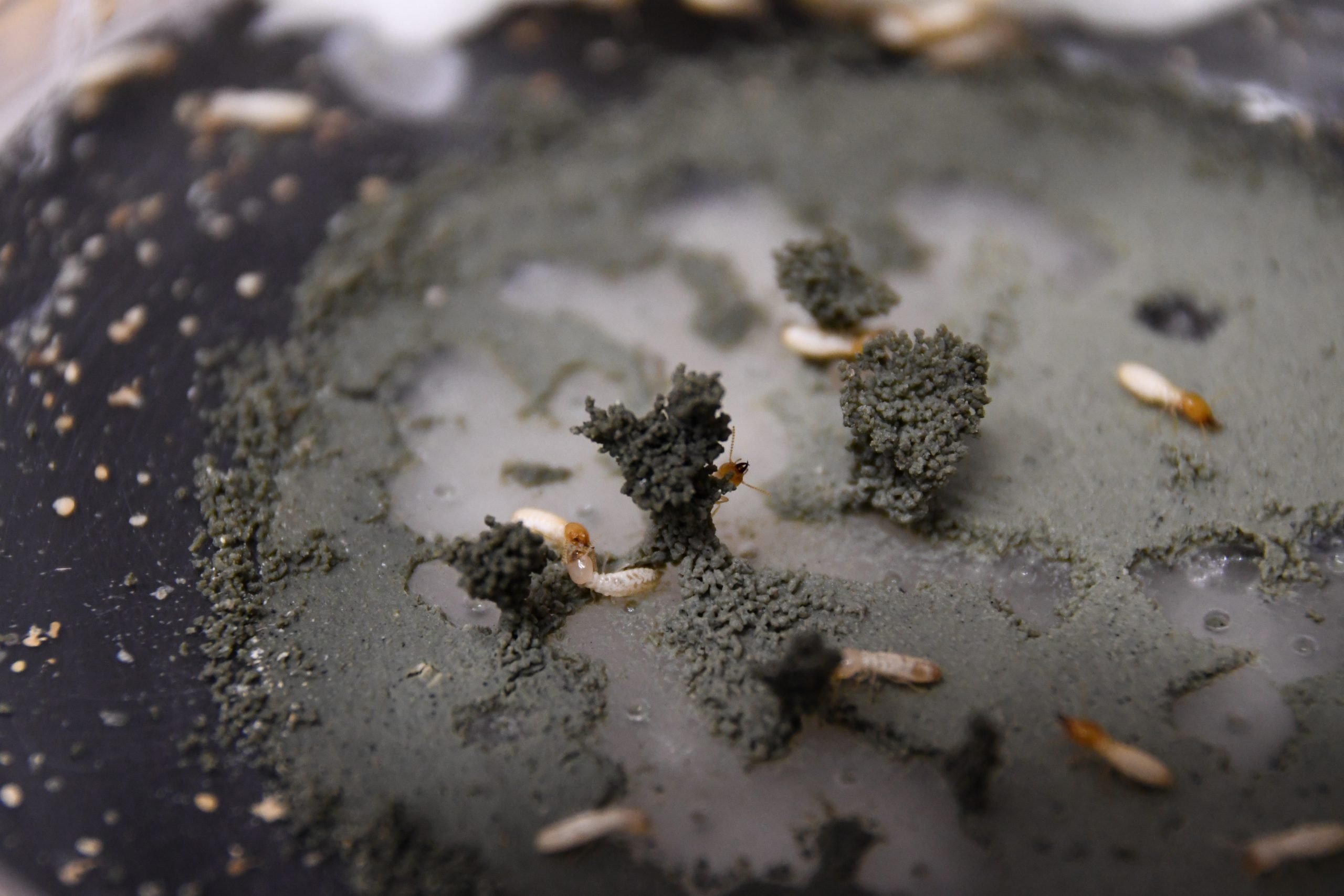
For carrying out their laboratory experiment on termites of the species Coptotermes gestroi (originally from South Asia, but which has spread to the east coast of the United States), the researchers created small arenas with artificial structures of different heights and shape by using wet clay.
They then collected small populations of termites from a larger colony and quantified their building behavior in response to these structures by video-tracking the activity of all termites in the population, while simultaneously characterizing the changes in the 3D structure. In this way, it was possible to test various hypotheses to discover the coordination mechanism used for building nests.
Comparative Insights and Experiments
In the case of ants, which – besides termites – are the other major group of insects capable of building large and intricate structures for example, it is believed that ants impregnate the building material with a pheromone, a chemical substance that attracts other ants to the building site and ‘tells them’ where to build. In this way, the action of one worker ant triggers the activity of other ants in a self-amplifying process.
If termites, like ants, also relied on pheromones to guide their building activity, then they shouldn’t show a preference for depositing their pellets of building material at any particular location, because there weren’t any pheromones in the artificial arenas prepared by the experimenters. But this was not the case: while pellet collections happened everywhere in the arena, the depositions were all localized at the top of already existing structures. Perhaps they might be able to assess the elevation of small pillars and heterogeneities in the ground, and in this way, they would keep adding building material on top of already existing structures. But this was not the case either: in fact, termites deposited their building pellets with equal probability on both short and tall pillars.
A small group of Coptotermes gestroi termites add clay pellets to the tops of artificial pillars placed by the experimenters. Credit: Giulio Facchini
Another hypothesis was that termites might be able to sense the curvature of the building substrate, since some previous modelling had shown that constantly adding pellets at the locations of highest curvature is sufficient to produce very complex structures that resemble the termite nests of some species. “In our simulations, we observed that small heterogeneities of the surface have higher curvature than the flat surrounding substrate and so they are expanded to form a pillar, the pointed extremities of pillars, in turn, attract further depositions of building material and continue to grow until they split or merge with another pillar, and so on; very complex structures can be formed with this simple rule,” says Giulio Facchini, first author of the study and researcher at the CNRS Institut Matière et Systèmes Complexes in Paris, France.
In fact, when the termites were confronted with the artificial stimuli provided in the experiments, they always preferred to build at the locations of highest curvature, adding pellets at the top of the pillars (independently of their height), and when a small wall stimulus was provided, they most often kept adding pellets at the two corners of the wall, the two points where the curvature reaches its maximum.
Understanding Termite Sensory Capabilities
The problem is: how could termites so reliably sense the curvature of the structures that they were building? The researchers had a clue that water evaporation and humidity could have to do with it. “Termites are very sensitive to humidity concentrations: unlike most other insects, they have a thin exoskeleton and soft skin, meaning that even a prolonged exposure to humidity levels below 70 percent can be lethal to them,” explains Perna. “It is not too surprising that they can sense these gradients of humidity and respond to them with their behavior.”
But how to prove it? “We found a solution that was described as a ‘very ingenious low tech solution’: by one of the anonymous reviewers of the journal eLife: we prepared experimental arenas identical to those used with termites, but this time impregnating the clay with a saline solution of sodium bicarbonate. As the water from the saline solution evaporated, it left behind tiny crystals of salt, whose growth marked the regions of highest evaporation: these were the tips of the pillars, the corners of the walls: exactly the same regions that termites had selected for their building activity!” explains Facchini.
“What really surprised us was to discover that termites use such a simple solution to a very complex problem,” Perna comments. “In our experiments, nest complexity emerges from just one simple mechanism: termites only need to add pellets of material depending on the local humidity, but the pellets that they add in turn change all the pattern of evaporation and humidity, inducing other termites to build at a different location, and so on, until very complex structures are produced.”
Reference: “Substrate evaporation drives collective construction in termites” by G. Facchini, A. Rathery, S. Douady, D. Sillam-Dussès and A. Perna, 8 February 2024, eLife.
DOI: 10.7554/eLife.86843.3
Never miss a breakthrough: Join the SciTechDaily newsletter.
Follow us on Google and Google News.
1 Comment
Wow – social contagian in ants! I wonder how many of them are trans?