
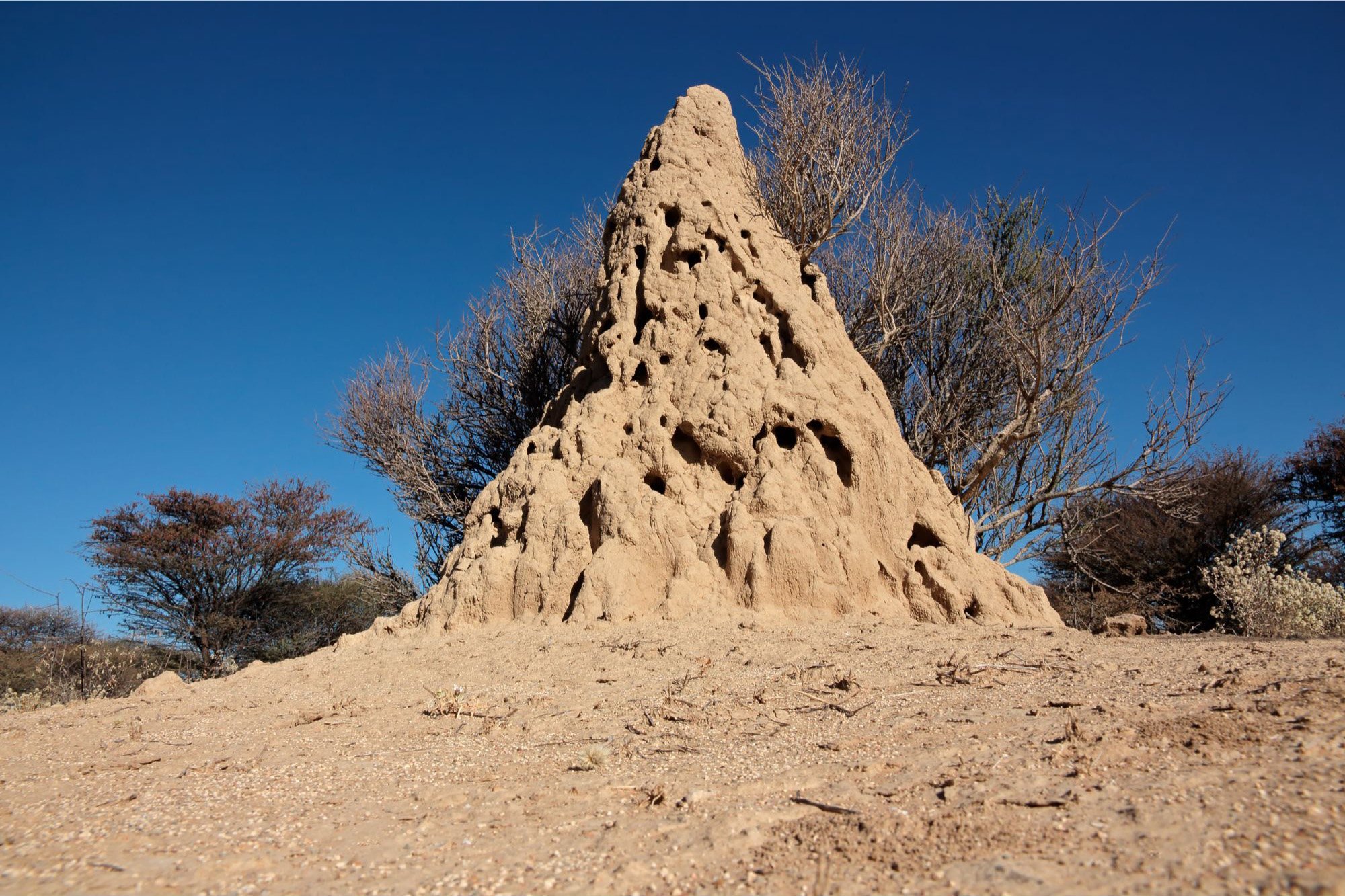
Researchers in Namaqualand have found the world’s oldest termite mounds, dating 34,000 years, revealing key insights into ancient climates and carbon storage.
In a remarkable breakthrough, scientists have uncovered the world’s oldest inhabited termite mounds along the Buffels River in Namaqualand. These mounds, which date back an astonishing 34,000 years, are transforming our understanding of prehistoric life, climate, and carbon storage.
An Ancient Marvel
These termite mounds, called “heuweltjies” in Afrikaans, meaning “little hills,” are inhabited by the southern harvester termite, Microhodotermes viator, explains lead author on the study, Dr. Michele Francis, a Senior Lecturer (Extraordinary), in the Department of Soil Science in the Faculty of AgriSciences at Stellenbosch University (SU).
“Recent radiocarbon dating has revealed that these mounds are far older than any previously known, with some dating as far back as 34,000 years – that’s older than the iconic cave paintings in Europe and even older than the Last Glacial Maximum, when vast ice sheets covered much of the northern hemisphere.”

The mounds are still inhabited by termites, and the radiocarbon dating of the organic carbon within these mounds has shown ages ranging from 13,000 to 19,000 years, while the carbonate dates back up to 34,000 years. This make the Buffels River mounds the oldest active termite mounds to be dated so far with both organic and inorganic carbon. The previous oldest inhabited mounds from different species from Brazil are 4000 years old.
“To put it in perspective, these termite mounds were already ancient when woolly mammoths still roamed the Earth. During the Last Glacial Maximum, around 20,000 years ago, massive ice sheets covered parts of North America, Europe, and Asia. These mounds were already thousands of years old by then, providing a living archive of environmental conditions that shaped our world,” says Francis.
A Peek into Prehistoric Climate
These ancient mounds are more than just a historical curiosity; they serve as valuable records of prehistoric climate condition, says Francis. “The heuweltjies have shown that during their formation, the region experienced significantly more rainfall than today. This wetter climate allowed for minerals such as calcite and gypsum to dissolve and move down to the groundwater. This process is crucial in understanding natural carbon sequestration processes. What is interesting is that Namaqualand still has sporadic episodes of intense rainfall, like last winter, which would re-activate the process.”

Why It Matters
Not only are these the oldest termite mounds on earth, but they also offer two mechanisms to sequester CO2, adds Francis.
Firstly, the harvesting activities of termites inject younger organic material deep into their nests, leading to continuous renewal of important soil carbon reservoirs at depth, where they are preserved for longer than when still at the surface.
Secondly, these calcareous termite mounds offer a way to remove CO2 when the soil mineral calcite dissolves. This is a long-term carbon storage that companies are seeking to replicate in enhanced weathering or ocean alkalinity enhancement projects, and is important for calculating a country’s carbon budget as laid out in the Paris Agreement, and accounted for during land use change.
A Call for Global Recognition
“The discovery of these mounds is akin to being able to read an ancient manuscript that changes everything we thought we knew about history. Their age, and the insights they provide into ancient ecosystems, make them a candidate for global recognition as a natural wonder,” says Francis.
“By studying these mounds, scientists can gain a better understanding of how to combat climate change, utilizing nature’s own processes for carbon sequestration. They also highlight the importance of preserving our natural world, as these tiny engineers have been shaping our environment for tens of thousands of years.”
Conclusion
“The discovery of the world’s oldest termite mounds in Namaqualand is a testament to the incredible history hidden beneath our feet. These mounds not only illuminate the past but also offer vital clues for our future. As we continue to uncover the secrets of these ancient structures, they stand as a reminder of the delicate interplay between climate, environment, and life on earth,” concludes Francis.
Reference: “Calcareous termite mounds in South Africa are ancient carbon reservoirs” by M.L. Francis, L. Palcsu, M. Molnár, T. Kertész, C.E. Clarke, J.A. Miller and J. van Gend, 25 March 2024, Science of The Total Environment.
DOI: 10.1016/j.scitotenv.2024.171760
The pioneering research was conducted by a dedicated team from SU’s Departments of Soil Science and Earth Sciences, in collaboration with experts from the Institute for Nuclear Research in Hungary.
The heuweltjies are now being studied further by a SU PhD student as part of a joint United States (National Science Foundation) – South Africa (National Research Foundation) collaboration grant to find out more about their carbon storage potential.
Funding: Water Research Commission South Africa (project K5-2825), National Research Foundation of South Africa, European Union, and the State of Hungary, co-financed by the European Regional Development Fund in the project of GINOP-2.3.2-15-2016-00009 ‘ICER
Never miss a breakthrough: Join the SciTechDaily newsletter.
Follow us on Google and Google News.