

A new termite treatment blocks molting, spreads through colonies, and kills up to 95% when combined with a chemical lure.
Drywood termites, which live hidden inside wooden structures, molt about seven times during their lives. Researchers at UC Riverside have discovered that a chemical preventing the formation of new exoskeletons can effectively eliminate termite infestations in homes.
This chemical, called bistrifluron, has been shown to kill approximately 95 percent of a termite colony without causing harm to mammals. Its effectiveness is detailed in a study published in the Journal of Economic Entomology.
“This chemical is more environmentally friendly than ones traditionally used for drywood termite infestations,” said Nicholas Poulos, corresponding author of the paper and a doctoral student in UCR’s Department of Entomology. “It’s specific to insects and can’t harm humans.”
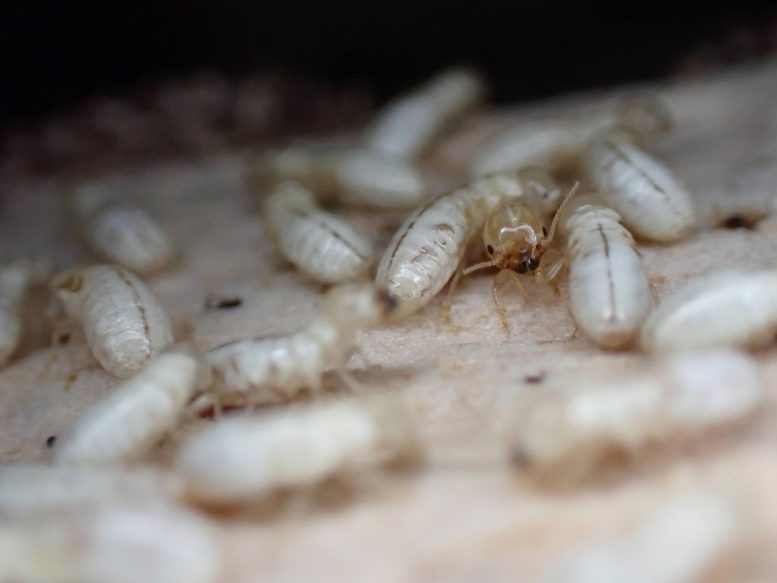
Bistrifluron stops exoskeleton formation
Unlike humans, who have internal skeletons, termites have external exoskeletons that protect them from environmental threats. These exoskeletons are made primarily of chitin, a substance also found in fungal cell walls, fish scales, and the beaks of squids and octopuses. Chitin gives insect exoskeletons their strength, acting both as armor and as a site for muscle attachment.
As termites are getting ready to molt, something they must do in order to grow, they also produce chitin to create the new exoskeleton. Bistrifluron prevents them from doing so.
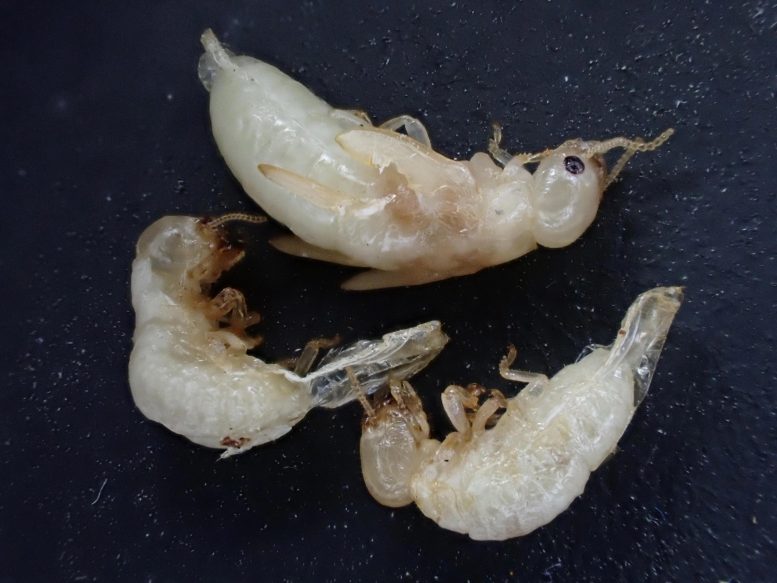
“Once the termites reach a certain stage, they have to molt. They cannot avoid that,” said Dong-Hwan Choe, UCR entomology professor and senior paper author. “With a lethal dose of this chemical, they’ll try to shed their old exoskeleton but won’t have a new one ready to protect them.”
Spreading through the colony over time
The researchers observed that bistrifluron initially slows the termites down, reducing their feeding activity. Eventually it prevents them from molting, and they die. This is one of the first studies, Choe said, that looks at the impact of chitin-inhibiting chemicals on drywood termites.
“It’s been successfully used on subterranean termites, which are also important structural pests,” Choe said. “But native western drywood termites are also important, especially in California.”
As the termites eat the treated wood, they also spread the chemical to other members of the colony. Full collapse happens in about two months, which is slower than other methods but carries certain advantages in addition to lower toxicity.
“We believe this method of spot treatment can kill a larger colony and spread more easily than current termite control methods,” Choe said. “You don’t have to apply too much to get a very good result. The chitin synthesis inhibitors show promise as localized treatment for drywood termites.”
An alternative to toxic fumigation
Traditional fumigation is not only toxic to humans and stressful ¾ it requires people to bag all of their food and move out of their home ¾ it also does not keep the termites from returning.
“Low-impact strategies like this one will become an attractive option in many cases. Furthermore, the chemical may stay active in the wood for some time, potentially providing protection from future infestations,” Choe said.
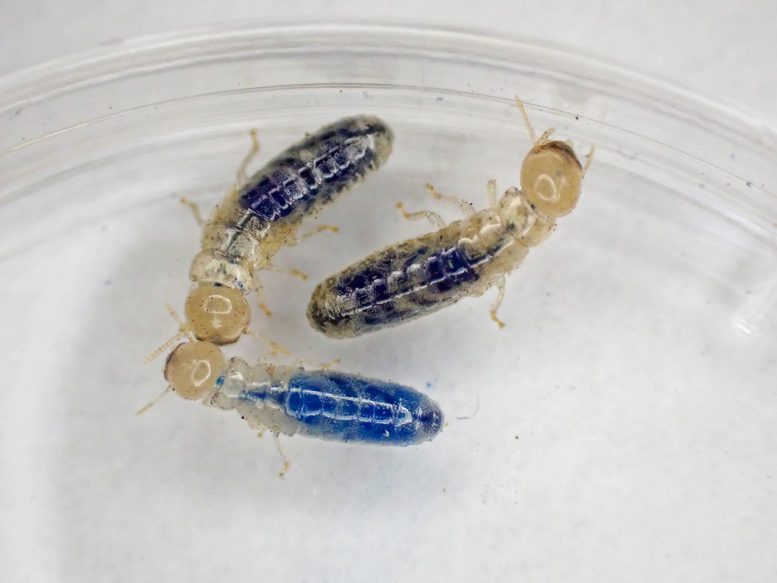
Previously, the Choe laboratory discovered a potent yet nontoxic way to lure western drywood termites to their doom. Pinene, a pleasant-smelling chemical released by forest trees, reminds the insects of their food. They follow the scent to wood treated with insecticide.
“We saw significant differences in the death rates using insecticide alone versus the insecticide plus pinene,” said Choe. “Without pinene, we got about 70% mortality. When we added it in, it was over 95%.
Improving practicality for real-world use
Moving forward, the researchers are looking into ways to make bistrifluron easier to apply to wood. For the research described in the paper, the chemical was dissolved in acetone and applied to wood. However, in real life, this solvent isn’t desirable because it is flammable and smells bad.
“We are working to make it more feasible for practical application in real-life scenarios,” Poulos said.
Property owners will likely welcome the innovation, as this species of termite causes a great deal of damage. They are endemic to northern Mexico and California, but as the climate warms, their range is expanding north to areas they did not previously inhabit.
“As we move lumber around the world, the termites are constantly transported to new locations. If they find the climate there acceptable, the problem will spread,” Choe said. “In areas where these termites are common, it’s just a matter of time before homes are infested, so this study is a good initial step toward alternative strategies for controlling them.”
Reference: “Toxicity and horizontal transfer of chitin synthesis inhibitors in the western drywood termite (Blattodea: Kalotermitidae)” by Nicholas A Poulos, Chow-Yang Lee, Michael K Rust and Dong-Hwan Choe, 19 March 2025, Journal of Economic Entomology.
DOI: 10.1093/jee/toaf064
Never miss a breakthrough: Join the SciTechDaily newsletter.
Follow us on Google and Google News.
16 Comments
Plenty could go wrong, despite the article’s enthusiastic tone. Here are several potential concerns:
—
1. Ecological Disruption
Non-target insects: Although bistrifluron is said to be “insect-specific,” chitin is present in all arthropods—including bees, ants, beetles, butterflies, and other beneficial or keystone species. If the compound or its delivery method is not highly selective, collateral damage to non-pest insect populations could occur.
Predator-prey cascades: Disrupting termite populations might affect food chains, especially in ecosystems where termites play critical roles in decomposition and soil formation.
—
2. Resistance Development
Evolutionary arms race: Like antibiotics or glyphosate, overuse could lead to termite populations evolving resistance to bistrifluron, especially if it becomes widespread and heavily relied upon.
Super termites: Partial mortality (e.g., 95%) means surviving termites could carry resistant genes, eventually producing a population that is immune to this chemical.
—
3. Bioaccumulation and Secondary Toxicity
Unknown environmental persistence: If the chemical remains active in wood for long periods, what is its fate in ecosystems? Could it leach into soil or water systems and accumulate?
Trophic transfer: Predators (like birds or lizards) that eat poisoned termites may ingest the compound too. Even if it’s said to be non-toxic to mammals, effects on birds, reptiles, or amphibians haven’t been discussed.
—
4. False Sense of Security
Underestimating reinfestation: While it may prevent some future infestations if it remains active, there’s no mention of how it interacts with other termite species or whether it might lull property owners into neglecting broader structural or environmental vulnerabilities.
Replacement pests: Removing termites from an ecological niche sometimes results in replacement by other, potentially more difficult or damaging pests.
—
5. Human and Pet Exposure Underestimated
Limited testing scope: “Can’t harm humans” is a sweeping claim. Has it been tested against chronic exposure, endocrine disruption, long-term inhalation in enclosed environments, or unusual metabolic responses in certain individuals (children, elderly, immunocompromised)?
Chemical mixtures: The chemical is delivered using acetone in current tests—a flammable and volatile solvent. Real-world formulations might involve different carriers or additives with unknown interactions.
—
6. Misuse or Overuse
DIY risks: If marketed as “safe” and “effective,” overenthusiastic or untrained individuals may overapply it, use it in unintended ways, or spread it into ecosystems where it’s unnecessary.
Black market formulations: Cheap knock-offs or unregulated international versions might use similar compounds with impurities, or incorrect concentrations.
—
7. Moral Hazard in Development or Trade
Encourages global lumber trade without caution: If people believe there’s a “magic bullet” for termites, attention may drift away from essential policies regarding lumber inspection, sustainable forestry, or pest-prevention infrastructure.
Complacency in climate adaptation: The article notes that warming climates are allowing termite range expansion—relying on chemical solutions might obscure the larger need for climate-resilient building practices.
—
In short, the promise of a “non-toxic miracle solution” for termites is likely overstated and potentially dangerous if adopted without broader ecological and public health scrutiny.
“In short, the promise of a “non-toxic miracle solution” for termites is likely overstated and potentially dangerous if adopted without broader ecological and public health scrutiny.”
Same with Covid-19 mRNA shots!
Haha you almost made sense there
The simple natural solution to pest control is applying predator to prey. Fire Ants are territorial. They defend their nest with their life. They also love to kill and eat termites. A real world experiment that I attempted (which was successful) was applying a shovel full of Fire Ants on top of a nest of Termites found in the wall (located under the tub where the drain comes through the concrete slab) of a house that I purchased. The wood frame of the wall was infested and needed to be replaced which I did after terminating the Termites by allowing the Fire Ants to naturally eliminate them. Once the Fire Ants had eliminated the Termites, they made their way out of the house by traveling under the concrete slab. I haven’t had a reoccurring problem with Termites since. I applied the Fire Ants about twenty years ago. The only residual affect I have observed is that during a hot extremely dry period, the Fire Ants return to collect water from the inside of the bathtub and water that is tracked onto the floor of the bathroom by my wife, children, and grandchildren. I thought about using a repellent to keep them out of the house, but they have not become aggressive, nor do they attempt to bite or sting us since they are territorial and only protect their nest which is outside of the house. If you touch one it runs away. We need more sound organic science like this to be applied to controlling problems instead of using chemicals and/or man made substances that always cause harm and casualties of non-target species. The issue with doing things naturally is that it’s not profitable to these companies that care nothing about our health, or the health of our planet.
LMFAO you are extremely delusional and mentally handicapped….. Fire ants are 10× more dangerous and diseased than any termite. You deserve every bite and venom injection you get. They are also one of the most aggressive insects in the animal Kingdom. Congrats, ant bozo!!!🤡🤹🏻🐜
“Can’t harm humans” is a sweeping claim.
You are being kind. The best science can offer is that, “No evidence has been found that it can harm humans.” Science proves what CAN happen, not what CANNOT.
Articles like this contribute to distrust in sciences when, as you state, evidence is discovered that chronic exposure is demonstrated to cause harm.
Succinctly stated. Well done.
Glyphosate inhibits EPSP synthase. Humans do not use EPSP synthase. Yet Glyphosate is harmful to humans. You can’t say “it can’t harm humans”. It’s OK to say it’s not known whether it will harm humans, other insects or environment at this time.
glyphosate is not harmful to humans
the additives in it are
Leaving only 5% of the toughest termites that are resistant to anything. They will destroy all life on Earth.
New Chemical. That means We don’t even know what’s side effects going to be yet.
New Chemical….
That means We don’t even know what’s side effects going to be yet.
Wood glue works really well
The article is so way off any intelligent standards that I felt a need to respond with some of the obvious caveats the writer missed out on – such that many animals, not just termites, rely on their exoskeletons and that a chemical which remains in place and accumulates over time seems a good candidate for the next troublesome forever chemical – but I can see that others beat me to it, and the AI contribution is particularly covering.
Thereby, I’ll just add that it also wouldn’t be the first time in history if a breakdown product from this new wonder chemical proved to be worse for us and the environment than the mother compound: in other words, this article sounds more like unscrupulous appraisals by a seller than what it was supposed to be.
I am in Sydney, and I need name and number of an Australian distributor for this product BISTRIFLURON
please reply urgently!!!!
This is a ton of delusional anti-science that is completely in effective in every sense of word.. Hey Song, Hwang, find another hallucination to get high on..you fkn weirdo….
Termites are important for our ecosystems. Unlike you!!!🤡🤹🏻🎪