
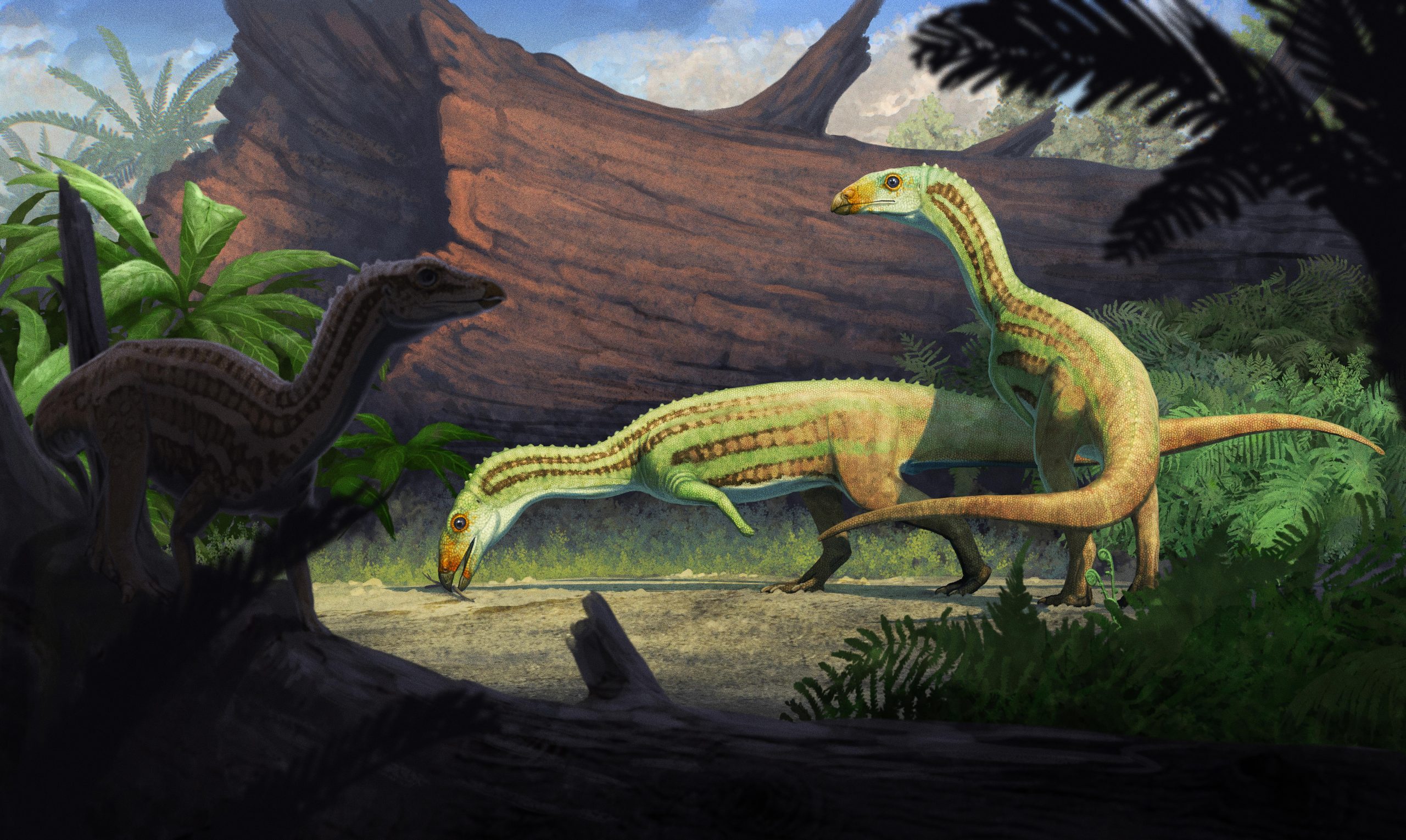
A strange crocodile relative that may have shifted from four legs to two is shedding light on convergent evolution and the hidden diversity of Triassic ecosystems.
A “peculiar” reptile from the age of dinosaurs is challenging assumptions about how ancient crocodile relatives moved. Scientists say this small Triassic animal may have begun life on four legs before later shifting to a two-legged stance, a rare developmental change among reptiles.
The species, Sonselasuchus cedrus, belonged to a group known as shuvosaurids, an unusual branch of crocodile-line archosaurs. Despite their lineage, many of these animals bore a striking resemblance to fast-running, ostrich-like dinosaurs called ornithomimids. Both groups lived side by side during the Late Triassic period (approximately 225-201 million years ago), long before modern crocodiles took on their familiar body plan.
Unusual Fossils Reveal a Unique Growth Pattern
A study published in the Journal of Vertebrate Paleontology describes how researchers from the University of Washington Department of Biology and the Burke Museum analyzed fossil remains with unusual limb proportions. These differences suggest the animal did not walk on two legs throughout its entire life.
“By analyzing the proportions of the limb skeletons of different animals, they determined its bipedal stance (standing on two feet) may have been the result of a differential growth pattern,” explains lead author Elliott Armour Smith.
“We think that Sonselasuchus had more proportional forelimbs and hindlimbs as young, and their hindlimb grew longer and more robust through adulthood. Essentially, we think these creatures started out their lives on four legs… they then started walking on two legs as they grew up.”
He adds, “This is particularly peculiar.”
Armour Smith, a graduate student, worked on the project with Burke Museum researcher Professor Christian Sidor.
Fossil Discovery and Excavation EffortsFossil Discovery and Excavation Efforts
Professor Sidor was part of the team that uncovered 950 Sonselasuchus fossils in 2014 at Arizona’s Petrified Forest National Park, a site known for its rich fossil record. Over the past decade of excavation and preparation, more than 3,000 fossil bones have been recovered from the area.
The fossils also offer insight into the animal’s appearance. Researchers estimate it stood about 25 inches (about 64 centimeters) tall and had a toothless beak, large eye sockets, and hollow bones.
“Although similar to the ornithomimid dinosaurs these features would have evolved separately,” explains Armour Smith, “and this similarity was probably due to the fact that croc-line and bird-line archosaurs evolved in the same ecosystems and converged upon similar ecological roles.
“Also, despite the fact that features like bipedalism, a toothless beak, hollow bones, and a large orbit are characteristic of ornithomimid theropod dinosaurs, shuvosaurids like Sonselasuchus show that these features evolved on the croc-line as well.”
Habitat, Naming, and Geological Context
Sonselasuchus likely lived in forested environments. The species name cedrus refers to cedar trees, evergreen conifers similar to those present during the Late Triassic.
The genus name (pronounced “sawn-SAY-la-SOOK-us”) comes from the Sonsela Member of the Upper Triassic Chinle Formation, the geologic unit where the fossils were found. This rock layer has produced many important discoveries.
For Professor Sidor, the research reflects more than ten years of collaboration with the National Park Service.
“Since starting fieldwork at Petrified Forest in 2014, we have collected over 3,000 fossils from the Sonselasuchus bonebed, and it doesn’t seem to show any signs of petering out,” Professor Sidor states.
“In addition to Sonselasuchus, the bonebed has yielded fossils of fish, amphibians, as well as dinosaurs and other reptiles. Over 30 University of Washington students and volunteers have been involved over the years. It’s exciting to see that the site continues to produce new and interesting fossils.”
Reference: “Osteology and relationships of a new shuvosaurid (Pseudosuchia, Poposauroidea) from the Upper Triassic Chinle Formation of Petrified Forest National Park, Arizona, U.S.A.” by Elliott Armour Smith and Christian A. Sidor, 8 March 2026, Journal of Vertebrate Paleontology.
DOI: 10.1080/02724634.2025.2604859
Never miss a breakthrough: Join the SciTechDaily newsletter.
Follow us on Google and Google News.
1 Comment
That rear one seems to be walking on two legs and his face…Center of gravity is impossible there…