
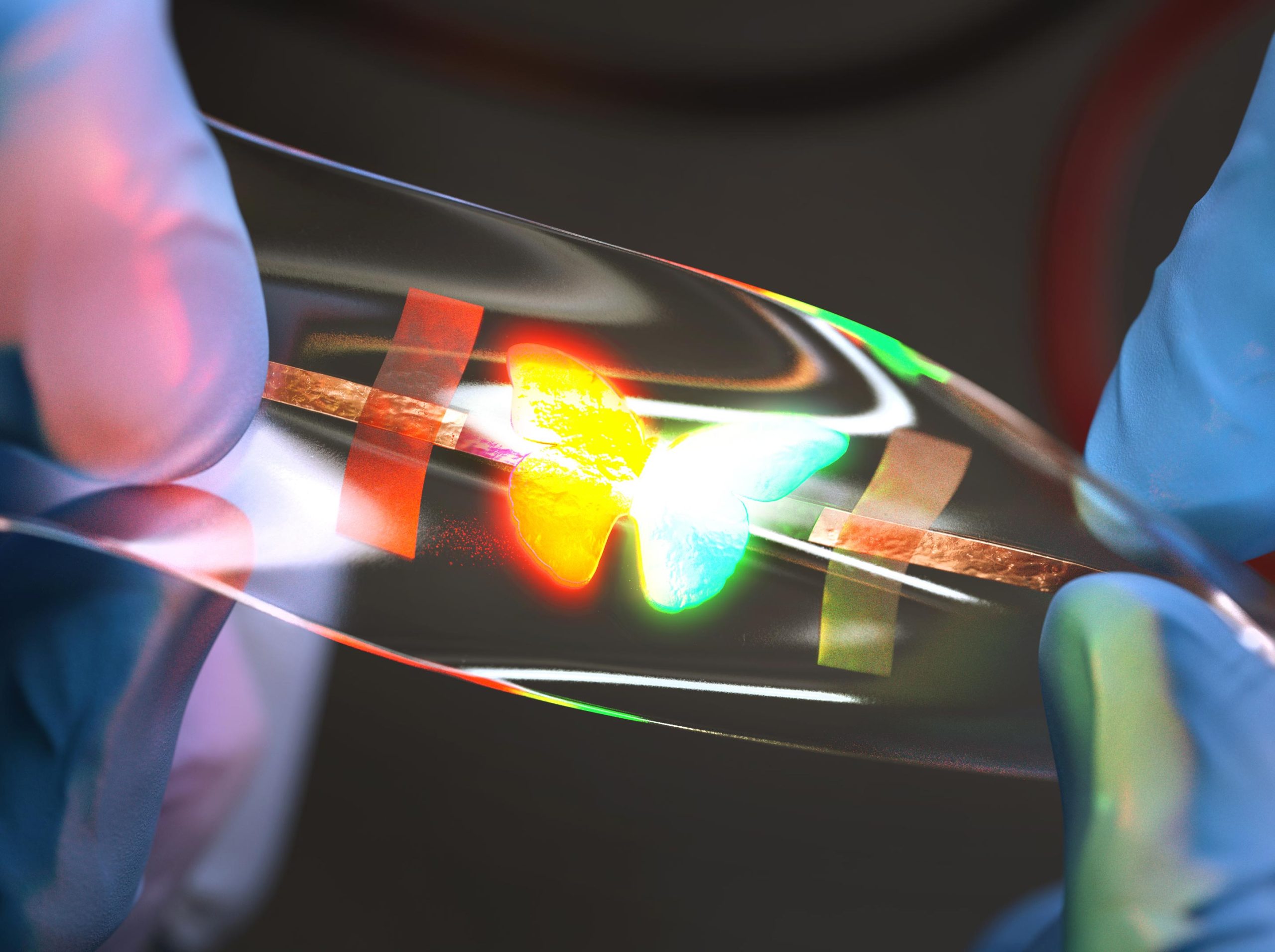
Intrinsically stretchable quantum dot-based light-emitting diodes achieved record-breaking performance.
A team of South Korean scientists led by Professor KIM Dae-Hyeong of the Center for Nanoparticle Research within the Institute for Basic Science has pioneered a novel approach to stretchable displays. The team announced the first development of intrinsically stretchable quantum dot light-emitting diodes (QLEDs).
Advancements in Display Technology
In the rapidly evolving world of display technologies, the quest for creating intrinsically stretchable displays has been ongoing. Traditional displays, constrained by rigid and inflexible components, have struggled to evolve beyond flexible ones.
There has been a clear need for novel materials and device designs that can endure significant stretching while maintaining their functionality, which is essential for applications including wearable and adaptable interfacing technologies.
Limitations of OLED and Advantages of QLED
The majority of the flexible displays on the market employ organic light-emitting diode (OLED) technology, which employs organic materials as light-emitting components. However, OLED often has drawbacks such as limited brightness and color purity issues. On the other hand, QLED displays offer excellent color reproduction, brightness, and longevity, making them a compelling choice for consumers who prioritize these factors.
Challenges in Developing Flexible QLEDs
However, the intrinsic challenge for developing flexible QLED displays lies in the nature of quantum dots (QDs) themselves; as 0-D inorganic nanoparticles, they do not possess inherent stretchability. There have been some attempts to embed QDs within elastic materials to create a light-emitting and elastic composite material.
A significant hurdle encountered during this approach was the elastomers’ insulating properties, which impede the efficient injection of electrons and holes into the QDs, thereby diminishing the device’s electroluminescent efficiency.
Breakthrough in Material Engineering
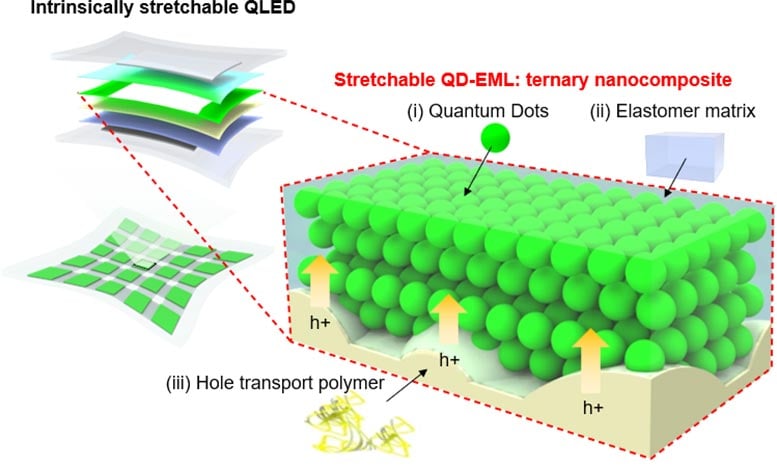
Hence the IBS researchers had to come up with innovations to overcome these limitations. Their work showcased the incorporation of a third material in the composite to enhance carrier delivery to the QDs. A p-type semiconducting polymer, TFB, was employed to enhance both the stretchability of the device and the efficiency of hole injection. Adding TFB also improved the balance between the electron and hole injections.
Enhanced Device Structure and Performance
An intriguing aspect of the ternary nanocomposite film was the distinctive internal structure exhibiting phase separation, where TFB-rich “islands” are formed at the base and QDs embedded in the SEBS-g-MA matrix lay on top of these islands. This unique structural arrangement minimizes exciton quenching sites and enhances hole injection efficiency, resulting in optimal device performance.
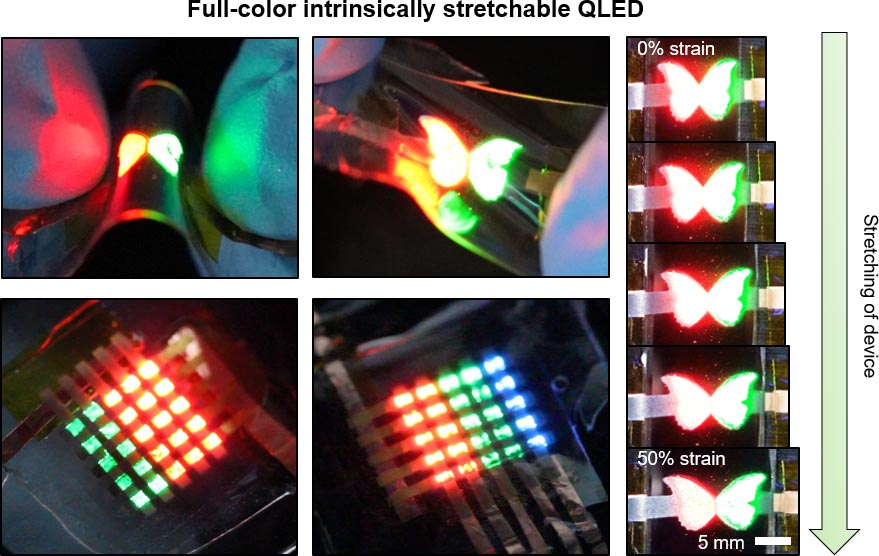
After careful selection and engineering of these materials, the IBS researchers achieved QLEDs with high brightness (15,170 cd m-2), which is the highest among the stretchable LEDs, in addition to a low threshold voltage (3.2 V). The device did not suffer damage even when significant force was applied to stretch the material. Even when stretched up to 1.5 times, there was no significant change in the distance between the quantum dots inside the device. For example, if a 20-inch QLED TV is made with this device, this means that the display performance will remain the same even when pulled to a 30-inch size.
Future Directions and Potential Applications
Co-first author Professor KIM Dong-chan explained, “Our research team has also developed a high-resolution patterning technology that can be applied to stretchable quantum dot light-emitting layers,” adding, “By combining light-emitting materials and patterning technology, we demonstrated the potential of our device for RGB LEDs and complex applications like passive matrix arrays.”
This research not only demonstrates the superior performance of QDs in stretchable displays but also sets a new direction for further enhancing device performance. Future research will focus on optimizing carrier injection efficiency and stretchability across all device layers. This finding lays a solid foundation for the next generation is-QLED technology, promising a future where display technologies are not just flexible but truly stretchable, allowing new forms of wearable electronics and beyond.
Reference: “Intrinsically stretchable quantum dot light-emitting diodes” by Dong Chan Kim, Hyojin Seung, Jisu Yoo, Junhee Kim, Hyeon Hwa Song, Ji Su Kim, Yunho Kim, Kyunghoon Lee, Changsoon Choi, Dongjun Jung, Chansul Park, Hyeonjun Heo, Jiwoong Yang, Taeghwan Hyeon, Moon Kee Choi and Dae-Hyeong Kim, 15 April 2024, Nature Electronics.
DOI: 10.1038/s41928-024-01152-w
This research has been conducted in collaboration with colleagues from Seoul National University, Ulsan National Institute of Science and Technology, and Daegu Gyeongbuk Institute of Science and Technology. It was published in Nature Electronics on April 16, 2024.
Never miss a breakthrough: Join the SciTechDaily newsletter.
Follow us on Google and Google News.