

Close Menu
    Facebook X (Twitter) Instagram
    SciTechDaily
    • Biology
    • Chemistry
    • Earth
    • Health
    • Physics
    • Science
    • Space
    • Technology
    Facebook X (Twitter) Pinterest YouTube RSS
    SciTechDaily
    Home»Technology»Scaling Up Quantum Computers: RIKEN Scientists Connect Distant Silicon Qubits
    Technology

    Scaling Up Quantum Computers: RIKEN Scientists Connect Distant Silicon Qubits

    By RIKENJune 5, 20232 Comments3 Mins Read
    Facebook Twitter Pinterest Telegram LinkedIn WhatsApp Email Reddit
    Share
    Facebook Twitter LinkedIn Pinterest Telegram Email Reddit
    Quantum Bits QuBits Atomic Particle Physics
    RIKEN researchers have connected two physically distant silicon spin qubits using a method called coherent spin shuttling, a major step toward large-scale quantum computing. This breakthrough overcomes the challenge of linking far-apart quantum dots, a critical hurdle in scaling quantum computers from hundreds to millions of qubits.

    The linking of two distant qubits will help to develop larger, more complex quantum computers based on silicon quantum dots.

    In a demonstration that promises to help scale up quantum computers based on tiny dots of silicon, RIKEN physicists have succeeded in connecting two qubits—the basic unit for quantum information—that are physically distant from each other.

    Many big IT players—including the likes of IBM, Google, and Microsoft—are racing to develop quantum computers, some of which have already demonstrated the ability to greatly outperform conventional computers for certain types of calculations. But one of the greatest challenges to developing commercially viable quantum computers is the ability to scale them up from a hundred or so qubits to millions of qubits.

    In terms of technologies, one of the front-runners to achieve large-scale quantum computing is silicon quantum dots that are a few tens of nanometers in diameter. A key advantage is that they can be fabricated using existing silicon fabrication technology. But one hurdle is that, while it is straightforward to connect two quantum dots that are next to each other, it has proved difficult to link quantum dots that are far from each other.
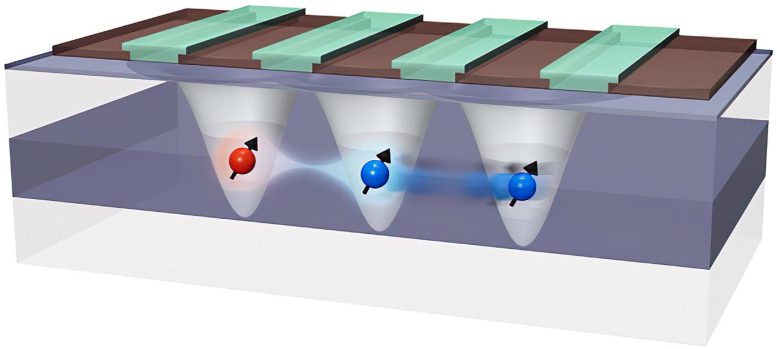
    Linking Two Distant Qubits
    Figure 1: RIKEN researchers have linked two distant qubits (red and blue spheres with black arrows gray cones on left and right) by coherent shuttling of one of the qubits (blue spheres). Credit: © 2023 RIKEN Center for Emergent Matter Science

    “In order to connect many qubits, we have to densely cram many of them into a very small area,” says Akito Noiri of the RIKEN Center for Emergent Matter Science. “And it’s very hard to use wires to connect such very densely packed qubits.”

    Now, Noiri and co-workers have realized a two-qubit logic gate between physically distant silicon spin qubits (Fig. 1).

    “While there has been a lot of work in this area using various approaches, this is the first time that anyone has succeeded in demonstrating a reliable logic gate formed by two distant qubits,” says Noiri. “The demonstration opens up the possibility of scaling up quantum computing based on silicon quantum dots.”
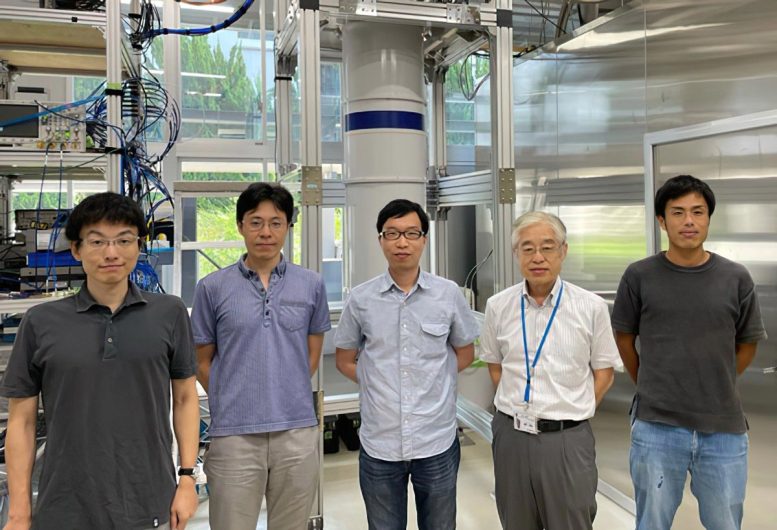
    Akito Noiri Distant Qubit Team
    Akito Noiri (far right) and co-workers have demonstrated a logic gate based on two distant qubits linked by coherent spin shuttling. Credit: © 2023 RIKEN

    To connect the two qubits, the team used a method known as coherent spin shuttling, which allows single spin qubits to be moved across an array of quantum dots without affecting their phase coherence—an important property for quantum computers since it carries information. This method involves pushing electrons through an array of qubits by applying a voltage.

    Although the physical separation between the two qubits was relatively short, Noiri is confident that it can be extended in future studies. “We want to increase the separation to about a micrometer or so,” he says. “That will make the method more practical for future use.”

    Reference: “A shuttling-based two-qubit logic gate for linking distant silicon quantum processors” by Akito Noiri, Kenta Takeda, Takashi Nakajima, Takashi Kobayashi, Amir Sammak, Giordano Scappucci and Seigo Tarucha, 30 September 2022, Nature Communications.
    DOI: 10.1038/s41467-022-33453-z

    Never miss a breakthrough: Join the SciTechDaily newsletter.
    Follow us on Google and Google News.

    Quantum Computing Quantum Dots RIKEN Semiconductors
    Share. Facebook Twitter Pinterest LinkedIn Email Reddit

    Related Articles

    The Dawn of a New Era: A New Type of Quantum Bit Achieved in Semiconductor Nanostructures

    A Hole New World: RIKEN’s Breakthrough in Silicon Quantum Dot Lifespan

    Quantum Computing Breakthrough: Entanglement of Three Spin Qubits Achieved in Silicon

    A Peculiar State of Matter in Layers of Semiconductors Could Advance Quantum Computing

    Important Milestone in the Creation of a Quantum Computer That Uses Transistors As Qubits

    Artificial Atoms in Silicon “Quantum Dot” Create Stable Qubits for Quantum Computing

    Kick-Starting Moore’s Law With Breakthrough ‘Synthetic’ Method for Making Microchips

    Researchers Demonstrate the Scalability of Quantum Dot Architectures

    New Spin Technique Moves Quantum Computers a Step Closer

    2 Comments

    1. Qqqqqqqq on June 6, 2023 10:36 pm

      Hahahahahahahahahahahahahahahahahahahahahahahahahahahahahahahahahahahahahahahahahahahahahahahahahahhahahahahahahahahahahahahhahahahahahahhhhahahahahahahahahahahahahhahahahahahahahwh

      Reply
    2. [email protected] on June 7, 2023 5:13 pm

      It’s reset is already done and replaced in a conjunction induced breaching shutterance with the solution is hard echo round mirror back in sync to hole cycle completions

      Reply
    Leave A Reply Cancel Reply

    • Facebook
    • Twitter
    • Pinterest
    • YouTube

    Don't Miss a Discovery

    Subscribe for the Latest in Science & Tech!

    Trending News

    Monster Storms on Jupiter Unleash Lightning Beyond Anything on Earth

    Scientists Create “Liquid Gears” That Spin Without Touching

    The Simple Habit That Could Help Prevent Cancer

    Millions Take These IBS Drugs, But a New Study Finds Serious Risks

    Scientists Unlock Hidden Secrets of 2,300-Year-Old Mummies Using Cutting-Edge CT Scanner

    Bread Might Be Making You Gain Weight Even Without Eating More Calories

    Scientists Discover Massive Magma Reservoir Beneath Tuscany

    Europe’s Most Active Volcano Just Got Stranger – Here’s Why Scientists Are Rethinking It

    Follow SciTechDaily
    • Facebook
    • Twitter
    • YouTube
    • Pinterest
    • Newsletter
    • RSS
    SciTech News
    • Biology News
    • Chemistry News
    • Earth News
    • Health News
    • Physics News
    • Science News
    • Space News
    • Technology News
    Recent Posts
    • This Simple Fruit Wash Could Make Produce Safer and Last Days Longer
    • These Tiny Robots 50x Smaller Than a Hair Can Hunt and Move Bacteria
    • Simple Blood Test May Predict Alzheimer’s Years Before Brain Scans Show Signs
    • Scientists Say Adding This Unusual Seafood to Your Diet Could Reverse Signs of Aging
    • U.S. Waste Holds $5.7 Billion Worth of Crop Nutrients
    Copyright © 1998 - 2026 SciTechDaily. All Rights Reserved.
    • Science News
    • About
    • Contact
    • Editorial Board
    • Privacy Policy
    • Terms of Use

    Type above and press Enter to search. Press Esc to cancel.