
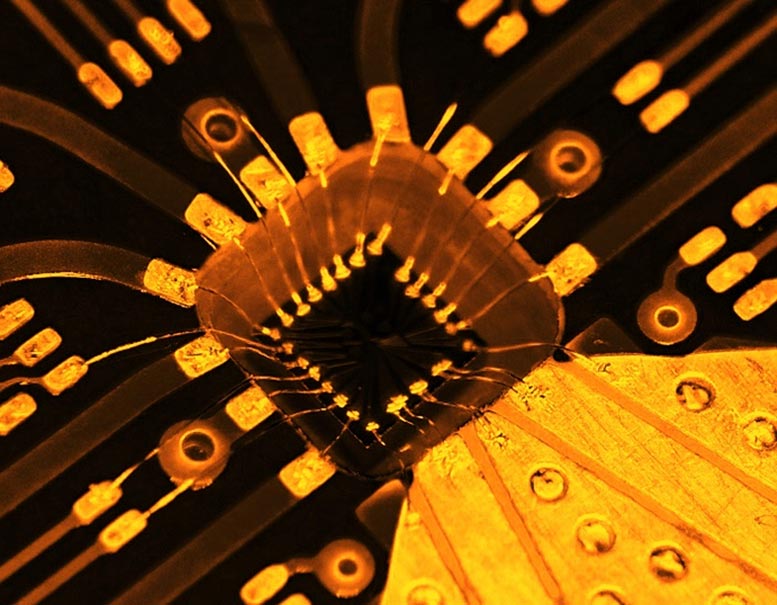
Researchers from RIKEN and QuTech—a collaboration between TU Delft and TNO— have achieved a key milestone toward the development of a fault-tolerant quantum computer. They were able to demonstrate a two-qubit gate fidelity of 99.5 percent—higher than the 99 percent considered to be the threshold for building fault-tolerant computers—using electron spin qubits in silicon, which are promising for large-scale quantum computers as the nanofabrication technology for building them already exists.
The world is currently in a race to develop large-scale quantum computers that could vastly outperform classical computers in certain areas. However, these efforts have been hindered by a number of factors, including in particular the problem of decoherence, or noise generated in the qubits. This problem becomes more serious with the number of qubits, hampering scaling up. In order to achieve a large-scale computer that could be used for useful applications, it is believed that a two-qubit gate fidelity of at least 99 percent to implement the surface code for error correction is required. This has been achieved in certain types of computers, using qubits based on superconducting circuits, trapped ions, and nitrogen-vacancy centers in diamond, but these are hard to scale up to the millions of qubits required to implement practical quantum computation with an error correction.
To do the current work, published in Nature, the group decided to experiment with a quantum dot structure that was fabricated by nanofabrication on a strained silicon/silicon germanium quantum well substrate, using a controlled-NOT (CNOT) gate. In previous experiments, the gate fidelity was limited due to slow gate speed. To improve the gate speed, they carefully designed the device and tuned the operation conditions by adjusting the voltages applied to the gate electrodes. This combined the established fast single-spin rotation technique using micromagnets with a large two-qubit coupling. This allows them to enhance the gate speed by a factor of 10 compared to the previous works. Interestingly, it was previously believed that increasing gate speed would always lead to better fidelity, but they found that there was a limit, and that beyond that the increasing speed actually made the fidelity worse.
Rabi Frequency and Gate Fidelity
Through the work, they discovered that a property called the Rabi frequency—a marker of how the qubits change states in response to an oscillating field—is key to the performance of the system, and they found a range of frequencies for which the single-qubit gate fidelity was 99.8 percent and the two-qubit gate fidelity was 99.5 percent, clearing the required threshold.
Through this, they demonstrated that they could achieve universal operations, meaning that all the basic operations that constitute quantum operations, consisting of a single-qubit operation and a two-qubit operation, could be performed with the gate fidelities above the error correction threshold.
To test the capability of the new system, the researchers implemented a two-qubit Deutsch-Jozsa algorithm and the Grover search algorithm. On both algorithms output correct results with a high fidelity of 96-97%, demonstrating that silicon quantum computers can perform quantum calculations with high accuracy.
Implications for Silicon Quantum Computers
Akito Noiri, the first author of the study, says, “We are very happy to have achieved high-fidelity universal quantum gate set, one of the key challenges for silicon quantum computers.”
Seigo Tarucha, leader of the research groups, said, “The presented result makes spin qubits, for the first time, competitive against superconducting circuits and ion traps in terms of universal quantum control performance. This study demonstrates that silicon quantum computers are promising candidates, along with superconductivity and ion traps, for research and development toward the realization of large-scale quantum computers.
In the same issue of Nature, experimental demonstrations of similarly high-fidelity universal quantum gate sets achieved in silicon qubits are also reported from two independent research teams. A team at QuTech also used electron spin qubits in quantum dots (Quantum logic with spin qubits crossing the surface code threshold). Another team at UNSW Sydney (University of New South Wales) used a pair of ion-implanted phosphorous nuclei in silicon as nuclear spin qubits (Precision tomography of a three-qubit donor quantum processor in silicon).
Reference: “Fast universal quantum gate above the fault-tolerance threshold in silicon” by Akito Noiri, Kenta Takeda, Takashi Nakajima, Takashi Kobayashi, Amir Sammak, Giordano Scappucci and Seigo Tarucha, 19 January 2022, Nature.
DOI: 10.1038/s41586-021-04182-y
See Major Breakthrough As Quantum Computing in Silicon Hits 99% Accuracy for more on this research.
Never miss a breakthrough: Join the SciTechDaily newsletter.
Follow us on Google and Google News.