

Close Menu
    Facebook X (Twitter) Instagram
    SciTechDaily
    • Biology
    • Chemistry
    • Earth
    • Health
    • Physics
    • Science
    • Space
    • Technology
    Facebook X (Twitter) Pinterest YouTube RSS
    SciTechDaily
    Home»Health»COVID-19 Has Revealed Critical Knowledge Gaps on the Transmission of Respiratory Viruses
    Health

    COVID-19 Has Revealed Critical Knowledge Gaps on the Transmission of Respiratory Viruses

    By American Association for the Advancement of Science (AAAS)September 6, 20211 Comment2 Mins Read
    Facebook Twitter Pinterest Telegram LinkedIn WhatsApp Email Reddit
    Share
    Facebook Twitter LinkedIn Pinterest Telegram Email Reddit
    Mutating Virus Cells
    Rendering of mutating virus cells. Credit: istock.com/wildpixel

    The COVID-19 pandemic has revealed critical knowledge gaps and assumptions concerning how respiratory viruses spread between hosts.

    Traditionally thought to be spread mainly through large respiratory droplets produced by the coughs and sneezes of sick individuals, a growing body of evidence indicates that many respiratory pathogens – including SARS-CoV-2– spread through virus-laden microscopic respiratory aerosols. In this Review, Chia Wang and colleagues discuss the recent research regarding airborne transmission of respiratory viruses and how an improved understanding of aerosol transmission will allow for better-informed controls to reduce and mitigate airborne transmission.

    Until recently, most respiratory pathogens were assumed to spread through large droplets expirated from an infectious person or transferred from contaminated surfaces. This understanding has largely guided public health recommendations in mitigating viral spread. However, several respiratory pathogens, including influenza and the common cold, are also known to spread through infectious respiratory aerosols, which can float and travel in air flows at far greater distances and for much longer, infecting those who inhale them.
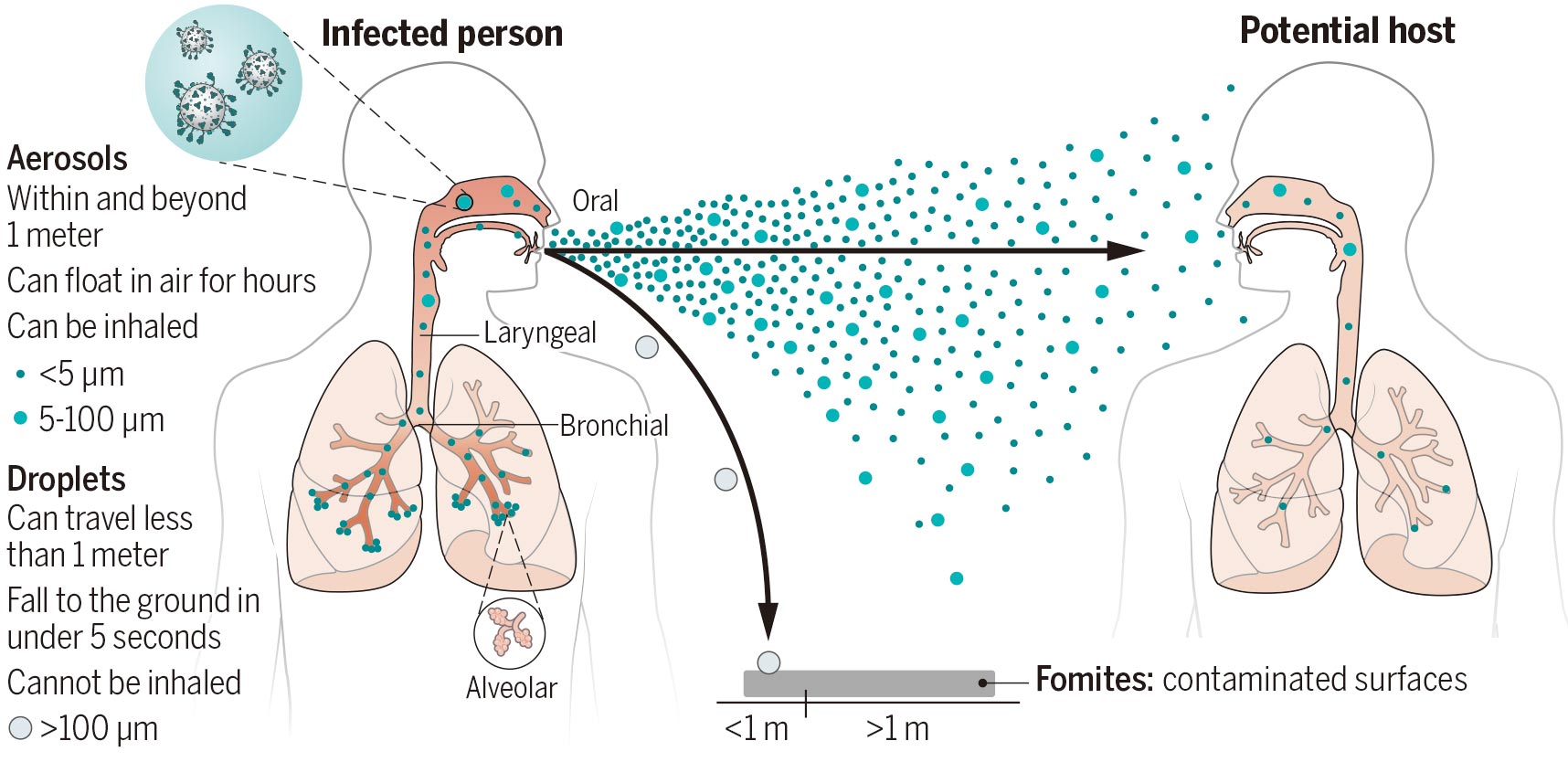
    Airborne Transmission of Virus-Laden Aerosols
    Phases involved in airborne transmission of respiratory viruses. Credit: From Wang et al., ‘Airborne transmission of respiratory viruses’ (https://doi.org/10.1126/science.abd9149). N.CARY/SCIENCE

    According to a growing body of evidence, much of which was gained from studying the spread of COVID-19, airborne transmission may be a more dominant mode of respiratory virus transmission than previously thought.

    Here, Wang et al. highlight how infectious aerosols are generated, travel throughout an environment and deliver their viral payloads to hosts. The authors also outline ways to mitigate aerosol transmission at long and short ranges, including improvements to ventilation and airflows, air filtration, UV disinfection and personal face mask fit and design.

    For more on this research, see It’s Not Just COVID-19: Most Respiratory Viruses Actually Spread by Aerosols.

    Reference: “Airborne transmission of respiratory viruses” by Kimberly A. Prather, Josué Sznitman, Jose L. Jimenez, Seema S. Lakdawala, Zeynep Tufekci and Linsey C. Marr, 27 August 2021, Science.
    DOI: 10.1126/science.abd9149

    Never miss a breakthrough: Join the SciTechDaily newsletter.
    Follow us on Google and Google News.

    American Association for the Advancement of Science COVID-19 Infectious Diseases Popular Public Health
    Share. Facebook Twitter Pinterest LinkedIn Email Reddit

    Related Articles

    New Study Shows Third Dose of Pfizer-BioNTech COVID Vaccine May Protect Against Omicron

    “Silent” COVID-19 Infection May Be Far More Common Than Thought – High Rate of False Negative Test Results

    Evidence Shows Cloth Masks May Help Against COVID-19 – Especially Those With Several Layers of Cotton Cloth

    Scientists Test Best Fabric Choices for Making a Homemade COVID Mask

    Vitamin D Determines Severity in COVID-19: Researchers Urge Government to Change Advice

    How COVID-19 Kills: New Study Explains the Mechanisms of the New Coronavirus

    Vitamin D Linked to Low Coronavirus Death Rate

    How Effective Are Cloth Masks Against Coronavirus? [Video]

    Key Insights on How Coronavirus Spreads From Chinese Megacity of Shenzhen

    1 Comment

    1. Howard Jeffrey Bender, Ph.D. on September 6, 2021 10:42 am

      Whether spread by droplets or airborne, the vaccines we have are only handling half the problem. Some of the virus will evade them and enter cells, and we need to understand what happens then.

      All the coronaviruses and all their variants have different protein spikes, with Delta having one that’s more efficient at getting around the vaccines. But the real problem is in the virus itself, not its protein shell, and why the most dangerous (MERS, SARS, and Covid-19) are so infectious. My independent research has found multiple one-in-a-million nucleotide sequence matches between all the coronaviruses and the human genome. Those sequences are the same as some of the loops of human tRNA. Using those loops and their amino acid code matches, viruses may be able to fool the nucleus membrane in cells to allow the virus to enter and associate with the human DNA, creating more opportunities for further infection. Our immune system may be compromised and may no longer be able to stop the virus and other diseases from attacking organs throughout the body. Vaccines that attack the virus protein shells while ignoring their contents are doomed to failure from the Darwin effect, but recognizing these loops suggests a possible approach to successful coronavirus vaccines. Only the infection process is considered in my work, not the innate virulence of the virus. For more info, check out this YouTube, Coronavirus – Using Your DNA Against You. https://www.youtube.com/watch?v=8dOIzD6ch8s

      Reply
    Leave A Reply Cancel Reply

    • Facebook
    • Twitter
    • Pinterest
    • YouTube

    Don't Miss a Discovery

    Subscribe for the Latest in Science & Tech!

    Trending News

    One of the Universe’s Largest Stars May Be Getting Ready To Explode

    Scientists Discover Enzyme That Could Supercharge Ozempic-Like Weight Loss Drugs

    Popular Sweetener Linked to DNA Damage – “It’s Something You Should Not Be Eating”

    Ancient “Rock” Microbes May Reveal How Complex Life Began

    Researchers Capture Quantum Interference in One of Nature’s Rarest Atoms

    “A Plague Is Upon Us”: The Mass Death That Changed an Ancient City Forever

    Scientists Discover Game-Changing New Way To Treat High Cholesterol

    This Small Change to Your Exercise Routine Could Be the Secret to Living Longer

    Follow SciTechDaily
    • Facebook
    • Twitter
    • YouTube
    • Pinterest
    • Newsletter
    • RSS
    SciTech News
    • Biology News
    • Chemistry News
    • Earth News
    • Health News
    • Physics News
    • Science News
    • Space News
    • Technology News
    Recent Posts
    • Natural Compounds Boost Bone Implant Success While Killing Bacteria and Cancer Cells
    • After 60 Years, Scientists Uncover Unexpected Brain Effects of Popular Diabetes Drug Metformin
    • New Research Uncovers Hidden Side Effects of Popular Weight-Loss Drugs
    • Scientists Rethink Extreme Warming After Surprising Ocean Discovery
    • The Surprising Role of Asteroids in the Origin of Life
    Copyright © 1998 - 2026 SciTechDaily. All Rights Reserved.
    • Science News
    • About
    • Contact
    • Editorial Board
    • Privacy Policy
    • Terms of Use

    Type above and press Enter to search. Press Esc to cancel.