
Close Menu
    Facebook X (Twitter) Instagram
    SciTechDaily
    • Biology
    • Chemistry
    • Earth
    • Health
    • Physics
    • Science
    • Space
    • Technology
    Facebook X (Twitter) Pinterest YouTube RSS
    SciTechDaily
    Home»Science»Revolution in Methane Detection: Scientists Achieve Groundbreaking 500-Fold Sensitivity Increase
    Science

    Revolution in Methane Detection: Scientists Achieve Groundbreaking 500-Fold Sensitivity Increase

    By Hefei Institutes of Physical Science, Chinese Academy of SciencesMay 5, 2024No Comments2 Mins Read
    Facebook Twitter Pinterest Telegram LinkedIn WhatsApp Email Reddit
    Share
    Facebook Twitter LinkedIn Pinterest Telegram Email Reddit
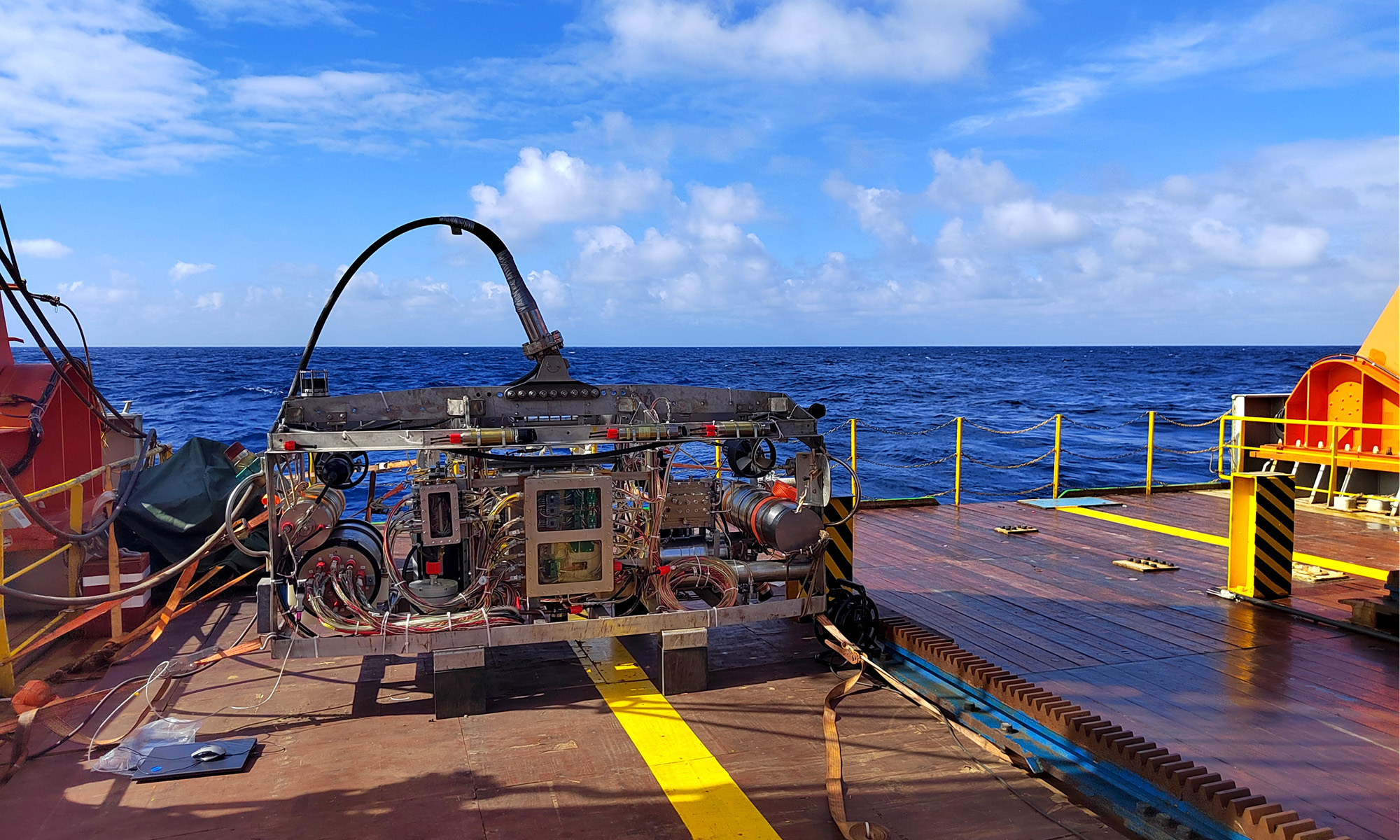
    Intelligent Microsystem Laboratory’s Underwater Mass Spectrometry
    Researchers led by Prof. Chen Chilai have increased the sensitivity of methane detection in water by over 500 times, enabling precise monitoring of oceanic and lake methane levels, crucial for climate research and energy exploration. The image above depicts the Intelligent Microsystem Laboratory’s Underwater Mass Spectrometry (ims-UMS). Credit: HFIPS

    A research group headed by Professor Chen Chilai from the Hefei Institutes of Physical Science of the Chinese Academy of Sciences has significantly enhanced the detection sensitivity of dissolved methane in water. Achieving an improvement of more than 500 times, this advancement allows for baseline methane detection in oceans and lakes.

    The research was published in Talanta.

    Monitoring ocean methane emissions is vital for understanding climate change and exploring clean energy sources like natural gas hydrates. However, existing data on dissolved methane in the ocean remain limited, leading to significant uncertainties in estimating oceanic methane flux due to sensitivity limitations. While deep-sea mass spectrometry serves as a crucial tool for rapid detection of dissolved gases in the ocean, its limited sensitivity restricts its application to specific regions or anomalous events.

    Technological Breakthrough in Detection

    In this research, the team developed a small-volume, low-power online water removal system to address challenges such as high gas content in samples and limited space in detection instruments. By optimizing the gas sampling route design and integrating it into the Intelligent Microsystem Laboratory’s Underwater Mass Spectrometry (ims-UMS), they achieved a significant improvement in detection sensitivity. The methane detection limit plummeted from above 16 nmo/L to a remarkable 0.03 nmol/L, exceeding a 500-fold enhancement.

    The team’s dedication to deep-sea mass spectrometry, Micro-electromechanical systems technology, and intelligent microsystem technology played crucial role in this breakthrough.

    This research lays an important technological foundation for further methane flux calculations, global climate research, plume tracking, and cold seep discovery, according to the team.

    Reference: “Online water vapor removal membrane inlet mass spectrometer for high-sensitivity detection of dissolved methane” by Han Wang, Changjie Liu, Haiyun Song, Haobin Wang, Yupeng Cheng, Youjiang Liu and Chilai Chen, 11 March 2024, Talanta.
    DOI: 10.1016/j.talanta.2024.125907

    Never miss a breakthrough: Join the SciTechDaily newsletter.
    Follow us on Google and Google News.

    Chinese Academy of Sciences Engineering Methane
    Share. Facebook Twitter Pinterest LinkedIn Email Reddit

    Related Articles

    This Could Be Forever: New Design Greatly Prolongs the Lifespan of Plasma Torches

    Researchers Control Water Movement by Varying Surface Stiffness

    Spintronics Device Captures Wasted Heat, Uses it to Power Devices

    Methane Gas Leaks Undermine Shift to Natural Gas

    Space-Launched Paintballs Could Possibly Deflect an Incoming Asteroid

    Growing Genetically Engineered Stingrays for Footwear Raises Ethical Concerns

    Methane Hydrate Cages, The Key to Using Methane as a Clean Energy Source?

    Foldit Online Gamers Achieve Crowdsourced Redesign of Protein

    Methane Released from Arctic Ocean Could Cause Climate Change

    Leave A Reply Cancel Reply

    • Facebook
    • Twitter
    • Pinterest
    • YouTube

    Don't Miss a Discovery

    Subscribe for the Latest in Science & Tech!

    Trending News

    125-Million-Year-Old Crocodile Fossil Reveals Astonishing New Secrets

    Scientists Discover an “Impossible” Way Muscle Filaments Can Grow

    A Star’s Spin Could Solve a Longstanding Black Hole Mystery

    NASA Finds Earth Microbes Could Hide in the Moon’s Deep Shadows

    New Study: Intermittent Fasting Lowers Blood Sugar in Type 1 Diabetes

    Alzheimer’s Brain Changes May Begin 7 Years Earlier Than Scientists Thought

    This New Molecule Could Transform How We Recover Gold From Electronic Waste

    A Billion Years Before the Grand Canyon, a Giant Cliff May Have Stretched Across America

    Follow SciTechDaily
    • Facebook
    • Twitter
    • YouTube
    • Pinterest
    • Newsletter
    • RSS
    SciTech News
    • Biology News
    • Chemistry News
    • Earth News
    • Health News
    • Physics News
    • Science News
    • Space News
    • Technology News
    Recent Posts
    • How Insects Conquered Land Was Stranger Than Scientists Thought
    • A 250-Year-Old Heat Mystery Leads to a Surprising Discovery About Human Sweat
    • Thousands of Giant Whales Are Suddenly Flooding Into an Arctic “Feeding Frenzy”
    • AI Searched 150 Million Materials – and Found Two Promising Candidates for Future Electronics
    • A Major Quantum Computing Problem May Finally Have an Answer: Can We Trust the Results?
    Copyright © 1998 - 2026 SciTechDaily. All Rights Reserved.
    • Science News
    • About
    • Contact
    • Editorial Board
    • Privacy Policy
    • Terms of Use

    Type above and press Enter to search. Press Esc to cancel.