
Close Menu
    Facebook X (Twitter) Instagram
    SciTechDaily
    • Biology
    • Chemistry
    • Earth
    • Health
    • Physics
    • Science
    • Space
    • Technology
    Facebook X (Twitter) Pinterest YouTube RSS
    SciTechDaily
    Home»Science»Scientists Discover 45-Million-Year-Old Crocodile With a Strange Connection to Egypt’s Great Sphinx
    Science

    Scientists Discover 45-Million-Year-Old Crocodile With a Strange Connection to Egypt’s Great Sphinx

    By Swedish Museum of Natural HistoryOctober 13, 2026No Comments3 Mins Read
    Facebook Twitter Pinterest Telegram LinkedIn WhatsApp Email Reddit
    Share
    Facebook Twitter LinkedIn Pinterest Telegram Email Reddit
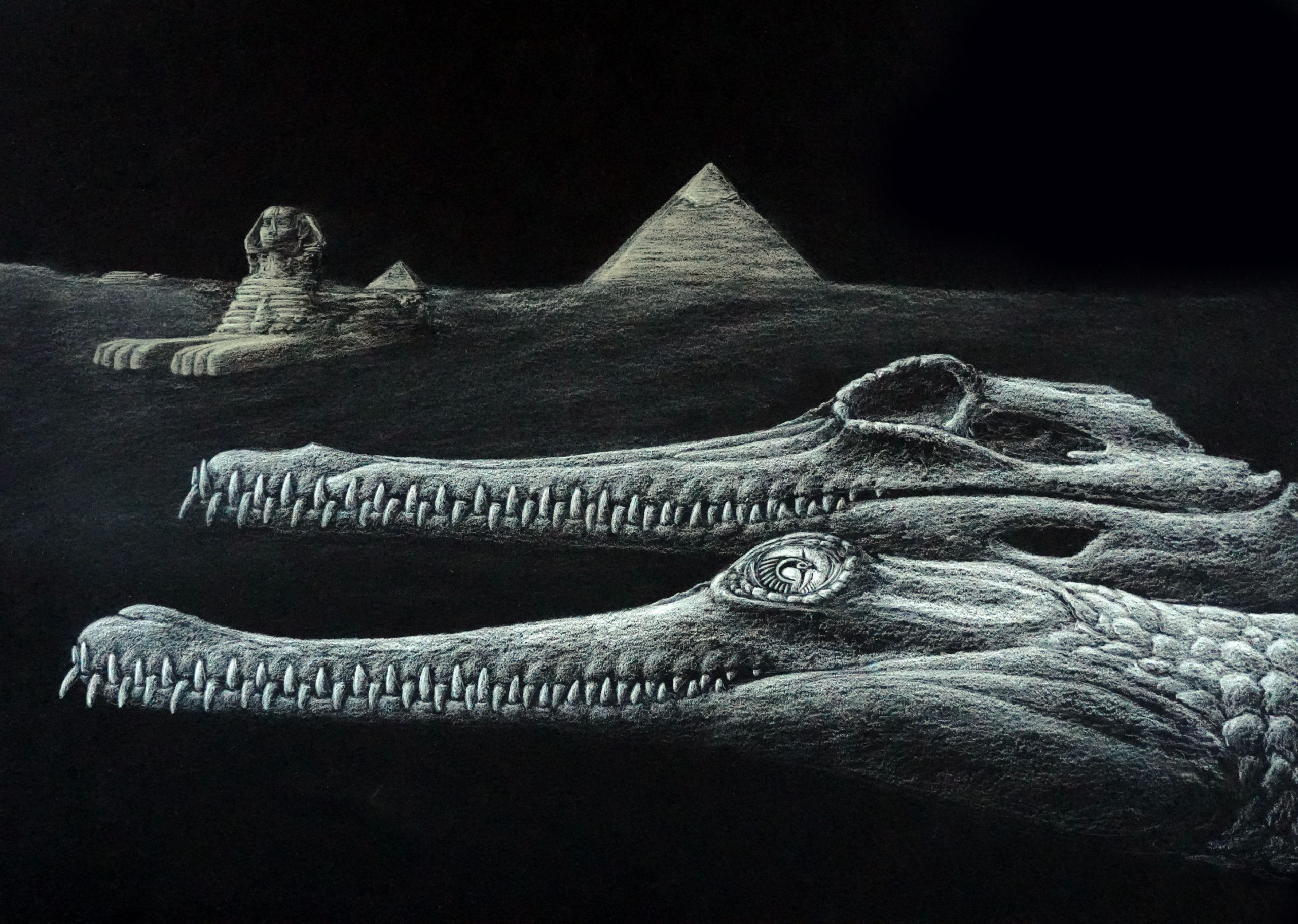
    Life Reconstruction of Herugavialis Cairensis
    Reconstruction of the extinct Herugavialis cairensis with the Great Sphinx and pyramids depicted in the background. Credit: Karim Zanaty

    Fossils of a newly recognized Egyptian crocodile species come from the same rocks as the Great Sphinx, and a missing snout tip helped inspire the animal’s name.

    Crocodile fossils recovered in Egypt in the 1920s were initially grouped with a living long-snouted crocodile called the false gharial because of their outward resemblance. A new examination, including CT scans that let researchers look inside a nearly complete skull, has identified the Egyptian fossils as a distinct extinct species, Herugavialis cairensis.

    Dr. Paul Burke, a researcher at the Swedish Museum of Natural History in Stockholm, led the international team from the UK, Sweden, Germany, and Egypt. Advances in paleontological analysis allowed the researchers to identify several differences between the Egyptian fossils and the false gharial, challenging their original assignment to the genus Tomistoma.

    Long-snouted crocodiles once lived at sea

    The fossils came from Egypt’s 45-million-year-old Mokattam Formation. At that time, shallow seas covered much of the region, and Herugavialis shared those waters with at least two other species of gavials, a group of crocodiles distinguished by their long, narrow snouts.

    Today, gavials live only in freshwater environments on the Indian subcontinent and in Southeast Asia. Just two species survive, Gavialis gangeticus and Tomistoma schlegelii, the false gharial. Their fossil record, however, spans more than 100 million years and documents a nearly worldwide distribution, with many species inhabiting shallow marine environments.

    The Sphinx inspires a crocodile’s name

    The Egyptian skull also has an unusual connection to the Great Sphinx. It comes from the same rocks used to build the monument and, although otherwise relatively well preserved, is missing the tip of its snout.

    “Given this coincidence with the famously missing nose of the Great Sphinx, we decided to name the new crocodile after the Egyptian god Heru, who was possibly the inspiration for this iconic monument,” says Professor Philip Mannion of University College London, who co-led the study.

    How the Mediterranean lost its crocodiles

    The shallow seas inhabited by Herugavialis were part of a much longer history of crocodile life across the Mediterranean.

    “Throughout much of the last 50 million years, the Mediterranean region hosted a high diversity of crocodiles, including gavials,” says Burke, the study’s lead author.

    “However, this diversity fluctuated over time, seemingly corresponding to changes in global temperature and sea level, before the loss of all crocodiles in this region as a result of the drying of the Mediterranean approximately 6 million years ago.”

    Reference: “Cranial anatomy of the Middle Eocene Egyptian crocodylian Herugavialis cairensis provides new insights into gavialoid diversity in the Mediterranean region” by Paul M. J. Burke, Stephan N. F. Spiekman, Belal S. Salem, Sara Saber, Hesham M. Sallam and Philip D. Mannion, 1 October 2026, Royal Society Open Science.
    DOI: 10.1098/rsos.261173

    P.M.J.B. is supported by the Knut and Alice Wallenberg Foundation (KAW-2020.0145). S.N.F.S. is supported by the DFG Emmy Noether Programme (SP 2138/1-1). P.D.M.’s research was supported by funding from The Royal Society (UF 160216, URF\R\221010, RGF\EA\201037) and NERC (NE/X014010/1).

    Never miss a breakthrough: Join the SciTechDaily newsletter.
    Follow us on Google and Google News.

    Crocodiles Fossils Paleontology Reptiles
    Share. Facebook Twitter Pinterest LinkedIn Email Reddit

    Related Articles

    Extinct Prehistoric Reptile That Lived Among Dinosaurs Discovered by Smithsonian Researchers

    Mega-Predator: Fossils Discovered of Giant Sea Monster That Ruled the Oceans 66 Million Years Ago

    Kyhytysuka: 130-Million-Year-Old Hypercarnivore “Fish Lizard” Discovered

    Surprising Diversity of Cretaceous Reptiles at Argentina Fossil Site – Revealed by Discovery of Ancient Teeth

    Police Raid Uncovers Fossil of Exceptional Flying Reptile From Brazil

    Paleontologists Identify a New Species of Prehistoric Reptile, Colobops Noviportensis

    Turtles Share a Recent Common Ancestor with Birds and Crocodiles

    Carnufex Carolinensis – North America’s Top Predator Before Dinosaurs?

    27-Foot Long Crocodylus Thorbjarnarsoni Roamed Kenya

    Leave A Reply Cancel Reply

    • Facebook
    • Twitter
    • Pinterest
    • YouTube

    Don't Miss a Discovery

    Subscribe for the Latest in Science & Tech!

    Trending News

    Sleeping Less Than 5 Hours Was Linked to Higher Risk of 37 Diseases

    This 345-Million-Year-Old Fossil Fooled Scientists for Decades

    Scientists Restore Limited Vision in Blind Patients Using Gene Therapy and Special Goggles

    NASA Hubble Cold Case: A Dead Star May Have Given Birth to a New Planet

    A Giant Insect on the Brink of Extinction Is Making an Extraordinary Comeback

    Penguin Poop Is Turning Antarctica Green, and Scientists Are Concerned

    Why Too Much Cannabis Can Flip an Anxiety Switch in the Brain

    Scientists Discover That Chimpanzees Treat Friends by Different Rules

    Follow SciTechDaily
    • Facebook
    • Twitter
    • YouTube
    • Pinterest
    • Newsletter
    • RSS
    SciTech News
    • Biology News
    • Chemistry News
    • Earth News
    • Health News
    • Physics News
    • Science News
    • Space News
    • Technology News
    Recent Posts
    • Scientists Discover 45-Million-Year-Old Crocodile With a Strange Connection to Egypt’s Great Sphinx
    • Something Strange Is Happening Beneath Nicaragua’s Masaya Volcano
    • A Hidden Molecular Switch Could Change How We Treat Aggressive Prostate Cancer
    • Staying Active Could Have Two Major Benefits for People With Parkinson’s, Scientists Find
    • Scientists Discover Aspirin May Slash Dementia Risk by 70% – but Only for Certain People
    Copyright © 1998 - 2026 SciTechDaily. All Rights Reserved.
    • Science News
    • About
    • Contact
    • Editorial Board
    • Privacy Policy
    • Terms of Use

    Type above and press Enter to search. Press Esc to cancel.