

Close Menu
    Facebook X (Twitter) Instagram
    SciTechDaily
    • Biology
    • Chemistry
    • Earth
    • Health
    • Physics
    • Science
    • Space
    • Technology
    Facebook X (Twitter) Pinterest YouTube RSS
    SciTechDaily
    Home»Science»Police Raid Uncovers Fossil of Exceptional Flying Reptile From Brazil
    Science

    Police Raid Uncovers Fossil of Exceptional Flying Reptile From Brazil

    By PLOSAugust 29, 20211 Comment3 Mins Read
    Facebook Twitter Pinterest Telegram LinkedIn WhatsApp Email Reddit
    Share
    Facebook Twitter LinkedIn Pinterest Telegram Email Reddit
    Tupandactylus navigans
    Tupandactylus navigans (artist’s rendering). Credit: Victor Beccari

    Complete skeleton provides first look at entire body of Tupandactylus navigans.

    A fossil acquired in a police raid has turned out to be one of the best-preserved flying reptiles ever found, according to a study published on August 25, 2021 in the open-access journal PLOS ONE by Victor Beccari of the University of São Paulo and colleagues.

    Tapejarids (an Early Cretaceous subgroup of flying reptiles called pterosaurs) are known for their enormous head crests and their abundance in the fossil record of Brazil, but most Brazilian tapejarid fossils preserve only partial remains. In this study, researchers describe an exceptional tapejarid specimen which includes nearly the entire body, mostly intact and even including remnants of soft tissue alongside the bones, making it the most complete tapejarid skeleton ever found in Brazil.

    This fossil belongs to a species called Tupandactylus navigans, and it has a dramatic history. It is preserved across six square-cut limestone slabs which were confiscated during a police raid at Santos Harbour in São Paulo. It is now among the collections of the University of São Paulo, where researchers were able to reunite the slabs and examine the entire fossil, even CT-scanning to reveal the bones concealed within the stone. This is the first time that paleontologists have been able to study more than just the skull of this species.
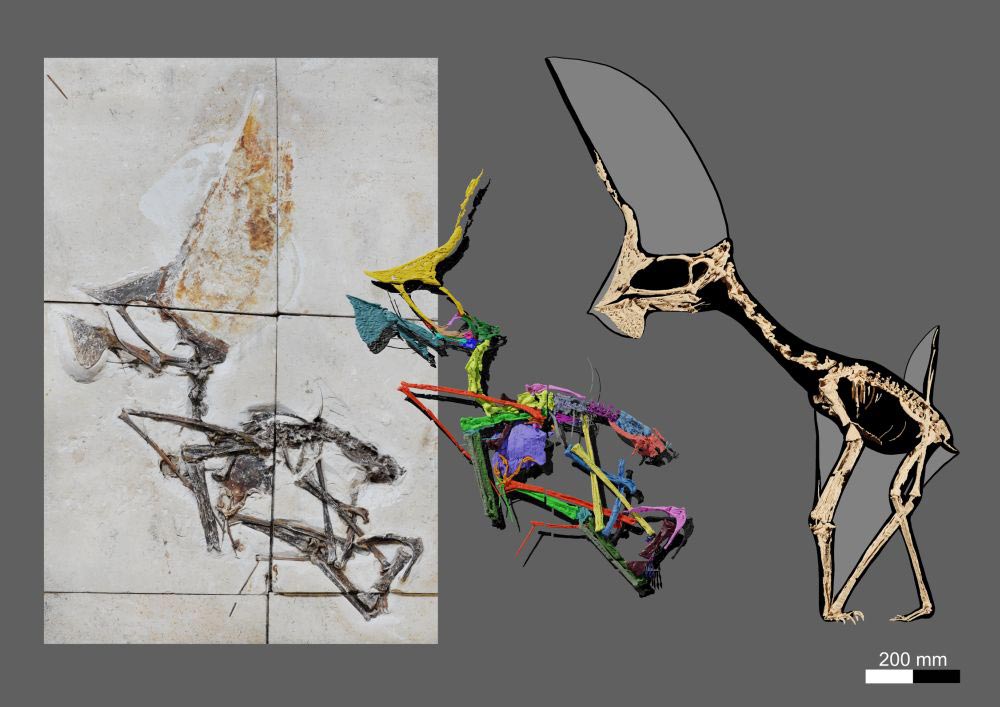
    Tupandactylus navigans Specimen
    A photo of the Tupandactylus navigans specimen on the left, a 3D model of the specimen (center) and a rendering. Credit: Victor Beccari

    Flight-Ready Features with Grounded Behaviors

    The description suggests this species had a terrestrial foraging lifestyle, due to its long neck and the proportions of its limbs, as well as its large head crest that could negatively influence long-distance flight. However, the specimen possesses all the necessary adaptation for powered flight, such as the presence of a notarium and a developed muscle anchoring region in the arm bones. This specimen also has an unusually large crest on its chin, part of its already impressive skull ornamentation. Precisely how all these factors contributed to the flight performance and lifestyle of these animals will be a subject of future research, among the many other questions that can be answered through study of this exceptional fossil.

    The authors add: “We described the most complete tapejarid fossil from Brazil, a partially articulated skeleton of Tupandactylus navigans with soft tissue preservation. This specimen brings new insights into the anatomy of this animal and its constraints for flight, arguing for terrestrial foraging ecology.”

    Reference: “Osteology of an exceptionally well-preserved tapejarid skeleton from Brazil: Revealing the anatomy of a curious pterodactyloid clade” by Victor Beccari, Felipe Lima Pinheiro, Ivan Nunes, Luiz Eduardo Anelli, Octávio Mateus and Fabiana Rodrigues Costa, 25 August 2021, PLOS ONE.
    DOI: 10.1371/journal.pone.0254789

    Funding: FLP is supported by grants from Conselho Nacional de Desenvolvimento Científico e Tecnológico (CNPq process numbers 407969/2016-0, 305758/2017-9) and Fundacão de Amparo à Pesquisa do Estado do Rio Grande do Sul (FAPERGS process number 16/2551-0000271-1). OM is supported by grants from GeoBioTec-GeoBioSciences, GeoTechnologies and GeoEngineering NOVA [GeoBioCiências, GeoTecnologias e GeoEngenharias], grant UIDB/04035/2020 by the Fundação para a Ciência e Tecnologia. FRC is supported by Conselho Nacional de Desenvolvimento Científico e Tecnológico (CNPq) for support (grant No. 421772/2018-2).

    Never miss a breakthrough: Join the SciTechDaily newsletter.
    Follow us on Google and Google News.

    Flying Reptile Fossils Paleontology Popular Reptiles
    Share. Facebook Twitter Pinterest LinkedIn Email Reddit

    Related Articles

    Redefining Marine Evolution: Oldest Sea Reptile Fossil in the Southern Hemisphere Discovered in New Zealand

    Jurassic Giant Revealed: Massive Pterosaur Fossil Unearthed in Oxfordshire, UK

    The Mysterious 280-Million-Year-Old Fossil That Fooled Scientists for Decades

    Jurassic Breakthrough: New Species of Pterosaur Discovered on the Isle of Skye Rewrites Evolutionary History

    Unearthing Prehistory: Australia’s Oldest Pterosaur Bones Date Back 107 Million Years

    Extinct Prehistoric Reptile That Lived Among Dinosaurs Discovered by Smithsonian Researchers

    Mega-Predator: Fossils Discovered of Giant Sea Monster That Ruled the Oceans 66 Million Years Ago

    Legendary Flying Reptile: Fleshing Out the Bones of Quetzalcoatlus, Earth’s Largest Flier Ever

    Kyhytysuka: 130-Million-Year-Old Hypercarnivore “Fish Lizard” Discovered

    1 Comment

    1. Mickaela on September 5, 2021 11:00 am

      wow very intersting

      Reply
    Leave A Reply Cancel Reply

    • Facebook
    • Twitter
    • Pinterest
    • YouTube

    Don't Miss a Discovery

    Subscribe for the Latest in Science & Tech!

    Trending News

    Largest-Ever Study Finds Medicinal Cannabis Ineffective for Anxiety, Depression, PTSD

    250-Million-Year-Old Egg Solves One of Evolution’s Biggest Mysteries

    Living With Roommates Might Be Changing Your Gut Microbiome Without You Knowing

    Century-Old Cleaning Chemical Linked to 500% Increased Risk of Parkinson’s Disease

    What if Your Memories Never Happened? Physicists Take a New Look at the Boltzmann Brain Paradox

    One of the Universe’s Largest Stars May Be Getting Ready To Explode

    Scientists Discover Enzyme That Could Supercharge Ozempic-Like Weight Loss Drugs

    Popular Sweetener Linked to DNA Damage – “It’s Something You Should Not Be Eating”

    Follow SciTechDaily
    • Facebook
    • Twitter
    • YouTube
    • Pinterest
    • Newsletter
    • RSS
    SciTech News
    • Biology News
    • Chemistry News
    • Earth News
    • Health News
    • Physics News
    • Science News
    • Space News
    • Technology News
    Recent Posts
    • What Did Prehistoric Europeans Eat? Scientists Uncover Surprising Answers
    • Scientists Say This Overlooked Organ Could Hold the Key to Longer Life
    • Want Less Stress? Landmark Study Points to a Simple Habit
    • Scientists Reveal Eating Fruits and Vegetables May Increase Your Risk of Lung Cancer
    • AI Reveals Explosive Growth of Floating Algae Across the World’s Oceans
    Copyright © 1998 - 2026 SciTechDaily. All Rights Reserved.
    • Science News
    • About
    • Contact
    • Editorial Board
    • Privacy Policy
    • Terms of Use

    Type above and press Enter to search. Press Esc to cancel.