

Highly stretchable and customizable microneedles that revolutionize the interface between human bodies and invasive monitoring devices have been developed through USC research. They are promising for wide applications in healthcare diagnostics and treatment including neuroscience, tissue engineering, and wearable bioelectronics.
The revolution in personalized medicine is well underway – with wearable devices and DIY home testing, it’s easier than ever to track everything from heart rate, to glucose levels, to microbiome diversity.
However, there’s still an innovation gap before we achieve a seamless interface between the human body and invasive monitoring devices.
Bridging the Gap With New Technology
That’s where USC researcher Hangbo Zhao comes in, an expert in advanced manufacturing and flexible electronics. As assistant professor in the Department of Aerospace and Mechanical Engineering and the Alfred E. Mann Department of Biomedical Engineering at USC, Hangbo has published a series of papers on stretchable sensors for biomedical purposes. His most recent paper, selected as the cover story for the prestigious journal Science Advances, presents new research that will directly enable the development of “soft” and more flexible microneedles – essential for ensuring the comfort and high accuracy of long-term health tracking.
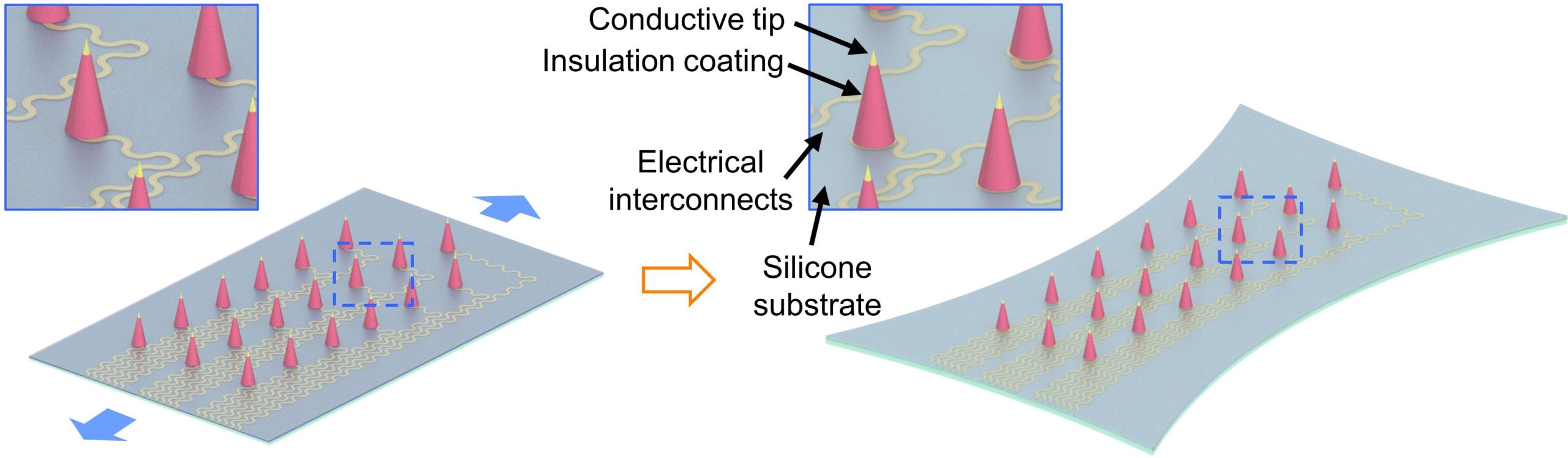
The technology is enabled by stretchable three-dimensional penetrating microelectrode arrays, produced by a novel manufacturing process developed by Zhao and his research group.
Revolutionizing Microneedle Technology
Microneedle electrodes are widely used in sensing and stimulation of the brain, as well as diagnosis of biomarkers under the skin. However, almost all existing microneedle electrodes are rigid due to material and fabrication limitations. Zhao’s expertise in advanced manufacturing gave him a new perspective when it came to envisioning a more flexible solution.
The new “soft” microneedle electrodes are highly desirable in the case of muscle tissues and skin tissues that “deform” or change shape. Electrodes need to follow the deformations of the target tissues to ensure intimate contact and minimize tissue damage; Zhao’s research paves the way for advances in microneedles that can sense ever-deeper into tissues and gain more accurate results. Whether monitoring the workings of a weak bladder or tracking minute fluctuations in heartbeats, the necessity of high-fidelity sensing is ever more vital.
Innovative Fabrication Methods
Central to the innovation is the development of a hybrid fabrication method discovered at Zhao’s lab at USC. The low-cost and scalable method combines laser micromachining, microfabrication, and transfer printing to make microneedle electrode arrays with the highest stretchability (60-90%) ever reported.
Crucially, the novel fabrication method enables convenient customization of key device parameters such as electrode geometry, recording sites, and mechanical and electrical properties. As with all Zhao’s research, adaptability and accuracy is the organizing principle: his perspectives on soft electronics and robotics also inform the flexible fabrication method.
Biomedical Applications and Future Prospects
Another intriguing feature of the research is its deep-sea origins. The feasibility of the globally applicable microneedle electrodes was originally demonstrated by recording electrical activities inside the moving muscles of a sea slug.
The wider global biomedical applications of the results were immediately clear to Zhao and his team of researchers. This platform technology can be used for the sensing and control of brain and nerve activities, electrochemical sensing of skin interstitial fluids, diagnosis of neuromuscular disorders, and drug delivery into deep tissues.
For those who feel queasy at the thought of microneedles, the next phase of highly stretchable “soft” microneedles might just be the answer. In the quest for ever more accurate tracking to catch abnormalities and identify rapid treatment, Zhao’s research is an important milestone for healthcare professionals, biotech companies, and anyone seeking to live a longer, healthier life.
Reference: “Highly stretchable and customizable microneedle electrode arrays for intramuscular electromyography” by Qinai Zhao, Ekaterina Gribkova, Yiyang Shen, Jilai Cui, Noel Naughton, Liangshu Liu, Jaemin Seo, Baixin Tong, Mattia Gazzola, Rhanor Gillette and Hangbo Zhao, 1 May 2024, Science Advances.
DOI: 10.1126/sciadv.adn7202
Never miss a breakthrough: Join the SciTechDaily newsletter.
Follow us on Google and Google News.