
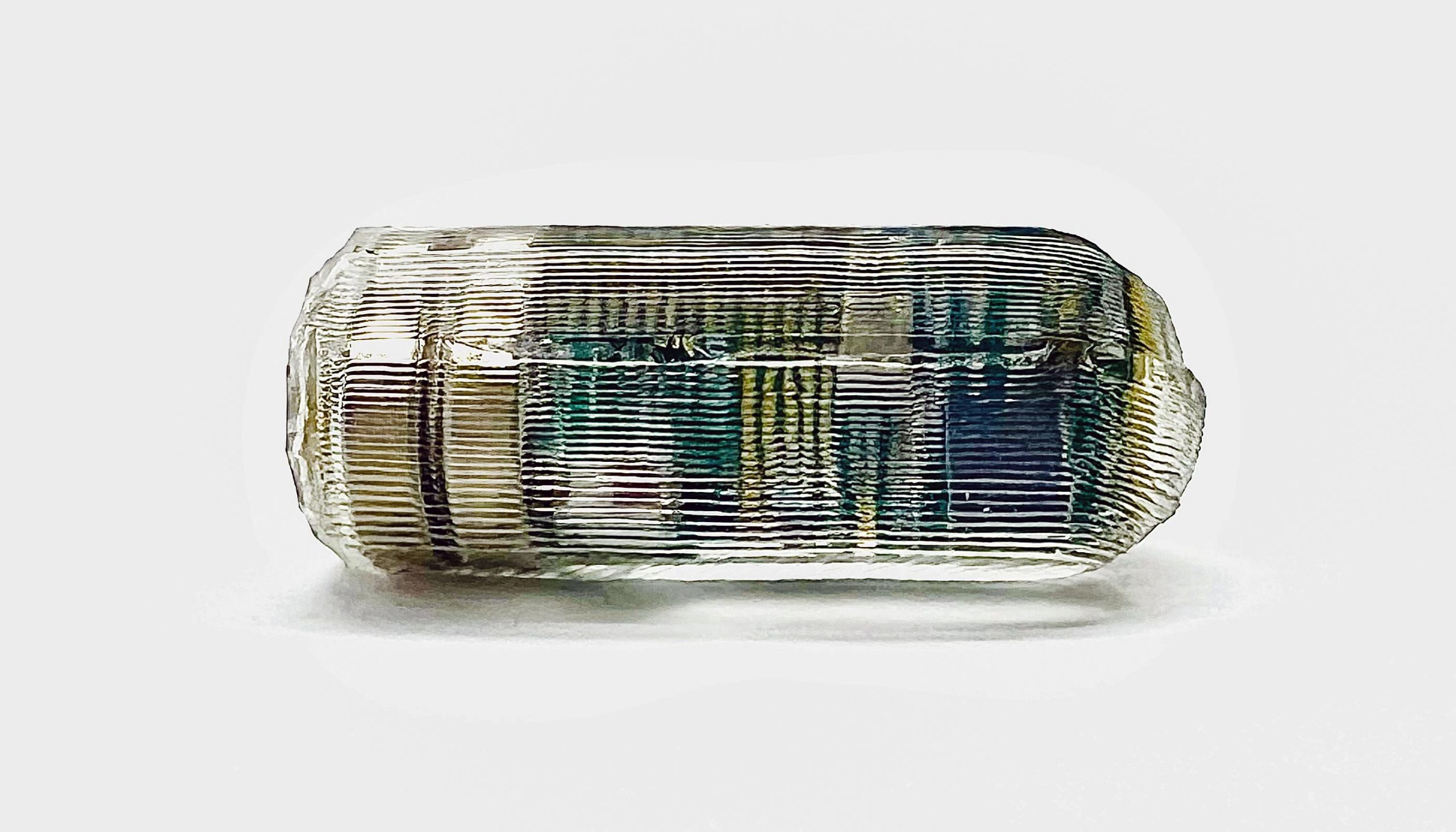
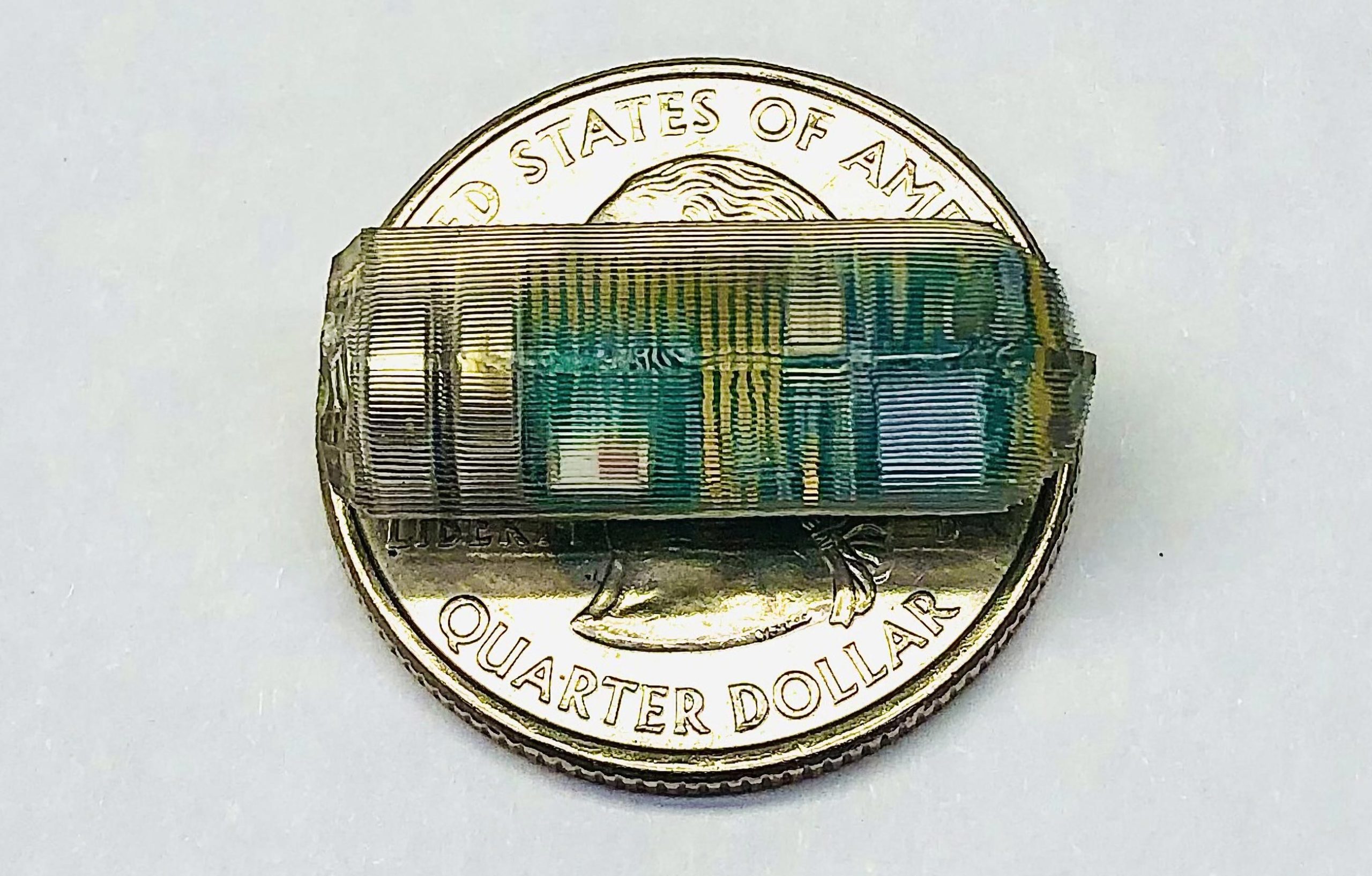
The sensor sends out its location as it moves through the GI tract, revealing where slowdowns in digestion may occur.
Engineers at MIT and Caltech have demonstrated an ingestible sensor whose location can be monitored as it moves through the digestive tract, an advance that could help doctors more easily diagnose gastrointestinal motility disorders such as constipation, gastroesophageal reflux disease, and gastroparesis.
The tiny sensor works by detecting a magnetic field produced by an electromagnetic coil located outside the body. The strength of the field varies with distance from the coil, so the sensor’s position can be calculated based on its measurement of the magnetic field.
In the new study, the researchers showed that they could use this technology to track the sensor as it moved through the digestive tract of large animals. Such a device could offer an alternative to more invasive procedures, such as endoscopy, that are currently used to diagnose motility disorders.
“Many people around the world suffer from GI dysmotility or poor motility, and having the ability to monitor GI motility without having to go into a hospital is important to really understand what is happening to a patient,” says Giovanni Traverso, an associate professor of mechanical engineering at MIT and a gastroenterologist at Brigham and Women’s Hospital.
Traverso is one of the senior authors of the new study, along with Azita Emami, a professor of electrical engineering and medical engineering at Caltech, and Mikhail Shapiro, a professor of chemical engineering at Caltech and an investigator of the Howard Hughes Medical Institute. Saransh Sharma, a graduate student at Caltech, and Khalil Ramadi SM ’16, PhD ’19, a graduate of the Department of Mechanical Engineering and the Harvard-MIT Program in Health Sciences and Technology who is now an assistant professor of bioengineering at New York University, are the lead authors of the paper, which was recently published in the journal Nature Electronics.
A Magnetic Sensor
GI motility disorders, which affect about 35 million Americans, can occur in any part of the digestive tract, resulting in failure of food to move through the tract. They are usually diagnosed using nuclear imaging studies or X-rays, or by inserting catheters containing pressure transducers that sense contractions of the GI tract.
The MIT and Caltech researchers wanted to come up with an alternative that would be less invasive and could be done at the patient’s home. Their idea was to develop a capsule that could be swallowed and then send out a signal revealing where it was in the GI tract, allowing doctors to determine what part of the tract was causing a slowdown and better determine how to treat the patient’s condition.
To achieve that, the researchers took advantage of the fact that the field produced by an electromagnetic coil becomes weaker, in a predictable way, as the distance from the coil increases. The magnetic sensor they developed, which is small enough to fit in an ingestible capsule, measures the surrounding magnetic field and uses that information to calculate its distance from a coil located outside the body.
“Because the magnetic field gradient uniquely encodes the spatial positions, these small devices can be designed in a way that they can sense the magnetic field at their respective locations,” Sharma says. “After the device measures the field, we can back-calculate what the location of the device is.”
To accurately pinpoint a device’s location inside the body, the system also includes a second sensor that remains outside the body and acts as a reference point. This sensor could be taped to the skin, and by comparing the position of this sensor to the position of the sensor inside the body, the researchers can accurately calculate where the ingestible sensor is in the GI tract.
The ingestible sensor also includes a wireless transmitter that sends the magnetic field measurement to a nearby computer or smartphone. The current version of the system is designed to take a measurement any time it receives a wireless trigger from a smartphone, but it can also be programmed to take measurements at specific intervals.
“Our system can support localization of multiple devices at the same time without compromising the accuracy. It also has a large field of view, which is crucial for human and large animal studies,” Emami says.
The current version of the sensor can detect a magnetic field from electromagnetic coils within a distance of 60 centimeters or less. The researchers envision that the coils could be placed in the patient’s backpack or jacket, or even the back of a toilet, allowing the ingestible sensor to take measurements whenever it is in range of the coils.
Location Tracking
The researchers tested their new system in a large animal model, placing the ingestible capsule in the stomach and then monitoring its location as it moved through the digestive tract over several days.
In their first experiment, the researchers delivered two magnetic sensors attached to each other by a small rod, so they knew the exact distance between them. Then, they compared their magnetic field measurements to this known distance and found that the measurements were accurate to a resolution of about 2 millimeters — much higher than the resolution of previously developed magnetic field-based sensors.
Next, the researchers performed tests using a single ingestible sensor along with an external sensor attached to the skin. By measuring the distance from each sensor to the coils, the researchers showed that they could track the ingested sensor as it moved from the stomach to the colon and then was excreted. The researchers compared the accuracy of their strategy with measurements taken by X-ray and found that they were accurate within 5 to 10 millimeters.
“Using an external reference sensor helps to account for the problem that every time an animal or a human is beside the coils, there is a likelihood that they will not be in exactly the same position as they were the previous time. In the absence of having X-rays as your ground truth, it’s difficult to map out exactly where this pill is, unless you have a consistent reference that is always in the same location,” Ramadi says.
This kind of monitoring could make it much easier for doctors to figure out what section of the GI tract is causing a slowdown in digestion, the researchers say. “The ability to characterize motility without the need for radiation, or more invasive placement of devices, I think will lower the barrier for people to be evaluated,” Traverso says.
The researchers now hope to work with collaborators to develop manufacturing processes for the system and further characterize its performance in animals, in hopes of eventually testing it in human clinical trials.
For more on this device, see “Smart Pills” Transform Diagnosis and Treatment of Gastrointestinal Disorders.
Reference: “Location-aware ingestible microdevices for wireless monitoring of gastrointestinal dynamics” by Saransh Sharma, Khalil B. Ramadi, Nikhil H. Poole, Shriya S. Srinivasan, Keiko Ishida, Johannes Kuosmanen, Josh Jenkins, Fatemeh Aghlmand, Margaret B. Swift, Mikhail G. Shapiro, Giovanni Traverso and Azita Emami, 13 February 2023, Nature Electronics.
DOI: 10.1038/s41928-023-00916-0
The research was funded by the National Science Foundation, the Rothenberg Innovation Initiative, and the Heritage Medical Research Institute.
Never miss a breakthrough: Join the SciTechDaily newsletter.
Follow us on Google and Google News.