
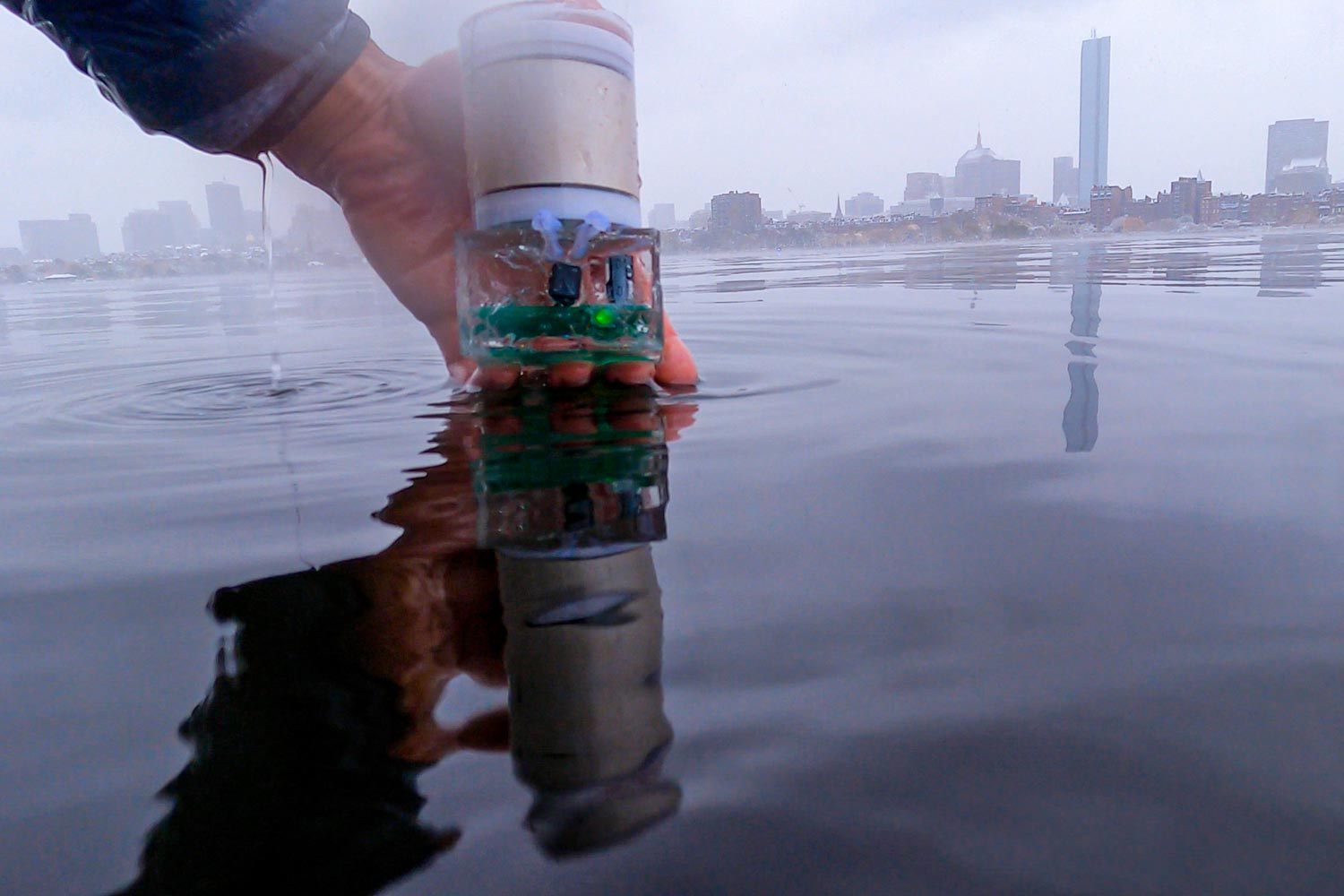
New approach could spark an era of battery-free ocean exploration, with applications ranging from marine conservation to aquaculture.
GPS isn’t waterproof. The navigation system depends on radio waves, which break down rapidly in liquids, including seawater. To track undersea objects like drones or whales, researchers rely on acoustic signaling. But devices that generate and send sound usually require batteries — bulky, short-lived batteries that need regular changing. Could we do without them?
MIT researchers think so. They’ve built a battery-free pinpointing system dubbed Underwater Backscatter Localization (UBL). Rather than emitting its own acoustic signals, UBL reflects modulated signals from its environment. That provides researchers with positioning information, at net-zero energy. Though the technology is still developing, UBL could someday become a key tool for marine conservationists, climate scientists, and the U.S. Navy.
These advances are described in a paper being presented this week at the Association for Computing Machinery’s Hot Topics in Networks workshop, by members of the Media Lab’s Signal Kinetics group. Research Scientist Reza Ghaffarivardavagh led the paper, along with co-authors Sayed Saad Afzal, Osvy Rodriguez, and Fadel Adib, who leads the group and is the Doherty Chair of Ocean Utilization as well as an associate professor in the MIT Media Lab and the MIT Department of Electrical Engineering and Computer Science.
“Power-hungry”
It’s nearly impossible to escape GPS’ grasp on modern life. The technology, which relies on satellite-transmitted radio signals, is used in shipping, navigation, targeted advertising, and more. Since its introduction in the 1970s and ’80s, GPS has changed the world. But it hasn’t changed the ocean. If you had to hide from GPS, your best bet would be underwater.
Because radio waves quickly deteriorate as they move through water, subsea communications often depend on acoustic signals instead. Sound waves travel faster and further underwater than through air, making them an efficient way to send data. But there’s a drawback.
“Sound is power-hungry,” says Adib. For tracking devices that produce acoustic signals, “their batteries can drain very quickly.” That makes it hard to precisely track objects or animals for a long time-span — changing a battery is no simple task when it’s attached to a migrating whale. So, the team sought a battery-free way to use sound.
Good vibrations
Adib’s group turned to a unique resource they’d previously used for low-power acoustic signaling: piezoelectric materials. These materials generate their own electric charge in response to mechanical stress, like getting pinged by vibrating soundwaves. Piezoelectric sensors can then use that charge to selectively reflect some soundwaves back into their environment. A receiver translates that sequence of reflections, called backscatter, into a pattern of 1s (for soundwaves reflected) and 0s (for soundwaves not reflected). The resulting binary code can carry information about ocean temperature or salinity.
In principle, the same technology could provide location information. An observation unit could emit a soundwave, then clock how long it takes that soundwave to reflect off the piezoelectric sensor and return to the observation unit. The elapsed time could be used to calculate the distance between the observer and the piezoelectric sensor. But in practice, timing such backscatter is complicated, because the ocean can be an echo chamber.
The sound waves don’t just travel directly between the observation unit and sensor. They also careen between the surface and seabed, returning to the unit at different times. “You start running into all of these reflections,” says Adib. “That makes it complicated to compute the location.” Accounting for reflections is an even greater challenge in shallow water — the short distance between seabed and surface means the confounding rebound signals are stronger.
The researchers overcame the reflection issue with “frequency hopping.” Rather than sending acoustic signals at a single frequency, the observation unit sends a sequence of signals across a range of frequencies. Each frequency has a different wavelength, so the reflected sound waves return to the observation unit at different phases. By combining information about timing and phase, the observer can pinpoint the distance to the tracking device. Frequency hopping was successful in the researchers’ deep-water simulations, but they needed an additional safeguard to cut through the reverberating noise of shallow water.
Where echoes run rampant between the surface and seabed, the researchers had to slow the flow of information. They reduced the bitrate, essentially waiting longer between each signal sent out by the observation unit. That allowed the echoes of each bit to die down before potentially interfering with the next bit. Whereas a bitrate of 2,000 bits/second sufficed in simulations of deep water, the researchers had to dial it down to 100 bits/second in shallow water to obtain a clear signal reflection from the tracker. But a slow bitrate didn’t solve everything.
To track moving objects, the researchers actually had to boost the bitrate. One thousand bits/second was too slow to pinpoint a simulated object moving through deep water at 30 centimeters/second. “By the time you get enough information to localize the object, it has already moved from its position,” explains Afzal. At a speedy 10,000 bits/second, they were able to track the object through deep water.
Efficient exploration
Adib’s team is working to improve the UBL technology, in part by solving challenges like the conflict between low bitrate required in shallow water and the high bitrate needed to track movement. They’re working out the kinks through tests in the Charles River. “We did most of the experiments last winter,” says Rodriguez. That included some days with ice on the river. “It was not very pleasant.”
Conditions aside, the tests provided a proof-of-concept in a challenging shallow-water environment. UBL estimated the distance between a transmitter and backscatter node at various distances up to nearly half a meter. The team is working to increase UBL’s range in the field, and they hope to test the system with their collaborators at the Wood Hole Oceanographic Institution on Cape Cod.
They hope UBL can help fuel a boom in ocean exploration. Ghaffarivardavagh notes that scientists have better maps of the moon’s surface than of the ocean floor. “Why can’t we send out unmanned underwater vehicles on a mission to explore the ocean? The answer is: We will lose them,” he says.
UBL could one day help autonomous vehicles stay found underwater, without spending precious battery power. The technology could also help subsea robots work more precisely, and provide information about climate change impacts in the ocean. “There are so many applications,” says Adib. “We’re hoping to understand the ocean at scale. It’s a long-term vision, but that’s what we’re working toward and what we’re excited about.”
This work was supported, in part, by the Office of Naval Research.
Never miss a breakthrough: Join the SciTechDaily newsletter.
Follow us on Google and Google News.
1 Comment
The Russians built this during the cold war. It really f**ked us! It was the listening device inside the decorative seal behind an important US embassy director. Detection proof b/c no battery was needed. Energy came from the receiver. Using sound to power the wireless camera system b/c the wave will travel very fast. I’m guessing as well, that deep down that might be the only source of transmission that can get to your Tx.