
The streaming data from these biosensors can be used for health monitoring and diagnosis of neuro-degenerative conditions.
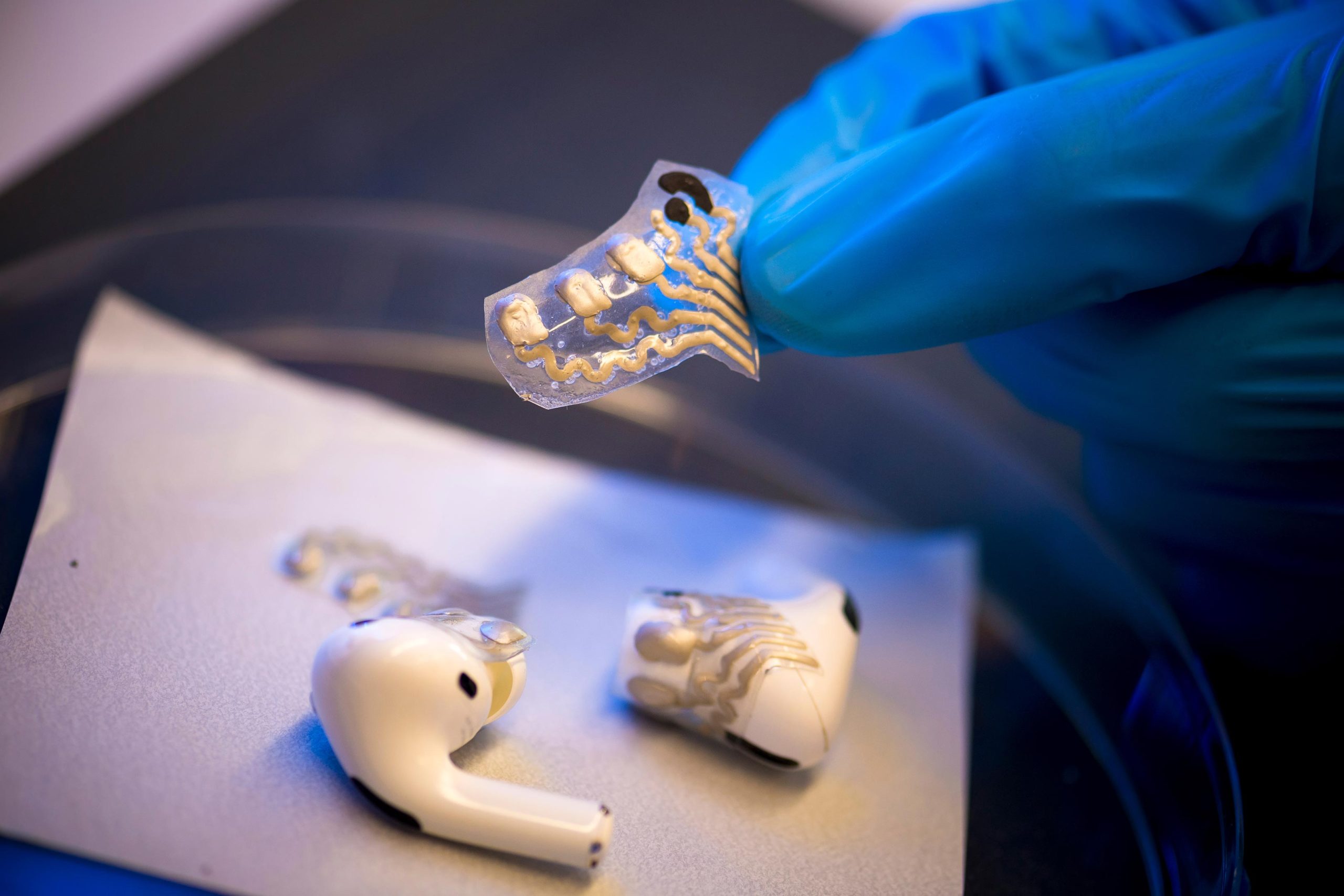
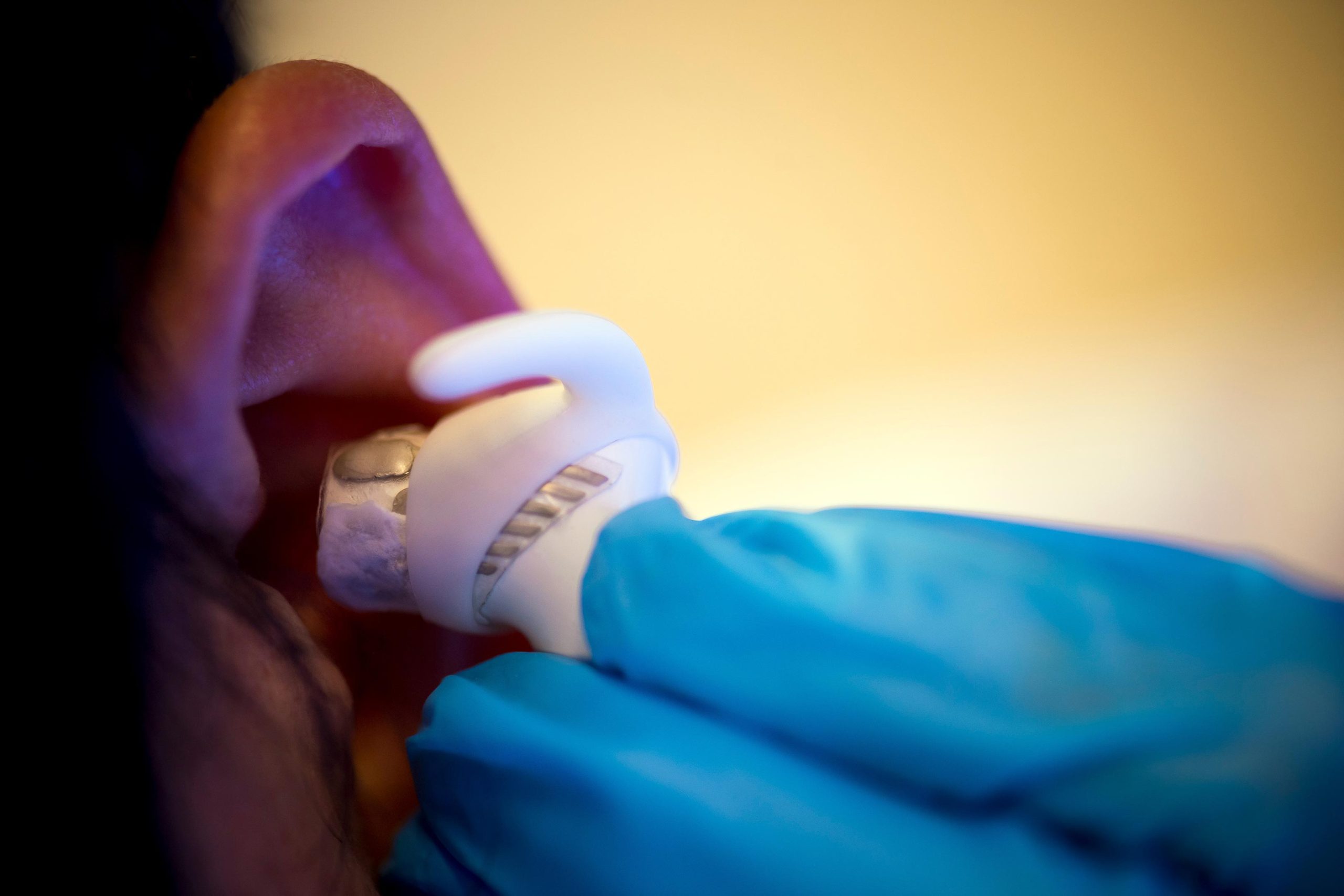
A pair of earbuds can be turned into a tool to record the electrical activity of the brain as well as levels of lactate in the body with the addition of two flexible sensors screen-printed onto a stamp-like flexible surface.
The sensors can communicate with the earbuds, which then wirelessly transmit the data gathered for visualization and further analysis, either on a smartphone or a laptop. The data can be used for long-term health monitoring and to detect long-term neuro-degenerative conditions.
The sensors, developed by a multidisciplinary research team of engineers at the University of California, San Diego, are a lot less cumbersome than state-of-the-art devices currently used to sense the brain’s electrical activity and the body’s sweat secretions. They can be used in the real world during exercise, the researchers showed.
While in-ear sensing of several physiological parameters is not new, integrating sensing of brain and body signals in a single platform is. The breakthrough was made possible by the combined expertise of biomedical, chemical, electrical, and nano-engineers.
Data and Validation
Data from an electroencephalogram (EEG), which measures electrical activity in the brain, and sweat lactate, an organic acid the body produces during exercise and normal metabolic activity, can be combined for a variety of purposes. For example, they can be used to diagnose different types of seizures, including epileptic seizures. They can also be used for monitoring effort during physical exercise and monitoring levels of stress and focus.
The researchers validated the data collected during this proof-of-concept study against data obtained from commercially available dry contact EEG headsets and lactate-containing blood samples. The data the flexible sensors collected were just as effective.
The team describes their work in an article appearing on the cover of the October 2023 issue of Nature Biomedical Engineering.
The researchers foresee a future, in which neuroimaging and health monitoring systems work with wearable sensors and mobile devices, such as phones, earbuds, watches, and more to track brain activity and levels of many health-related metabolites throughout the day. This would allow users to enhance brain and body capabilities. The team also envisages a future in which the capabilities of existing wearable audio devices, such as earbuds, can be considerably expanded to gather a much wider range of data.
“Being able to measure the dynamics of both brain cognitive activity and body metabolic state in one in-ear integrated device that doesn’t intrude on the comfort and mobility of the user opens up tremendous opportunities for advancing health and wellness of people of all ages, anytime and anywhere,” said Gert Cauwenberghs, a professor in the Shu Chien Gene Lay Department of Bioengineering at UC San Diego.
The sensors monitor the level of lactate in sweat during exercise. Credit: University of California San Diego
Why Earbuds?
The team felt that the ubiquitous wearing of earbuds translated to an untapped potential for gathering brain and body signals conveniently, both for wellness and health.
“Earbuds have been around for decades, and in many ways were one of the first wearable devices on the market,” said Patrick Mercier, a professor in the UC San Diego Department of Electrical and Computer Engineering. “This research takes important first steps to show that impactful data can be measured from the human body simply by augmenting the capabilities of earbuds that people already use on a daily basis. Since there are no major frictions to using this technology, we anticipate eventual wide scale adoption.”
The ear has sweat glands and is close to the brain, said Yuchen Xu, co-first author of the paper, and a postdoctoral researcher in Cauwenberghs’s lab. “It’s a natural entry point–people are used to wearing earbuds,” he said.
Building the Sensors
Such a system requires multi-domain expertise, which is how this project came about in the Center for Wearable Sensors at UC San Diego where bioengineering professor Cauwenberghs collaborated with nanoengineering professors Joseph Wang and Sheng Xu, who have extensive experience in designing and building stretchable, flexible, and high-performance chemical sensors. Patrick Mercier, a professor in the Jacobs School Department of Electrical and Computer Engineering, also lent his extensive experience in low-power biomedical electronics and wireless systems to the project.
“One of the reasons why we were able to achieve this breakthrough was that we really thought about integration,” said Ernesto De La Paz, a Ph.D. alumnus from the research group of nanoengineering Professor Joseph Wang, and co-first author of the paper. “We wanted to make the sensors as small as possible to collect tiny sweat samples. We also accounted for the irregular shape of the ear by integrating components that can bend.”
The first step in building the in-ear sensors was confirming that EEG and lactate data could be gathered in the ear. Researchers had to design smaller, more compact instruments to gather electrophysiological signals, such as EEG data, that would fit on an earbud. They also had to find a suitable material to collect sweat and sense lactate. After preliminary experiments on human subjects, researchers determined that the best location to collect and record lactate data was the tragus, where sweat accumulates at the entrance of the ear. The team also knew from previous experience that to collect EEG data, high-performance physiological electrodes pointed toward the temporal lobe were required.
“The primary technical challenge was not only fitting two sensors in the ear, which is a small space that varies from one individual to another, but also reliably acquiring signals from both EEG and lactate,” said Yuchen Xu. “We also had to accommodate for earbuds integration and reduce crosstalk. That’s when we landed on the idea of a stamp-like stretchable sensor, which is a simple addition to the earbud itself, but has all the necessary functions we needed and gave us enough freedom for our designs.”
To make sure that the electrophysiological sensors had firm contact with the ear, researchers designed 3D, spring-loaded sensors that hold contact but can adjust as earbuds move. On the other hand, to improve sweat collection, researchers covered the electrochemical sensors with a see-through hydrogel film. “It’s sponge-like and hydrophilic,” Yuchen Xu said. “It acts as a mechanical cushion between skin and sensors and also helps collect sweat.”
It is difficult to avoid crosstalk between the two sensors given the limited space inside the ear. Researchers analyzed various material selections, structural designs and validated the feasibility of simultaneously recording EEG and lactate signals with two sensors separated by two millimeters.
“This new and powerful in-ear multimodal wearable bioelectronic platform offers a rich source of real-time information on the health of the users, by recording simultaneously and dynamically physical and biochemical information,” said Joseph Wang, a professor in the Department of NanoEngineering and director of the Center for Wearable Sensors at the Jacobs School.
Future Opportunities
One of the devices’ limitations is that in order to gather enough lactate to meaningfully analyze data, subjects need to perform exercise or other physical activity that get people to sweat. In future work, researchers will aim to do away with this requirement.
“The next step is also to integrate electronics into the sensor,” Yuchen Xu said.
The team is also working on processing the data on the device itself. Ultimately, the goal is to transmit the processed data wirelessly to a computer or a smartphone. In-ear sensors could also gather additional data, such as oxygen saturation levels and glucose levels.
The researchers envision this work to lead to new therapies.
“Auditory neurofeedback coupling the measured brain signals with sound played by the device in the ear may enable potentially far-reaching new therapeutic advances for active remediation of debilitating neurological disorders, such as tinnitus for which currently no effective treatment is available,” Cauwenberghs said.
Sensor Evaluation
Throughout the study, researchers conducted extensive experiments to validate the efficacy of the sensors.
They characterized the electrode performance as well as several prominent brain signal patterns, including alpha modulation and auditory steady-state responses, in addition to electrooculography (EOG) for the electrophysiological sensors.
They characterized the sensitivity, selectivity, and long-term stability of lactate sensors.
They also characterized crosstalk between sensors, mechanical stability, and environmental stability for the integrated sensors.
“The ear canal has been relatively underexplored within the wearable technology community,” said Sheng Xu, a faculty member in the Jacobs School Department of NanoEngineering. “This work demonstrates the potential of continuous sensing to capture valuable physical and chemical signals from the ear canal thereby paving the way for numerous exciting opportunities in the field of wearables.”
Reference: “Unobtrusive in-ear integrated physiological and metabolic sensors for continuous brain-body activity monitoring” by Yuchen Xu, Ernesto De la Paz, Akshay Paul, Kuldeep Mahato, Juliane R. Sempionatto, Nicholas Tostado, Min Lee, Gopabandhu Hota, Muyang Lin, Abhinav Uppal, William Chen, Srishty Dua, Lu Yin, Brian L. Wuerstle, Stephen Deiss, Patrick Mercier, Sheng Xu, Joseph Wang and Gert Cauwenberghs, 28 September 2023, Nature Biomedical Engineering.
DOI: 10.1038/s41551-023-01095-1
UC San Diego Shu Chien-Gene Lay Department of Bioengineering: Yuchen Xu, Akshay Paul, Min Lee, Abhinav Uppal, William Chen, Stephen Deiss, Gert Cauwenberghs
UC San Diego Department of NanoEngineering and Chemical Engineering: Ernesto De la Paz, Kuldeep Mahato, Juliane R. Sempionatto, Nicholas Tostado, Muyang Lin, Srishty Dua, Lu Yin, Sheng Xu, Joseph Wang
UC San Diego Department of Electrical and Computer Engineering: Gopabandhu Hota, Brian L. Wuerstle, Patrick Mercier
This research was performed at, and supported by, the Center for Wearable Sensors at the UC San Diego Jacobs School of Engineering.
Never miss a breakthrough: Join the SciTechDaily newsletter.
Follow us on Google and Google News.
1 Comment
Do not see any brain wave depicted. Just electrical activity related to sweat gland. I use Neurotherapy and QEEG to guide me in working with my client so am will versed on the brain wave traces.