
Wearable Microgrid Powers Electronics from the Human Body
Nanoengineers at the University of California San Diego have developed a “wearable microgrid” that harvests and stores energy from the human body to power small electronics. It consists of three main parts: sweat-powered biofuel cells, motion-powered devices called triboelectric generators, and energy-storing supercapacitors. All parts are flexible, washable, and can be screen printed onto clothing.
The technology, reported in a paper published today (March 9, 2021) in Nature Communications, draws inspiration from community microgrids.
“We’re applying the concept of the microgrid to create wearable systems that are powered sustainably, reliably and independently,” said co-first author Lu Yin, a nanoengineering Ph.D. student at the UC San Diego Jacobs School of Engineering. “Just like a city microgrid integrates a variety of local, renewable power sources like wind and solar, a wearable microgrid integrates devices that locally harvest energy from different parts of the body, like sweat and movement, while containing energy storage.”
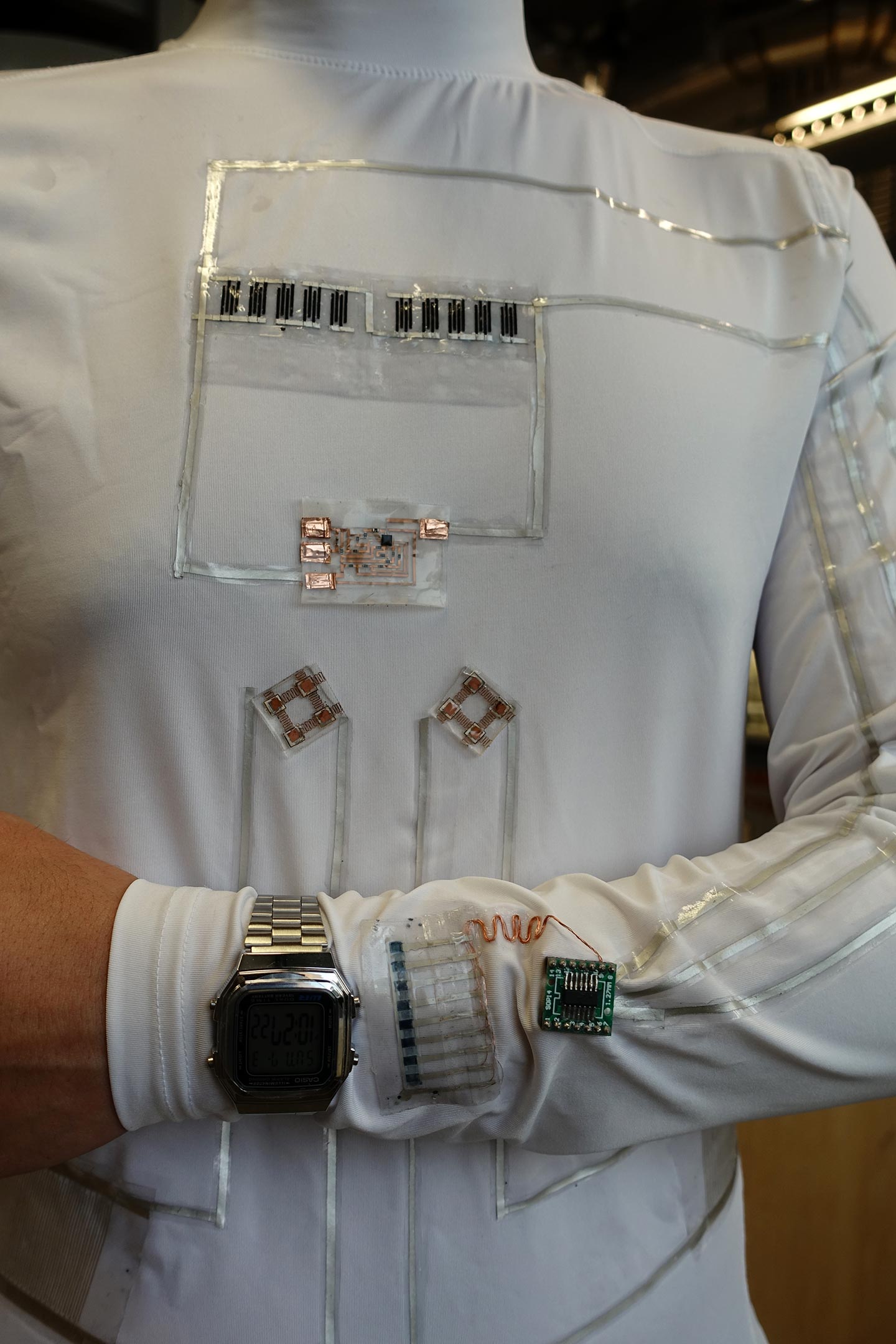
This shirt harvests and stores energy from the human body to power small electronics. UC San Diego nanoengineers call it a “wearable microgrid” — it combines energy from the wearer’s sweat and movement to provide sustainable power for wearable devices. Credit: UC San Diego Jacobs School of Engineering
The wearable microgrid is built from a combination of flexible electronic parts that were developed by the Nanobioelectronics team of UC San Diego nanoengineering professor Joseph Wang, who is the director of the Center for Wearable Sensors at UC San Diego and corresponding author on the current study. Each part is screen printed onto a shirt and placed in a way that optimizes the amount of energy collected.
Optimizing Energy Harvesting from Sweat and Motion
Biofuel cells that harvest energy from sweat are located inside the shirt at the chest. Devices that convert energy from movement into electricity, called triboelectric generators, are positioned outside the shirt on the forearms and sides of the torso near the waist. They harvest energy from the swinging movement of the arms against the torso while walking or running. Supercapacitors outside the shirt on the chest temporarily store energy from both devices and then discharge it to power small electronics.

Harvesting energy from both movement and sweat enables the wearable microgrid to power devices quickly and continuously. The triboelectric generators provide power right away as soon as the user starts moving, before breaking a sweat. Once the user starts sweating, the biofuel cells start providing power and continue to do so after the user stops moving.
“When you add these two together, they make up for each other’s shortcomings,” Yin said. “They are complementary and synergistic to enable fast startup and continuous power.” The entire system boots two times faster than having just the biofuel cells alone, and lasts three times longer than the triboelectric generators alone.
The wearable microgrid was tested on a subject during 30-minute sessions that consisted of 10 minutes of either exercising on a cycling machine or running, followed by 20 minutes of resting. The system was able to power either an LCD wristwatch or a small electrochromic display — a device that changes color in response to an applied voltage — throughout each 30-minute session.
Greater Than the Sum of Its Parts
The biofuel cells are equipped with enzymes that trigger a swapping of electrons between lactate and oxygen molecules in human sweat to generate electricity. Wang’s team first reported these sweat-harvesting wearables in a paper published in 2013. Working with colleagues at the UC San Diego Center for Wearable Sensors, they later updated the technology to be stretchable and powerful enough to run small electronics.
The triboelectric generators are made of a negatively charged material, placed on the forearms, and a positively charged material, placed on the sides of the torso. As the arms swing against the torso while walking or running, the oppositely charged materials rub against each and generate electricity.
Each wearable provides a different type of power. The biofuel cells provide continuous low voltage, while the triboelectric generators provide pulses of high voltage. In order for the system to power devices, these different voltages need to be combined and regulated into one stable voltage. That’s where the supercapacitors come in; they act as a reservoir that temporarily stores the energy from both power sources and can discharge it as needed.
Yin compared the setup to a water supply system.
“Imagine the biofuel cells are like a slow-flowing faucet and the triboelectric generators are like a hose that shoots out jets of water,” he said. “The supercapacitors are the tank that they both feed into, and you can draw from that tank however you need to.”
All of the parts are connected with flexible silver interconnections that are also printed on the shirt and insulated by waterproof coating. The performance of each part is not affected by repeated bending, folding and crumpling, or washing in water — as long as no detergent is used.
The main innovation of this work is not the wearable devices themselves, Yin said, but the systematic and efficient integration of all the devices.
“We’re not just adding A and B together and calling it a system. We chose parts that all have compatible form factors (everything here is printable, flexible and stretchable); matching performance; and complementary functionality, meaning they are all useful for the same scenario (in this case, rigorous movement),” he said.
Other Applications
This particular system is useful for athletics and other cases where the user is exercising. But this is just one example of how the wearable microgrid can be used. “We are not limiting ourselves to this design. We can adapt the system by selecting different types of energy harvesters for different scenarios,” Yin said.
The researchers are working on other designs that can harvest energy while the user is sitting inside an office, for example, or moving slowly outside.
Reference: “A Self-Sustainable Wearable Multi-Modular E-Textile Bioenergy Microgrid System” by Lu Yin, Kyeong Nam Kim, Jian Lv, Farshad Tehrani, Muyang Lin, Zuzeng Lin, Jong-Min Moon, Jessica Ma, Jialu Yu, Sheng Xu and Joseph Wang, 9 March 2021, Nature Communications.
DOI: 10.1038/s41467-021-21701-7
This work was supported by the UC San Diego Center for Wearable Sensors and the National Research Foundation of Korea.
Never miss a breakthrough: Join the SciTechDaily newsletter.
Follow us on Google and Google News.
3 Comments
I’ll bet the embedded energy used to make these devices will never be recovered from their lifetime of trivial amounts of output energy. So give us the numbers, inputs and lifetime output in Whrs of energy.
Powering an LCD watch was solved almost 50 years ago too.
Just green washing nonsense.
Stupid. Really stupid. Todo los poder.
its a step in a direction… efficiency and usability takes time. maybe cut them some slack- at least they are out there creating something to work on!