
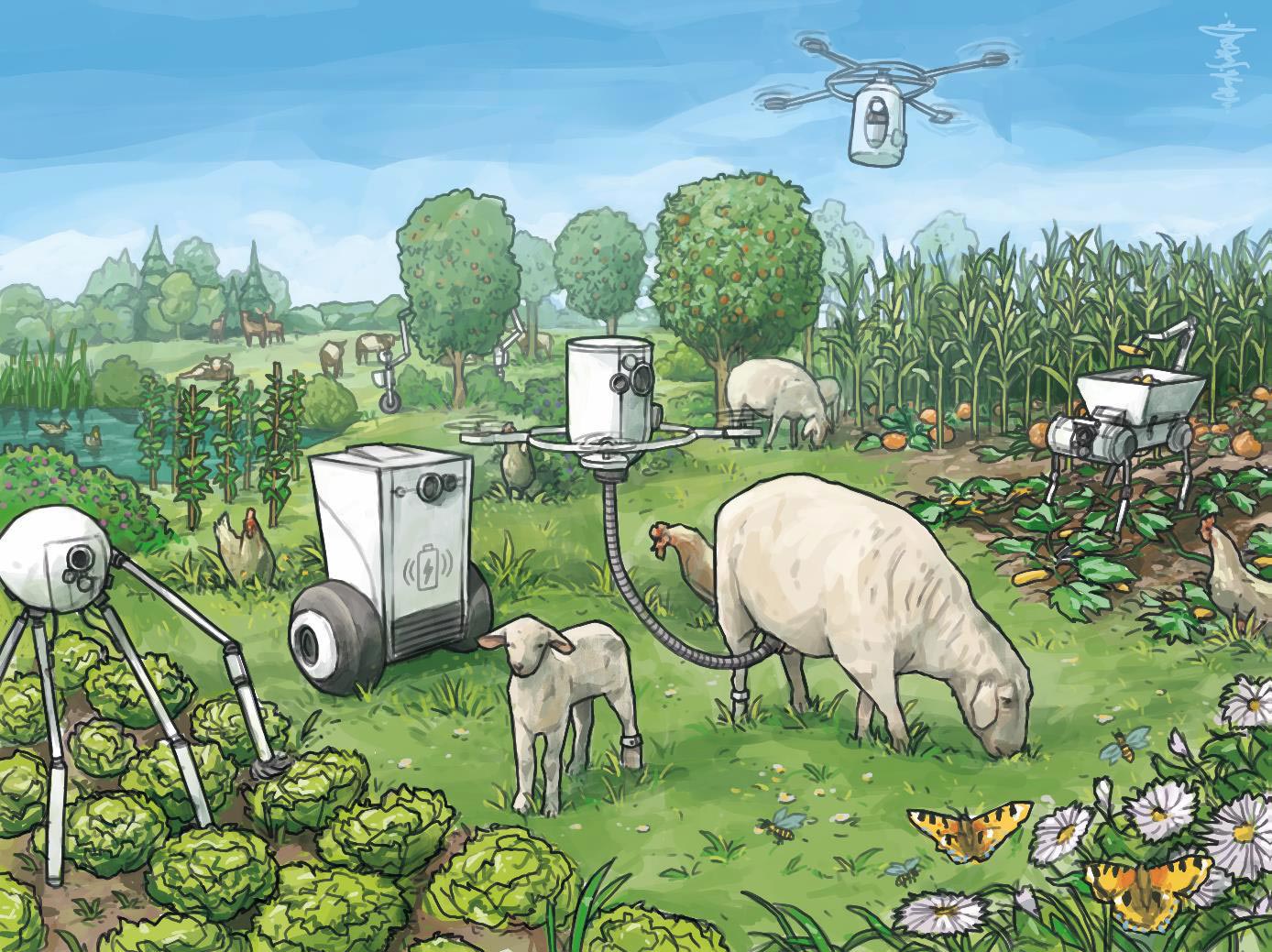
Robot farming could empower sustainable agriculture—or fuel harmful monocultures. The future depends on choices we make now.
No longer science fiction, farm robots are already here — and they have created two possible extremes for the future of agriculture and its impacts on the environment, argues agricultural economist Thomas Daum in a Science & Society article published on July 13, 2021, in the journal Trends in Ecology & Evolution. One is a utopia, where fleets of small, intelligent robots farm in harmony with nature to produce diverse, organic crops. The other is a dystopia in which large, tractor-like robots subdue the landscape through heavy machinery and artificial chemicals.
He describes the utopian scenario as a mosaic of rich, green fields, streams, and wild flora and fauna, where fleets of small robots fueled by sustainable energy flit around the fields, their whirrs intermixed with insect chirps and birdsong. “It’s like a Garden of Eden,” says Daum (@ThomDaum), a research fellow at the University of Hohenheim in Germany studying agricultural development strategies. “Small robots could help conserve biodiversity and combat climate change in ways that were not possible before.”
He suggests that the utopian scenario, which is too labor intensive for conventional farming but is possible with robots working 24/7, would likely benefit the environment in numerous ways. Plants would be more diverse and the soil would be more nutrient-rich. Thanks to micro-spraying of biopesticides and laser weed removal, nearby water, insect populations, and soil bacteria would also be healthier. Organic crops yields — which are currently often lower than conventional crop yields — would be higher, and farming’s environmental footprint would be significantly reduced.

However, he says a parallel future with negative environmental ramifications is just as possible. In that scenario, he says, big but technologically-crude robots would bulldoze the natural landscape, and a few monoculture crops would dominate the terrain. Large fences would isolate people, farms, and wildlife from each other. With humans removed from the farms, agrochemicals and pesticides may be more broadly used. The ultimate objectives would be structure and control: qualities that these simpler robots thrive in but would likely have harmful effects on the environment.
A Crossroads Moment
While he notes it’s not likely that the future will be confined to either a pure utopia or a pure dystopia, by creating these two scenarios, Daum hopes to spark conversation at what he sees as a crossroads moment in time. “The utopia and dystopia are both possible from a technological perspective. But without the right guardrails on policy, we may end up in the dystopia without wanting to if we don’t discuss this now,” Daum says.
But these impacts aren’t limited to just the environment — normal people are affected too. “Robot farming may also concretely affect you as a consumer,” he says. “In the utopia, we aren’t just producing cereal crops — we have lots of fruits and vegetables whose relative prices would fall, so a healthier diet would become more affordable.”
The small robots described in Daum’s utopian scenario would also be more feasible for small-scale farmers, who could more easily afford them or share them through Uber-like services. In contrast, he argues that the family farm is less likely to survive in the dystopian scenario: only major manufacturers, he says, would be able to manage the vast swaths of land and high costs of large machinery.
Global Differences in Feasibility and Benefits
In parts of Europe, Asia, and Africa, where there are currently many smaller farms, there are clear benefits of making a conscious effort to achieve the utopian scenario. The situation is more challenging in countries like the United States, Russia, or Brazil, which historically have been dominated by large-scale farms producing high-volume, low-value grains and oilseeds. There, small robots — which perform less efficiently on energy-intensive tasks like threshing corn — may not always be the most economically effective option.
“While it is true that the preconditions for small robots are more challenging in these areas,” he says, “even with large robots — or a mix between small and large — we can take steps towards the utopia with practices such as intercropping, having hedgerows, agroforestry, and moving away from larger farms to smaller plots of land owned by large farmers. Some such practices may even pay off for farmers once robots can do the job, as previously uneconomic practices become profitable.”
Funding, Policy, and Technological Development
To do so requires action now, Daum says. While some aspects of the utopian scenario like laser weeding have already been developed and are ready to be distributed widely, funding must go toward other aspects of machine learning and artificial intelligence in order to develop robots intelligent enough to adapt to complex, unstructured farm systems. Policy changes are also a necessity and could take the form of subsidies, regulations, or taxes. “In the European Union, for example, farmers get money when they do certain landscape services like having a lot of trees or rivers on their farms,” he says.
While it may seem like the dystopia scenario is more likely, it’s not the only path forward. “I think the utopia is achievable,” Daum says. “It won’t be as easy as the dystopia, but it’s very much possible.”
Reference: “Farm robots: Ecological utopia or dystopia?” by Thomas Daum, 13 July 2021, Trends in Ecology and Evolution.
DOI: 10.1016/j.tree.2021.06.002
This work was supported by “Program of Accompanying Research for Agricultural Innovation,” which is funded by the German Federal Ministry of Economic Cooperation and Development (BMZ).
Never miss a breakthrough: Join the SciTechDaily newsletter.
Follow us on Google and Google News.
5 Comments
The robots-as-a-service thing is very feasible and small robots are encouraged since one unit of a swarm breaking down doesn’t stop an operation like one big tractor does, but some of the writing and that 1960s futurism pic tells me someone should try visiting a farm for once.
For instance, the flying milking drone thing is already in operation without wings, and it works better for the cows that way. They go when they want instead of working on something else’s calendar, get fed for it, and get a hygiene treatment in the process.
The “visit a farm” request should be the first thing anyone writing about the future of farming should do.
We already have an exclusive economy that values the few and disregards the many. The world is so overpopulated that if we allowed everyone access to purpose, shelter, nutrition.., basically a chance at inclusion, we would find that workload would be reduced for all. Many hands make light work.
You want to remove more humans to create even more exclusivity and control. FOOLS!
This is just as stupid as “wondering” why we have a housing problem in even the most developed countries, yet ignoring the fact that the wealth gap provides many with two or more houses and rental units. Blind hypocrites.
Science supporting this false economy is no loner science, it becomes politics.
What rubbish! Where will you get the energy needed to build and power all these robots?
Wind and solar?? Of course not. Fossil fuels, of course.
Why not instead abandon the toxic delusions of industrial agriculture and instead relocalize, teaching ordinary people how to grow gardens, grow community, and grow awareness instead? Let’s invest in Permaculture, not in elitist techno-fantasy.
Jesus wept!