
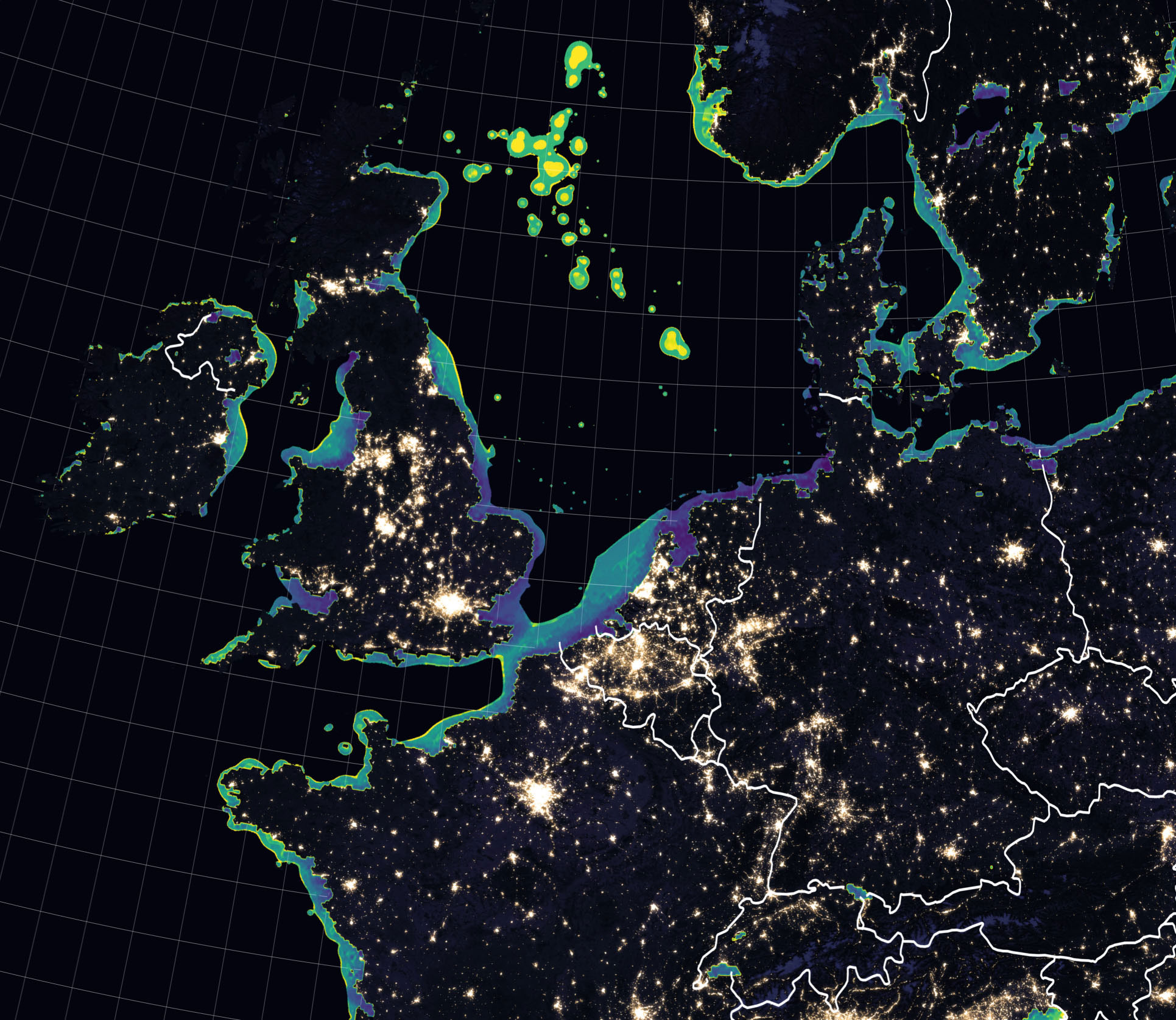
A new global atlas extends measurements of nighttime lights to the sea, revealing marine ecosystems affected by light pollution.
Ecologists and biologists have long recognized that artificial light at night can have adverse effects on the health of humans and terrestrial wildlife, including disrupted sleep patterns, feeding schedules, and reproductive cycles.
A growing body of research is showing that marine life is also sensitive to artificial light, including extremely low levels and certain wavelengths, particularly blue and green light. Now, for the first time, scientists have quantified underwater light levels for coastal zones around the world. A team of researchers from England, Norway, and Israel have released the first global atlas of artificial light in the sea.
“These very low light levels that artificial light generates are critically important for biological organisms,” said lead author and oceanographer Tim Smyth, who specializes in marine optics and remote sensing of ocean color at Plymouth Marine Laboratory. “But how much of an impact it has in the marine environment has been pretty understudied.”
Modeling Light Pollution in Coastal Zones
The research team built a model based on two satellite datasets: one of nighttime light pollution and one of ocean color, which reveals the water’s optical properties. The model projects how nighttime light pollution above the water’s surface will penetrate and be absorbed underwater. The results show the depths to which marine species could be exposed to light sufficient to cause a biological response.
The study gives researchers a guide to where they should focus future studies of the effects of artificial light on marine life. In particular, Smyth said, the study highlights areas where ecosystems are particularly stressed by artificial light, which could lead to rapid evolutionary changes and adaptation.
“The effects of artificial light in marine ecosystems should be a real focus for global change research,” Smyth said.
The scientists found that 1.9 million square kilometers (735,000 square miles) of the ocean experience biologically significant amounts of artificial light pollution to a depth of 1 meter (3 feet). This represents about 3 percent of the world’s Exclusive Economic Zones (EEZs)—the area extending 370 kilometers (200 nautical miles) off a country’s coast. Significant areas of the ocean are seeing light exposures to depths of 10 meters (33 feet), 20 meters (66 feet), or more.
The depth to which light can penetrate depends not only on the intensity of light above water, Smyth said, but also on the optical properties of the water, which vary seasonally. For example, in areas with very clear water, including part of the South China Sea near Malaysia, light at night can reach depths of more than 40 meters.
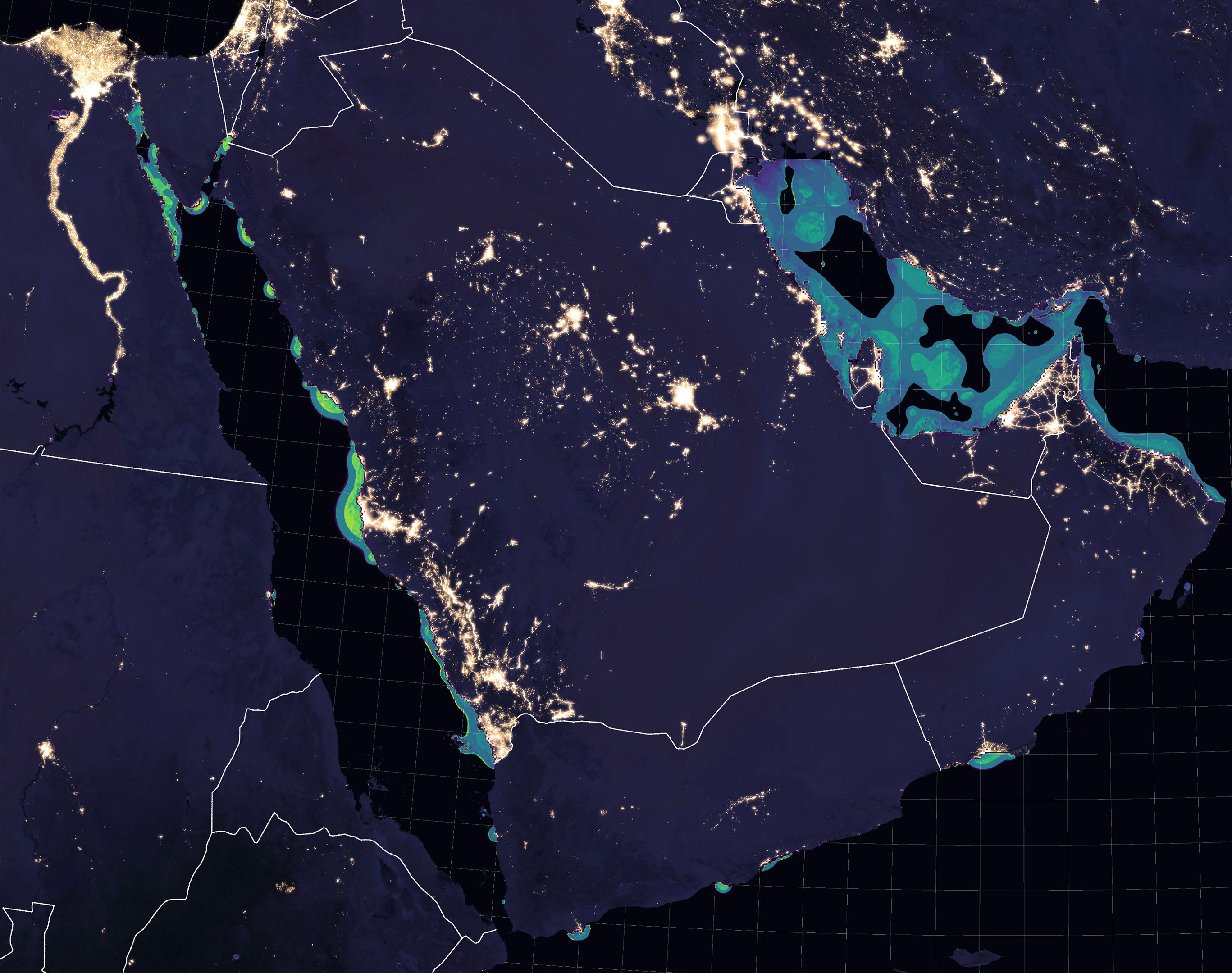
Some of the most extensive marine light pollution occurs in areas where offshore oil and gas platforms, wind farms, and island development brighten the night above and below the water line. The maps above show the North Sea in April and the Persian Gulf in December. They include both sky brightness above water and the critical depth to which underwater light is reaching. (Note the different scales for each.)
Effects on Marine Species and Ecosystems
Artificial light is very different from natural light in its spectral properties, intensity, and timing, Smyth said. Artificial lights switch on abruptly at dusk and burn throughout the night, every night, whereas natural nighttime light, like moonlight, waxes and wanes on daily, monthly, and seasonal timescales.
Many marine species have evolved biological functions that are governed by natural light cycles, even at low levels and at great depths, and some are attuned to certain wavelengths of light. For example, copepods are particularly sensitive to moonlight, which signals their daily migration up and down the water column to feed. Copepods are keystone organisms in many marine food webs. For the study, the researchers used the light sensitivity of copepods as the threshold for a biologically significant amount of light.
A foundational piece of the new research was a global atlas of artificial night sky brightness published by Fabio Falchi, a physicist at the Light Pollution Science and Technology Institute (Italy) and colleagues in 2016. That atlas was built on data from the Visible Infrared Imaging Radiometer Suite (VIIRS) on the Suomi National Polar-orbiting Partnership (NPP) satellite, which can observe dim lights with its day-night band (DNB).
The day-night band is good at capturing low levels of light in a broad spectrum, Smyth said. But the behavior of light underwater depends on its spectral properties, and VIIRS DNB does not discriminate red, green, and blue wavelengths. In field work conducted around Plymouth, the team built a model connecting what VIIRS “sees” at night with the spectrum of light entering the water.
The team then accounted for other variables that affect how light penetrates water, such as the abundance of phytoplankton, dissolved organic matter, and sediment, which all change seasonally. These properties can also be observed from space using ocean-color sensing instruments such as the Medium Resolution Imaging Spectrometer (MERIS) on Envisat, the Moderate Resolution Imaging Spectroradiometer (MODIS) on NASA’s Terra, the Sea-viewing Wide Field-of-view Sensor (SeaWiFS), and VIIRS.
“We used ocean-color satellite products to construct climatologies for every month of the year, everywhere in the global ocean,” Smyth said. The model could then calculate how the above-water light—now split into its red, green, and blue components—would propagate underwater based on the optical properties of water at a given location in a given month.
Future Concerns and the Role of LED Lighting
Coastal zones are home to many of the largest urban areas on Earth. As they continue to grow, skyglow—the scattering and diffusion of light by clouds, fog, and pollutants in the atmosphere—seeping into the sea, may grow as well, Smyth said.
Additionally, efforts by urban planners to transition to more energy-efficient light-emitting diode (LED) lighting could also adversely affect marine ecosystems, he said. Cities that once glowed orange under sodium vapor lights now give off a harsher blue glow and a broader spectrum of light that could affect marine species.
NASA Earth Observatory images by Joshua Stevens, using data courtesy of Smyth, T.J., et al. (2021).
Never miss a breakthrough: Join the SciTechDaily newsletter.
Follow us on Google and Google News.