

A new superhydrophobic biosensor enables the monitoring of “insensible” sweat (vaporized water loss from the skin), which was previously hard to measure. This sensor can be integrated into wearable tech for continuous tracking, aiding in assessing body thermoregulation, skin health, disease conditions, nervous system activity, and detection of other health biomarkers.
Sweat contains biomarkers that help doctors make health diagnoses. Wearable sensors can be used to monitor a person’s perspiration rate and provide information about the skin, nervous system activity, and underlying health conditions. But not all sweat is created equal, and some cannot be measured with current sensors. A newly developed superhydrophobic biosensor could be used as a diagnostic tool to detect such types of sweat.
The sensor, developed by Huanyu “Larry” Cheng, James L. Henderson, Jr. Memorial Associate Professor of Engineering Science and Mechanics, was featured in a paper published in the journal ACS Nano.
Sensible, or liquid, perspiration is sweat that can be perceived by a person, such as during intensive exercise. Wearable sensors can provide continuous, non-invasive tracking of this type of sweat. Insensible, or vapor, perspiration is different. It is the loss of only water from the skin, secreted at a much smaller rate during low-intensity exercise or rest, and measuring it is difficult, according to Cheng.
“Monitoring insensible sweat is of high interest for evaluating skin health and disease conditions, such as eczema and wound healing, as well as underlying health statuses, such as pain or anxiety,” Cheng said. “Skin-interfaced devices that detect sweat rate and loss are currently limited to working with sensible sweat and are not suitable for insensible sweat in a vapor state.”
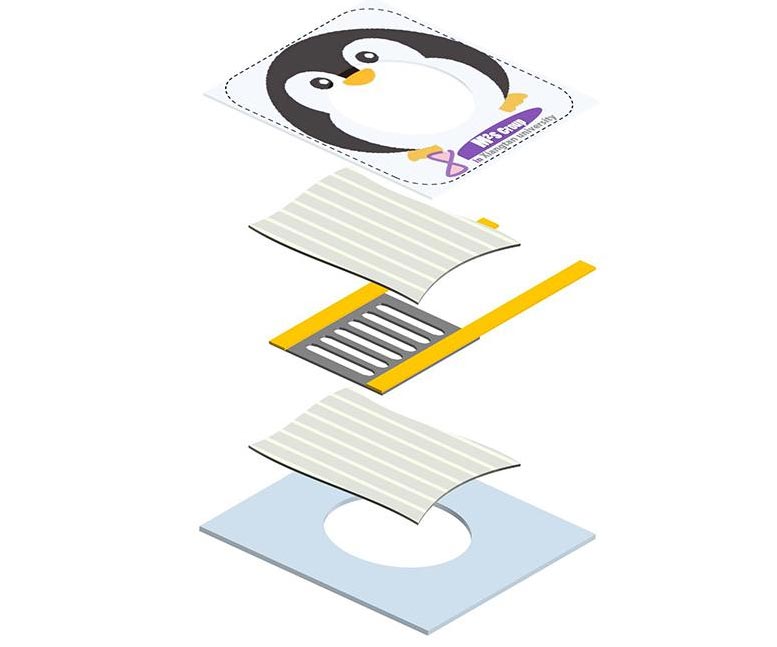
Innovative Superhydrophobic Sweat Sensor
Cheng developed a prototype of a superhydrophobic sweat sensor to measure vapor from insensible perspiration. The material — a superabsorbent hydrogel composite on a porous substrate sandwiched between two superhydrophobic textile layers — allows the permeation of sweat vapor while preventing the sensor from being affected by the external water droplets of sensible perspiration. The sensor could be integrated with a flexible wireless communication and powering module that continuously monitors sweat rates at different body locations.
“Proof-of-concept demonstrations on human subjects showcased the feasibility to continuously evaluate the body’s thermoregulation and skin barrier functions,” Cheng said. “This enables the assessment of thermal comfort, disease conditions and nervous system activity and provides a low-cost device platform to detect other health-relevant biomarkers in the sweat vapor as the next-generation sweat sensor for smart healthcare and personalized medicine.”
Reference: “Skin-Interfaced Superhydrophobic Insensible Sweat Sensors for Evaluating Body Thermoregulation and Skin Barrier Functions” by Yangchengyi Liu, Xiaofeng Li, Hanlin Yang, Ping Zhang, Peihe Wang, Yi Sun, Fengzhen Yang, Weiyi Liu, Yujing Li, Yao Tian, Shun Qian, Shangda Chen, Huanyu Cheng and Xiufeng Wang, 6 February 2023, ACS Nano.
DOI: 10.1021/acsnano.2c11267
Cheng’s work was supported in part by the National Institutes of Health, the National Science Foundation and Penn State. The National Natural Science Foundation of China, the Natural Science Foundation of Hunan Province and the Furong Scholars of Hunan Province program also provided support.
Co-authors include Shangda Chen, Xiaofeng Li, Yujing Li, Weiyi Liu, Yangchengyi Liu, Shun Qian, Yi Sun, Yao Tian, Peihe Wang, Xiufeng Wang, Fengzhen Yang, Hanlin Yang and Ping Zhang, all affiliated with Xiangtan University in China.
Never miss a breakthrough: Join the SciTechDaily newsletter.
Follow us on Google and Google News.