
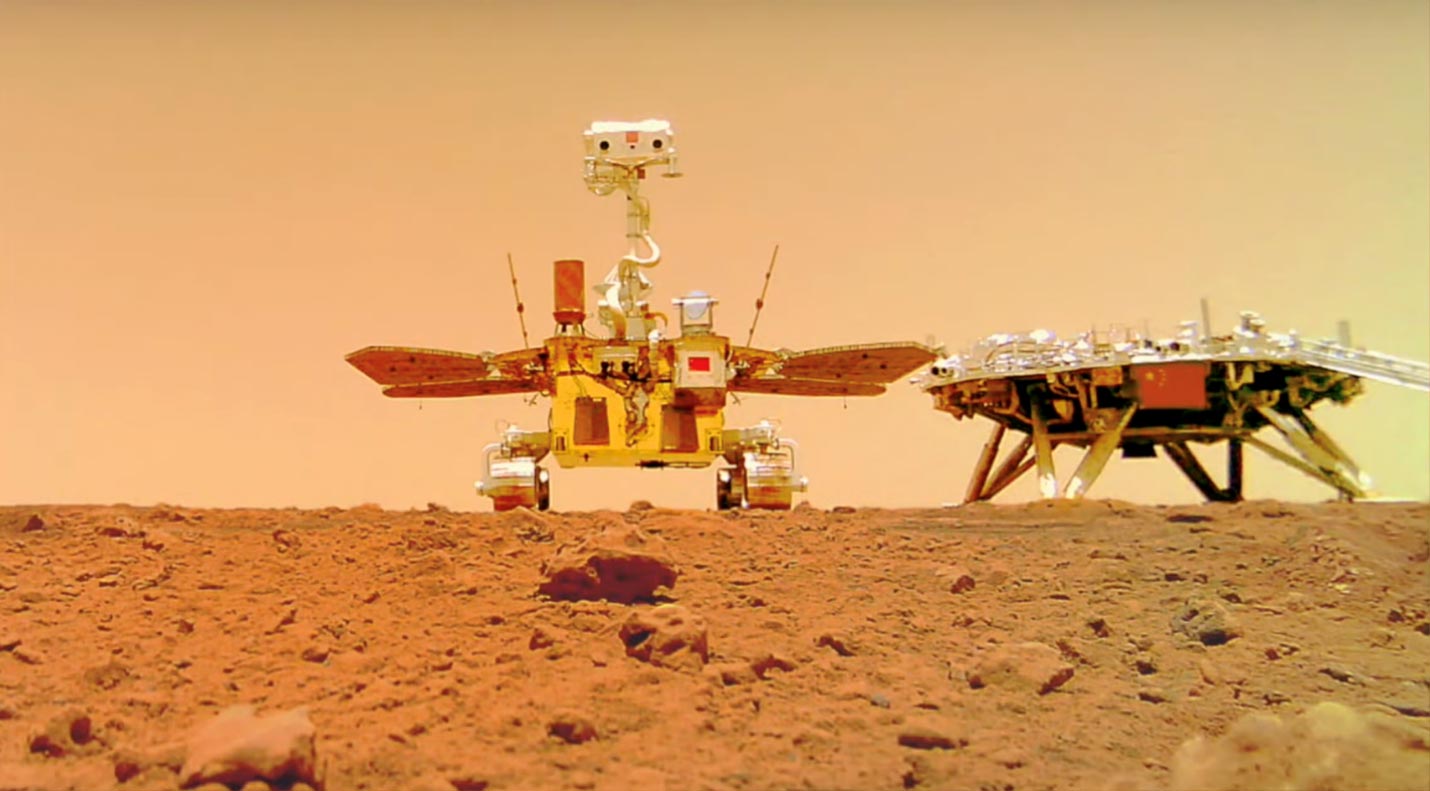
The Zhurong rover, part of China’s Tianwen-1 Mars mission, has found evidence of liquid water at low Martian latitudes, indicating potentially habitable environments. This discovery, contradicting previous beliefs that water could only exist in solid or gaseous states on Mars, was made by analyzing morphological features and mineral compositions of dunes in the landing area.
The Zhurong rover has found evidence of water on dune surfaces on modern Mars by providing key observational proof of liquid water at low Martian latitudes, according to a study led by Prof. Xiaoguang Qin from the Institute of Geology and Geophysics (IGG) of the Chinese Academy of Sciences (CAS).
The study was published on April 28 in the journal Science Advances.
Researchers from the National Astronomical Observatories of CAS and the Institute of Atmospheric Physics of CAS were also involved in the study.
Previous studies have provided proof of a large amount of liquid water on early Mars, but with the escape of the early Martian atmosphere during the later period, the climate changed dramatically. Very low pressure and water vapor content make it difficult for liquid water to sustainably exist on Mars today. Thus, it has been widely believed that water can only exist there in solid or gaseous forms.
Nonetheless, droplets observed on the Phoenix’s robotic arm prove that salty liquid water can appear in the summer at current high latitudes on Mars. Numerical simulations have also shown that climatic conditions suitable for liquid water can briefly occur in certain areas of Mars today. Until now, though, no evidence has shown the presence of liquid water at low latitudes on Mars.
Now, however, findings from the Zhurong rover fill the gap. The Zhurong rover, which is part of China’s Tianwen-1 Mars exploration mission, successfully landed on Mars on May 15, 2021. The landing site is located at the southern edge of the Utopia Planitia (UP) Plain (109.925 E, 25.066 N), where the northern lowlands unit is located.
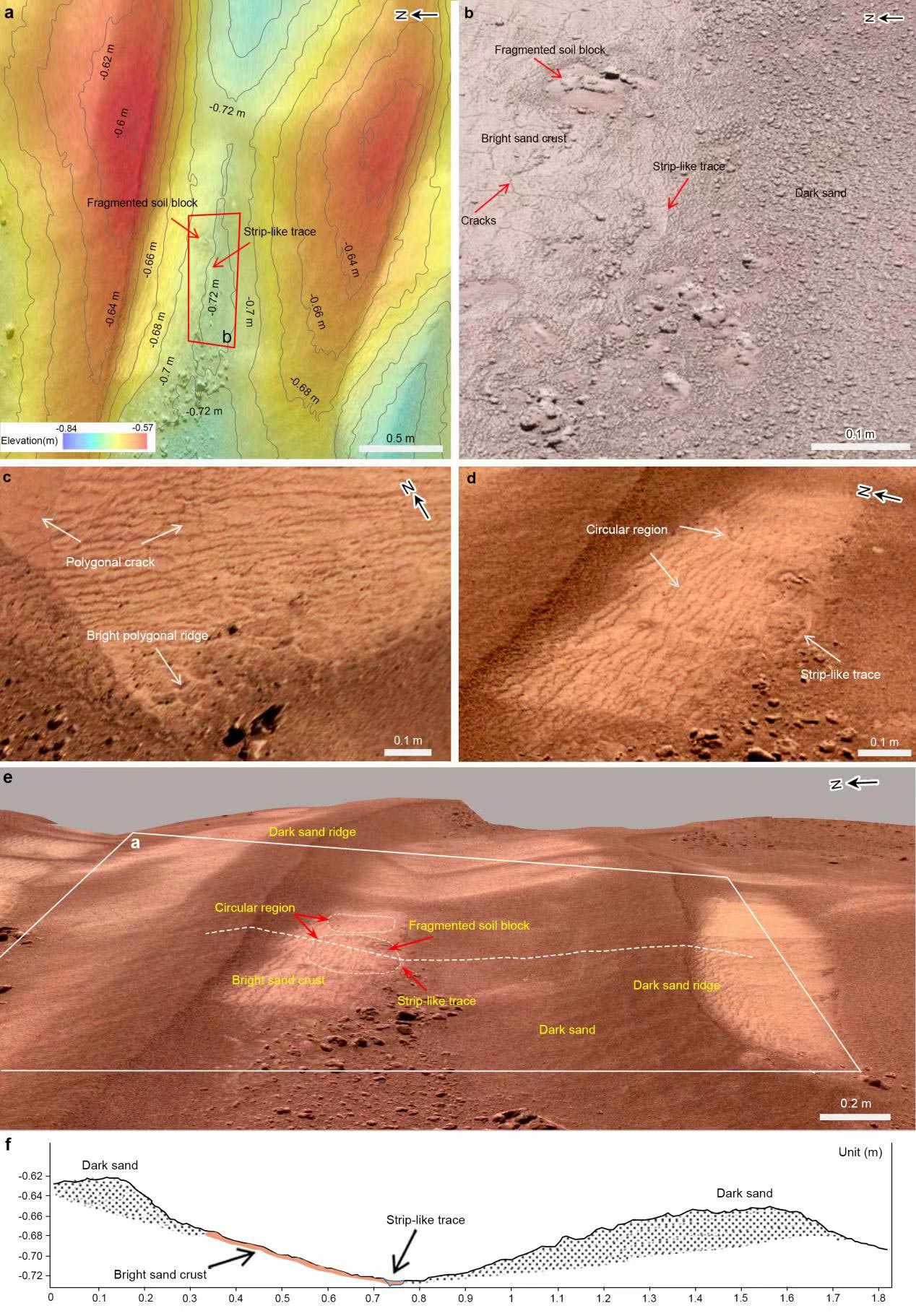
The researchers used data obtained by the Navigation and Terrain Camera (NaTeCam), the Multispectral Camera (MSCam), and the Mars Surface Composition Detector (MarSCoDe) aboard the Zhurong rover to study the different-scale surface features and material compositions of dunes in the landing area.
They found some important morphological features on the dune surfaces, such as crusts, cracks, granulation, polygonal ridges, and a strip-like trace. The analysis of spectral data revealed that the dune surficial layer is rich in hydrated sulfates, hydrated silica (especially opal-CT), trivalent iron oxide minerals (especially ferrihydrite), and possibly chlorides.
Formation Mechanism of Saline Water on Dunes
“According to the measured meteorological data by Zhurong and other Mars rovers, we inferred that these dune surface characteristics were related to the involvement of liquid saline water formed by the subsequent melting of frost/snow falling on the salt-containing dune surfaces when cooling occurs,” said Prof. Qin.
Specifically, salts in dunes cause frost/snow to melt at low temperatures to form salty liquid water. When the saline water dries, the precipitated hydrated sulfate, opal, iron oxide, and other hydrated minerals cement sand particles to form sand aggregates and even crust. Then the crust is further cracked by shrinkage. The later frost/snow melting process further forms polygonal ridges and a strip-like trace on the crust surface.
The estimated age of the dunes (about 0.4–1.4 million years) and the relationship among the three phases of water suggest that the transfer of water vapor from the polar ice sheet toward the equator during the large obliquity stages of Mars’s late Amazonian period led to repeated humid environments at low latitudes. Therefore, a scenario of water activity has been proposed, i.e., cooling at low latitudes during Mars’s large obliquity stages prompts frost/snow to fall and subsequently results in the formation of crusts and aggregates on the salty dune surface, thus solidifying dunes and leaving traces of liquid saline water activity.
The discovery provides key observational evidence of liquid water at Martian low latitudes, where surface temperatures are relatively warmer and more suitable for life than at high latitudes.
“This is important for understanding the evolutionary history of the Martian climate, looking for a habitable environment, and providing key clues for the future search for life,” said Prof. Qin.
Reference: “Modern water at low latitudes on Mars: Potential evidence from dune surfaces” by Xiaoguang Qin, Xin Ren, Xu Wang, Jianjun Liu, Haibin Wu, Xingguo Zeng, Yong Sun, Zhaopeng Chen, Shihao Zhang, Yizhong Zhang, Wangli Chen, Bin Liu, Dawei Liu, Lin Guo, Kangkang Li, Xiangzhao Zeng, Hai Huang, Qing Zhang, Songzheng Yu, Chunlai Li and Zhengtang Guo, 28 April 2023, Science Advances.
DOI: 10.1126/sciadv.add8868
Never miss a breakthrough: Join the SciTechDaily newsletter.
Follow us on Google and Google News.
3 Comments
“The analysis of spectral data revealed that the dune surficial layer is rich in hydrated sulfates, hydrated silica (especially opal-CT), trivalent iron oxide minerals (especially ferrihydrite), and possibly chlorides.”
It should be obvious that the presence of all of these hydrated minerals tells us that the water is gone…tied up. Hematite is non-hydrous and it was used (incorrectly) by US rovers as a “beacon” for liquid water. Hematite is derived from the dehydration of minerals like ferrihydrite. This is not evidence of any water in sand dunes.
And that’s all that this “Rover” is ever going to find as it lays dormant for eternity~
El hombre necesita del oxígeno y del agua,esa combinación es la vida,de lo contrario no se puede habitar ningún planeta, pienso que con los robot podría haber algún avance,para que el hombre se arriesgue ha habitar algún planeta,pero de lo contrario solo serviría para la extracción de minerales, talves con algún descubrimiento de minerales podría superarse la velocidad de la luz y llegar a descubrir de manera artificial habitar otros planetas.