
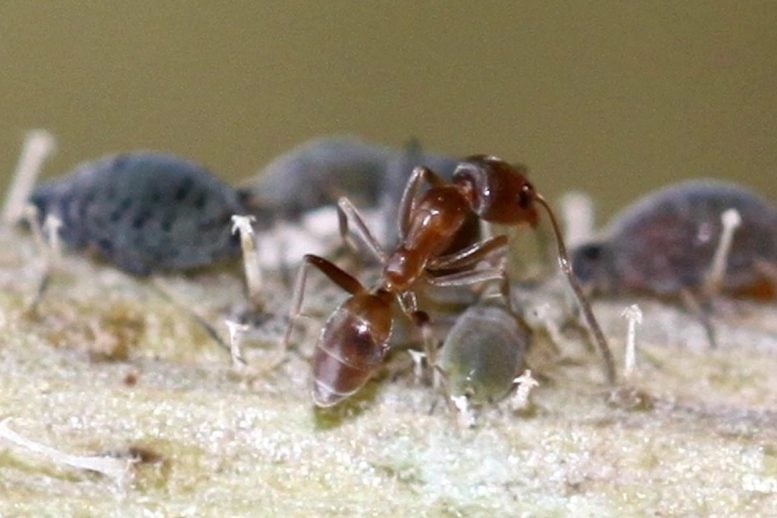
In a twist that surprised UCLA researchers, starving ants were more cautious, not less, in their search for food.
- Argentine ants have been able to displace native ant species in large part because of their aggressive foraging for sugar and other carbohydrates.
- However, when they’ve been deprived of food and competitors are present, they significantly limit their foraging activity instead of vigorously pursuing food.
- On the whole, this strategy may provide a benefit to their colonies, researchers say.
It might seem like common sense that a starving animal is more likely to take dangerous risks to obtain food than one with a full belly. But new research from the University of California, Los Angeles (UCLA) shows that groups of Argentine ants, who forage boldly when they’re well fed, exercise far more caution when they’ve been deprived of carbohydrates and the risks from competitors are high.
Argentine Ants: A Successful but Invasive Species
This counterintuitive foraging strategy might contribute to the success of these insects, known as Linepithema humile, an invasive species that displaces native ant populations in California and elsewhere and has become a significant agricultural pest, the researchers said.
Their findings, published in the journal Current Zoology, suggest that the unwillingness of Argentine ants to expose themselves to danger when weakened by hunger could possibly give them a competitive edge over other species by helping to preserve their colonies’ foraging capabilities.
“While not foraging may lead to a reduction in food stores when those stores are already low, foraging in a high-risk environment exposes the colony to potential loss of foragers,” said the study’s senior author, Noa Pinter-Wollman, a UCLA professor of ecology and evolutionary biology. “So reduced foraging could be interpreted as individual foragers not taking unnecessary risks.”
To support the energetic requirements of daily life, all ants require carbohydrates, which they obtain from a variety of plant and animal sources. They also need protein, which they generally get from dead animals, to nourish their larval offspring. Ant colonies adjust their foraging strategies according to the availability of these food sources, the presence of competing ant species, and the threat of predators or other dangers. Well-fed ants will forage for carbohydrates even in the presence of other ant species or danger cues.
First author Bryce Barbee, who conducted the research as a UCLA undergraduate, expected that starving Argentine ants of either carbohydrates or protein would only increase their willingness to forage for those foods in high-risk environments because they had little to lose and everything to gain.
Together with Pinter-Wollman, Barbee designed a series of laboratory experiments that involved feeding ants normally, depriving them of either carbohydrates or protein, and depriving them of both, then allowing them to forage as they normally would in either low-risk or high-risk environments.
The researchers created the impression of high-risk environments with formic acid, a chemical marker produced by ants, to signal the presence of competitors.
When the risk was low, starving ants did indeed forage more vigorously for the food of which they had been deprived. But when the risk was high, starving ants surprised the researchers by becoming more cautious, not less, in their foraging strategies.
In both high- and low-risk foraging scenarios, the ants were more willing to forage for carbohydrates than protein, which they only need to raise their brood. Since no eggs or pupae were present in the laboratory colonies, this finding might not be surprising, but it could also indicate that starving ants put their own energetic needs ahead of raising offspring, the researchers said.
Theories Behind Foraging Strategies
Scientists who study animal behavior have advanced two ideas to explain foraging strategies. The first, known as the asset-protection principle, holds that hungry animals have less to lose than satiated animals and will therefore behave more assertively to get food. The second, the state-dependent safety hypothesis, holds that animals in good condition are more likely to take risks because they are more likely to survive dangers they encounter.
“Our work upheld the state-dependent safety hypothesis but not the asset-protection principle,” said Barbee, now a doctoral student at UC Santa Barbara. “The findings suggest that factors such as activity level and energetic costs of starvation are important for Argentine ant foraging decisions.”
The work points toward an avenue of research that could lead to better efforts to control the spread of Argentine ants and mitigate their detrimental impact on agriculture, the researchers said.
Reference: ” Nutritional needs and mortality risk combine to shape foraging decisions in ants” by Bryce Barbee and Noa Pinter-Wollman, 12 November 2022, Current Zoology.
DOI: 10.1093/cz/zoac089
Never miss a breakthrough: Join the SciTechDaily newsletter.
Follow us on Google and Google News.