
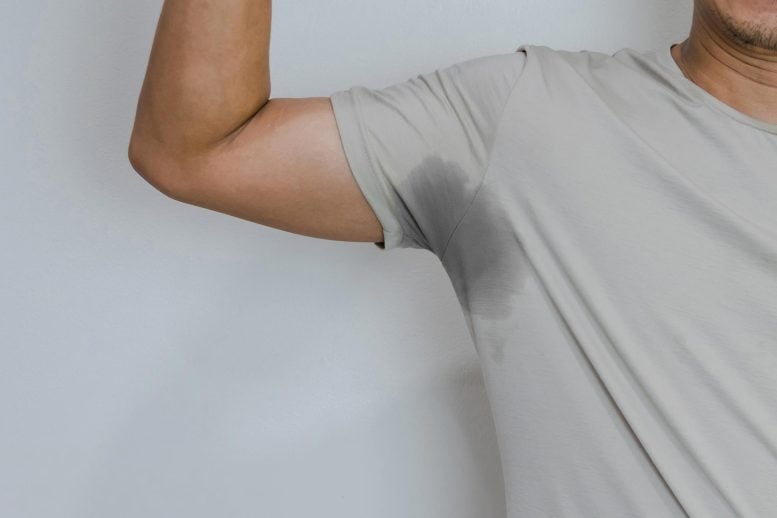
European researchers found that human sweat odors may boost mental health treatment, particularly for social anxiety. Patients exposed to these odors during mindfulness therapy showed greater improvement than those receiving only mindfulness therapy.
A group of European researchers has shown that exposure to human odors, extracted from other people’s sweat, might be used to boost treatment for some mental health problems.
In a preliminary study, the researchers were able to show that social anxiety was reduced when patients underwent mindfulness therapy while exposed to human ‘chemo-signals’, or what we commonly refer to as body odor, obtained from underarm sweat from volunteers. Presenting the results of a pilot study at the European Congress of Psychiatry in Paris, lead researcher Ms. Elisa Vigna, of the Karolinska Institute in Stockholm said:
“Our state of mind causes us to produce molecules (or chemo-signals) in sweat which communicate our emotional state and produce corresponding responses in the receivers. The results of our preliminary study show that combining these chemo-signals with mindfulness therapy seem to produce better results in treating social anxiety than can be achieved by mindfulness therapy alone.”
Social anxiety is a common mental health condition where people worry excessively about participating in social situations. This can affect interactions, for example within the workplace or relationships, but also in everyday situations such as shopping or holidays. This may make it difficult to lead a normal life without excessive worrying about contact with others.[1]
Sweat, Emotions, and Mindfulness
The study involved collecting sweat from volunteers, and then exposing patients to chemo-signals extracted from these sweat samples, while they were being treated for social anxiety. The sweat samples were collected from volunteers who were watching short clips from movies: these films had been chosen to elicit particular emotional states such as fear or happiness; this was to see if the specific emotions experienced while perspiring had differing effects on the treatment. The clips from fearful movies included content from horror films such as The Grudge. The ‘happy’ clips included material from Mr. Bean’s Holiday, Sister Act, and others.
Once the sweat had been collected, researchers recruited 48 women (aged between 15 and 35), all of whom suffered from social anxiety, and divided them into 3 groups each of 16 people. Over a period of 2 days, they all underwent mindfulness therapy for social anxiety. At the same time, each group was exposed to a different odor, obtained from the sweat samples of people who had seen different types of video clips, plus a control group, which was exposed to clean air.
Elisa Vigna said “We found that the women in the group exposed to sweat from people who had been watching funny or fearful movies, responded better to mindfulness therapy than those who hadn’t been exposed. We were a little surprised to find that the emotional state of the person producing the sweat didn’t differ in treatment outcomes – sweat produced while someone was happy had the same effect as someone who had been scared by a movie clip. So there may be something about human chemo-signals in sweat generally which affects the response to treatment.
It may be that simply being exposed to the presence of someone else has this effect, but we need to confirm this. In fact, that is what we are testing now in a follow-up study with a similar design, but where we are also including sweat from individuals watching emotionally neutral documentaries. This should allow us to tease out whether any potential therapy benefits stem from the unconscious perception of specific emotional signals, or whether it is simply to do with human presence, irrespective of emotion.”
Ms. Vigna continued “We found that individuals who undertook one treatment session of mindfulness therapy together with being exposed to human body odors showed about 39% reduction[2] in anxiety scores). For comparison, in the group receiving only mindfulness (i.e., the control group) we saw a 17% reduction in anxiety scores after one treatment session.
We are hopeful that this may lead to a new way of helping people with Social Anxiety Disorder, for example increasing the effectiveness of standalone e-health interventions (such as meditation apps) or provide an additional opportunity for those who don’t respond to current treatment. However, we caution that this is a proof-of-concept study, which is why we are now embarking on a bigger study to confirm the findings.”
Analyzing Sweat for Therapeutic Potential
Human sweat is complex and variable in the way it carries information. The researchers are working with analysts at the University of Pisa who have been able to identify over 300 separates compounds in human sweat. The researchers hope that If they can identify and isolate the molecules which are causing the effects seen in the study, then therapeutic use will become easier. This work is part of the EU-funded Horizon2020 project POTION (“Promoting Social Interaction through Emotional Body Odours”).[3]
Dr. Julian Beezhold (University of East Anglia, Secretary General of the European Psychiatric Association) commented:
“We welcome this study, looking at one of the least researched senses and its interaction with mental health. The findings are interesting but will need to be robustly replicated by independent researchers.”
This is an independent comment, Dr. Beezhold was not involved in this work.
Notes
- For background on social anxiety, see https://www.nhs.uk/mental-health/conditions/social-anxiety/
- Measured with the State-Trait Anxiety Inventory, STAI, a commonly used measure where higher scores indicate higher anxiety levels
- See https://cordis.europa.eu/project/id/824153
The European Congress of Psychiatry took place from March 25-28, 2023, in Paris. It is Europe’s largest congress dedicated to psychiatry, with around 4500 attendees.
Never miss a breakthrough: Join the SciTechDaily newsletter.
Follow us on Google and Google News.
1 Comment
It’s called pheromone treatment and it isn’t new.