
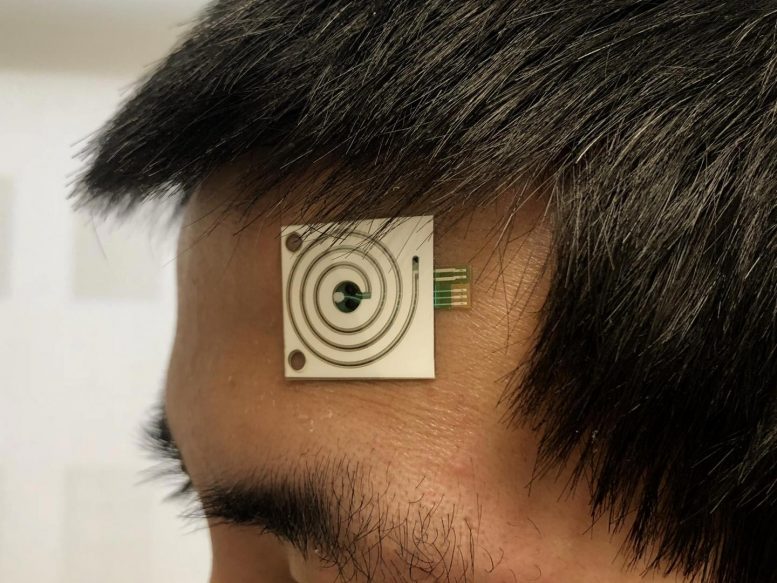
Needle pricks not your thing? A team of scientists at the University of California, Berkeley, is developing wearable skin sensors that can detect what’s in your sweat.
They hope that one day, monitoring perspiration could bypass the need for more invasive procedures like blood draws, and provide real-time updates on health problems such as dehydration or fatigue.
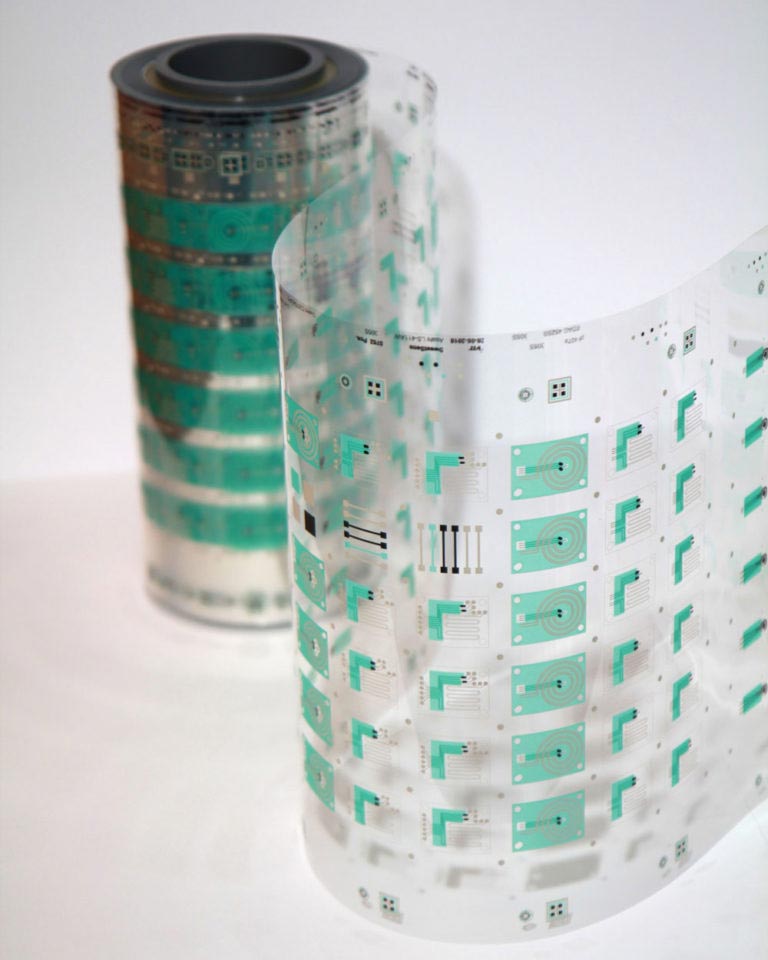
In a paper appearing today (Friday, August 16) in Science Advances, the team describes a new sensor design that can be rapidly manufactured using a “roll-to-roll” processing technique that essentially prints the sensors onto a sheet of plastic like words on a newspaper.
They used the sensors to monitor the sweat rate, and the electrolytes and metabolites in sweat, from volunteers who were exercising, and others who were experiencing chemically induced perspiration.
“The goal of the project is not just to make the sensors but start to do many subject studies and see what sweat tells us — I always say ‘decoding’ sweat composition,” said Ali Javey, a professor of electrical engineering and computer science at UC Berkeley and senior author on the paper.
“For that, we need sensors that are reliable, reproducible, and that we can fabricate to scale so that we can put multiple sensors in different spots of the body and put them on many subjects,” said Javey, who also serves as a faculty scientist at Lawrence Berkeley National Laboratory.
The new sensors contain a spiraling microscopic tube, or microfluidic, that wicks sweat from the skin. By tracking how fast the sweat moves through the microfluidic, the sensors can report how much a person is sweating, or their sweat rate.
The microfluidics are also outfitted with chemical sensors that can detect concentrations of electrolytes like potassium and sodium, and metabolites like glucose.
Javey and his team worked with researchers at the VTT Technical Research Center of Finland to develop a way to quickly manufacture the sensor patches in a roll-to-roll processing technique similar to screen printing.
“Roll-to-roll processing enables high-volume production of disposable patches at low cost,” Jussi Hiltunen of VTT said. “Academic groups gain significant benefit from roll-to-roll technology when the number of test devices is not limiting the research. Additionally, up-scaled fabrication demonstrates the potential to apply the sweat-sensing concept in practical applications.”
To better understand what sweat can say about the real-time health of the human body, the researchers first placed the sweat sensors on different spots on volunteers’ bodies — including the forehead, forearm, underarm and upper back — and measured their sweat rates and the sodium and potassium levels in their sweat while they rode on an exercise bike.
They found that local sweat rate could indicate the body’s overall liquid loss during exercise, meaning that tracking sweat rate might be a way to give athletes a heads-up when they may be pushing themselves too hard.
“Traditionally what people have done is they would collect sweat from the body for a certain amount of time and then analyze it,” said Hnin Yin Yin Nyein, a graduate student in materials science and engineering at UC Berkeley and one of the lead authors on the paper. “So you couldn’t really see the dynamic changes very well with good resolution. Using these wearable devices we can now continuously collect data from different parts of the body, for example, to understand how the local sweat loss can estimate the whole-body fluid loss.”
They also used the sensors to compare sweat glucose levels and blood glucose levels in healthy and diabetic patients, finding that a single sweat glucose measurement cannot necessarily indicate a person’s blood glucose level.
“There’s been a lot of hope that non-invasive sweat tests could replace blood-based measurements for diagnosing and monitoring diabetes, but we’ve shown that there isn’t a simple, universal correlation between sweat and blood glucose levels,” said Mallika Bariya, a graduate student in materials science and engineering at UC Berkeley and the other lead author on the paper. “This is important for the community to know, so that going forward we focus on investigating individualized or multi-parameter correlations.”
Ali Javey describes an earlier version of his lab’s wearable sweat sensor in this video from 2016. (UC Berkeley video by Roxanne Makasdjian and Stephen McNally)
Co-authors on the paper include Liisa Kivimaki, Sanna Uusitalo, Elina Jansson, Tuomas Happonen and Christina Liedert of the VTT Technical Research Center of Finland; and Tiffany Sun Liaw, Christine Heera Ahn, John A. Hangasky, Jianqi Zhao, Yuanjing Lin, Minghan Chao, Yingbo Zhao and Li-Chia Tai of UC Berkeley.
This work was supported by the NSF Nanomanufacturing Systems for Mobile Computing and Mobile Energy Technologies (NASCENT), the Berkeley Sensor and Actuator Center (BSAC), and the Bakar fellowship.
Reference: “Regional and correlative sweat analysis using high-throughput microfluidic sensing patches toward decoding sweat” by Hnin Yin Yin Nyein, Mallika Bariya, Liisa Kivimäki, Sanna Uusitalo, Tiffany Sun Liaw, Elina Jansson, Christine Heera Ahn, John A. Hangasky, Jiangqi Zhao, Yuanjing Lin, Tuomas Happonen, Minghan Chao, Christina Liedert, Yingbo Zhao, Li-Chia Tai, Jussi Hiltunen and Ali Javey, 16 Aug 2019, Science Advances.
DOI: 10.1126/sciadv.aaw9906
Never miss a breakthrough: Join the SciTechDaily newsletter.
Follow us on Google and Google News.
2 Comments
Remind me not to get reincarnated as a computer chip 😉
So when I am hungover at work sensors will go off as I sweat out the debauchery from the night before, lol?